
A Guide to the Cultural Regions of the World
Explore the cultural regions of the world with our expert guide. Learn how geographers define cultures, discover mapped examples, and see their global impact.
Cultural regions are the invisible borders that truly define our world. They're vast geographic areas where people are connected by shared cultural threads—things like language, religion, traditions, and social norms. These aren't the sharp, political lines you see on a standard map, but rather living, breathing frameworks that shape human identity and create broad, recognizable patterns across the globe.
Understanding the Global Cultural Mosaic
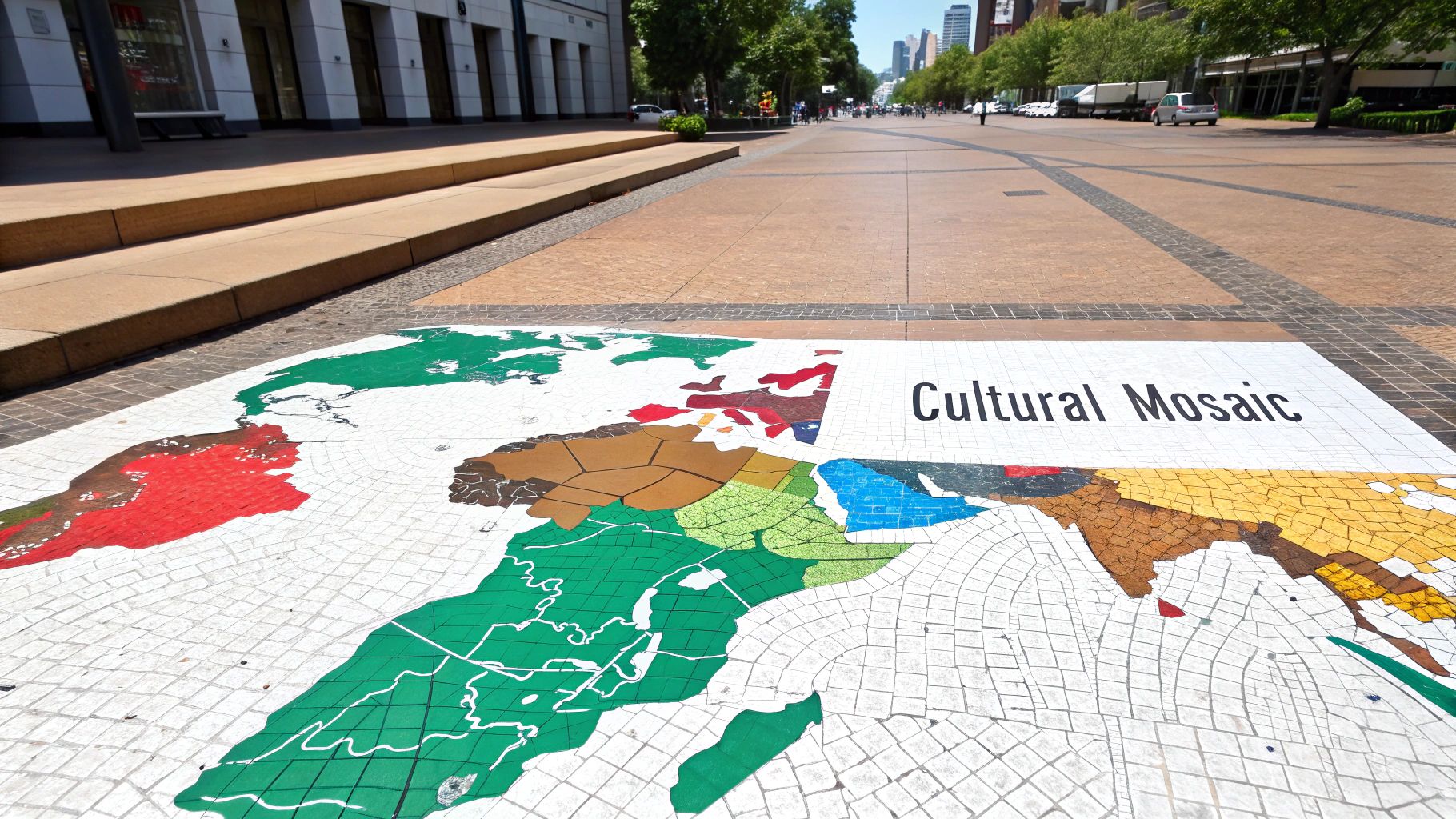
Imagine our world as a giant, intricate mosaic. Each tiny tile is a unique local culture, but when you step back, you see them come together to form larger, more distinct patterns. That's the perfect way to think about a cultural region.
These regions are the heart and soul of human geography, the field that explores the deep relationship between people and their places. They influence everything, from the words we speak at the dinner table to the dynamics of global politics. Understanding these massive groupings helps us piece together the puzzle of why societies developed the way they did.
Why Do Cultural Regions Matter?
Studying the cultural regions of the world lets us see past the simple political lines on a map to understand the deeper connections and divides that shape humanity. Take India, for example—a single country that is home to multiple distinct cultural regions defined by language and religion. On the flip side, the "Arab World" is a cultural region that stretches across dozens of countries, all linked by a common language.
This perspective is essential for a few key reasons:
- Global Understanding: It gives much-needed context to international relations, conflicts, and alliances that a political map alone can never explain.
- Cultural Appreciation: By recognizing these regions, we can appreciate the incredible diversity within them and avoid falling into the trap of monolithic stereotypes.
- Personal Connection: It allows us to trace how ideas, technologies, and customs have traveled and blended over time, shaping our own lives in ways we might not even realize.
A cultural region isn’t defined by a hard-and-fast border. Instead, it has a "cultural core" where its key traits are the strongest. As you move away from this core, those traits start to blend with neighboring regions, creating fascinating transitional zones.
To get us started, the table below breaks down some of the major cultural realms that geographers often use as a starting point. Think of each one as a huge expanse of land where shared history has woven a common cultural fabric.
Quick Guide to Major Cultural Realms
This table gives a high-level look at some of the planet's largest cultural groupings, outlining their main territories and the characteristics that tie them together.
| Cultural Realm | Primary Geographic Area | Key Defining Characteristics |
|---|---|---|
| Anglosphere | United Kingdom, United States, Canada, Australia, New Zealand | English language, common law legal systems, historical ties to the British Empire |
| Latin America | South America, Central America, Mexico, Caribbean | Dominance of Spanish and Portuguese (Romance languages), shared colonial history |
| Islamic World | Middle East, North Africa, parts of Asia and Africa | Predominance of Islam, influence of Arabic language, shared historical caliphates |
| Sub-Saharan Africa | Countries south of the Sahara Desert | Immense linguistic and ethnic diversity, complex religious landscape, shared colonial legacies |
| Sinosphere | China, Taiwan, Vietnam, Korea, Japan | Historical influence of Chinese language, writing systems, and Confucian philosophy |
These realms are just the beginning, of course. They provide a broad framework, but within each one lies a stunning variety of unique cultures and local identities waiting to be explored.
How Geographers Define and Map Cultures
Defining a cultural region isn’t like drawing a political border on a map. There are no official lines etched into the earth. Instead, geographers and anthropologists are a bit like cultural detectives, piecing together clues from language, religion, history, and social structures to find where a shared identity comes into focus.
Imagine layering different colored transparencies on an old-school projector. One sheet maps language families, another shows dominant religions, and a third outlines historical empires. Where those colors overlap most intensely, a distinct cultural region starts to appear. It's a method that looks for patterns and deep-seated influences, not rigid checklists.
This whole process is a huge part of cultural geography, the field that digs into how human culture shapes—and is shaped by—the physical world. When you understand these layers, you can see beyond simple stereotypes and appreciate the intricate forces that have woven our global mosaic.
The Building Blocks of a Cultural Region
To map the world’s cultures, geographers look for a few key ingredients. These elements almost never exist in isolation; they intertwine to give a region its unique character.
- Language Families: Language is one of the most powerful glues holding a culture together. The spread of Indo-European languages, for example, created a linguistic thread connecting areas from Ireland all the way to Northern India. In the same way, the Romance languages (Spanish, Portuguese, French) are a defining feature of Latin America.
- Religious Beliefs: A shared faith can create powerful cultural bonds that completely ignore national borders. The Islamic World is a perfect example—a massive cultural region unified by the practice of Islam, which shapes everything from daily routines to legal systems across North Africa, the Middle East, and beyond.
- Shared History: Common experiences like colonization, ancient trade routes, or major conflicts leave a lasting imprint. You can see this in Latin America, where the different colonial legacies—Spanish, Portuguese, and French—created distinct sub-regions, each with its own unique cultural blend.
- Political and Economic Systems: The way societies organize themselves also helps define a region. The historical shadow of communism, for instance, created shared cultural traits and attitudes across Eastern Europe and parts of Asia that you can still see today.
Cultural Hearths and the Spread of Ideas
So, how do these traits become so widespread in the first place? To answer that, geographers identify what they call cultural hearths. These are the "birthplaces" of cultural innovation—the points of origin where ideas, technologies, and new ways of doing things first sparked to life.
Think of Mesopotamia, the Nile Valley, or the Yellow River Valley. These ancient hearths were the crucibles of civilization where foundational concepts like agriculture, writing, and organized government first took root. From these centers, cultural traits spread outward in a process called cultural diffusion.
Cultural diffusion is simply the movement of ideas, customs, and technologies from one group of people to another. It can happen through trade, migration, conquest, or even modern media. It’s the engine that has driven cultural change and shaped regional identities for millennia.
This spread is rarely random; it often follows predictable paths. A new farming technique might move from its hearth to nearby villages before slowly making its way across a continent. A new music genre might explode along global transportation and communication networks, connecting major cities almost instantly.
By tracing these paths of diffusion from both ancient and modern cultural hearths, geographers can map how the cultural regions of the world formed, grew, and bumped into one another over thousands of years. It’s a dynamic story proving that cultures aren't static museum pieces—they're constantly flowing, mixing, and evolving as they move across the globe.
Exploring the World’s Major Cultural Realms
Alright, we’ve covered how geographers spot cultural patterns. Now for the fun part: let's take a quick trip around the globe to see some of the world's major cultural realms in action. Think of these as massive regions where shared history, language, or beliefs create a common, yet incredibly complex, human identity.
The key is to view these realms as broad frameworks, not rigid boxes. Inside each one, you'll find an absolutely staggering amount of diversity. Our goal here is to appreciate the big, unifying ideas without glossing over the unique local cultures that make our world so fascinating.
This infographic breaks down the big three—language, beliefs, and history—that help geographers map out these vast cultural regions.
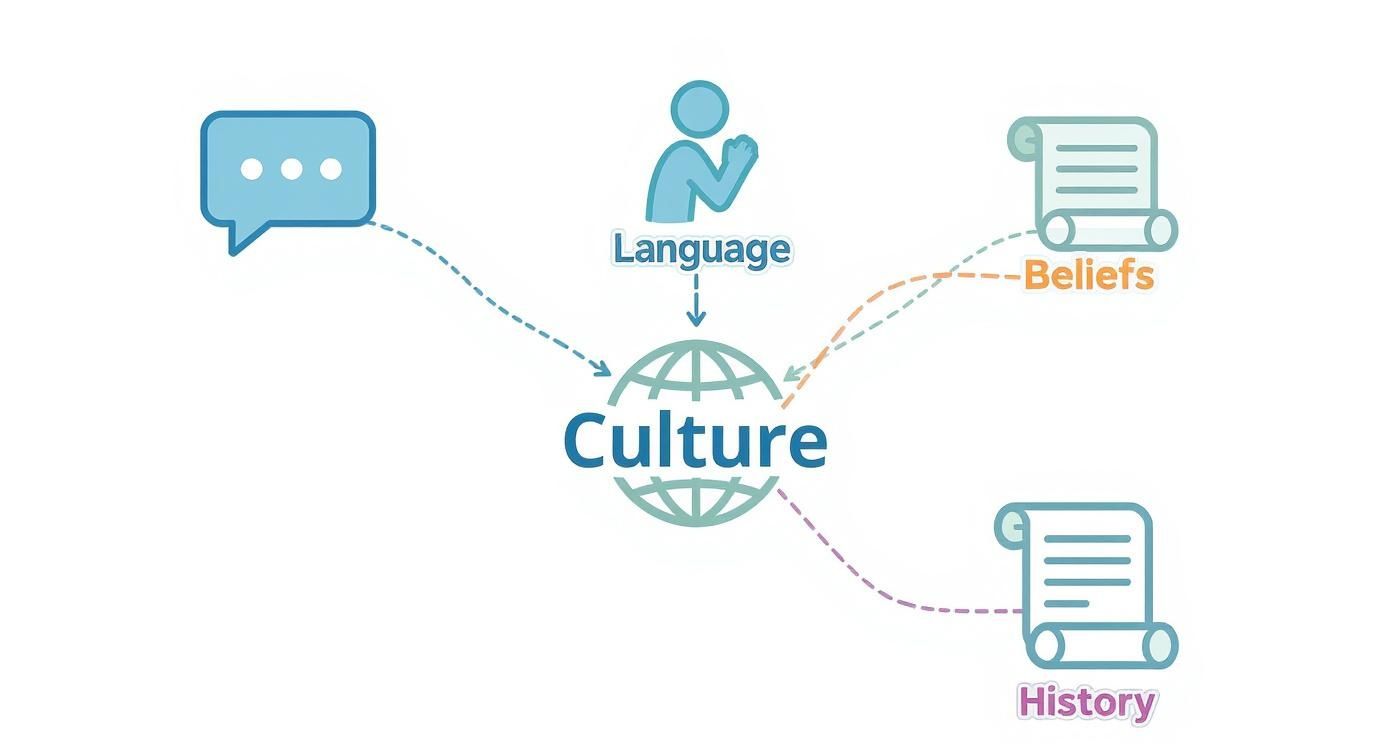
As you can see, these pillars don't stand alone. They’re deeply woven together, each one reinforcing the others to shape a culture's unique fingerprint.
The Anglosphere: A Legacy of Language
The Anglosphere is a perfect example of a realm defined mostly by language. It’s built around the historic spread of English, thanks to the former British Empire. The core countries here are the United Kingdom, United States, Canada, Australia, and New Zealand.
But they share more than just words. Many have similar legal systems rooted in common law and parallel political traditions. Of course, the culture in each is completely distinct, molded by everything from Indigenous histories and waves of immigration to their own unique geography.
Latin America: A Mosaic of Romance and Resilience
Stretching all the way from Mexico down to the tip of Argentina, Latin America is a vibrant realm unified by the dominance of Romance languages—primarily Spanish and Portuguese. This is a direct echo of its colonial history under Spain and Portugal.
Don't let that fool you into thinking it's all the same, though. This realm is anything but uniform. Indigenous cultures have survived, adapted, and blended with European and African influences, creating a stunningly rich cultural landscape. You can see this fusion in everything from its music and food to its religious traditions.
The Islamic World: A Realm United by Faith
The Islamic World offers a powerful look at a cultural region defined by religion. Spanning from North Africa through the Middle East and into parts of Asia, this realm is home to over 1.8 billion Muslims.
While faith is a powerful unifier, the region is incredibly diverse in almost every other respect. It’s a tapestry of countless ethnicities and languages—from Arabic and Persian to Turkish and Urdu. This is a crucial point: a single, powerful cultural trait like religion can create a cohesive realm across otherwise vastly different populations.
Sub-Saharan Africa: Dynamic Diversity and Growth
Sub-Saharan Africa is arguably the most linguistically and ethnically diverse place on Earth, with over 2,000 languages spoken. While colonial history left its mark, ancient kingdoms and local traditions continue to shape modern identities in profound ways.
This region is also at the heart of a huge global demographic shift. In 2015, about 26% of the world's Christians lived in sub-Saharan Africa. Thanks to the region's incredible growth, that share is projected to hit 42% by 2060. This is positioning Africa as a new, pivotal center of global culture and faith.
The Sinosphere: An Echo of Ancient Influence
Centered on China, the Sinosphere (or East Asian cultural sphere) includes countries like Japan, Korea, and Vietnam. The common thread here is the deep, historical influence of Chinese civilization—its writing systems, Confucian philosophy, and political structures.
But this isn't a copy-and-paste situation. Each nation adapted these influences into its own unique culture. For example, while their writing systems grew from Chinese characters, Japan developed Kana and Korea created Hangul. It’s a perfect example of how a cultural hearth can provide a blueprint that its neighbors then creatively reinterpret.
The Fine Line Between Generalization and Insight
It's so important to remember that these big categories are just tools for understanding, not concrete labels. They help us see large-scale patterns, but they can quickly lead to stereotypes if we aren't careful. The real magic of geography is zooming in on the diversity within.
A cultural realm gives us a map to start our journey, but the real discoveries are made when we explore the unique landscapes of individual communities. Art, for instance, is an incredible window into a culture's soul. Checking out something like an art history periods timeline can show you how different societies express their values and beliefs, revealing both their unique character and their ties to broader regional trends.
By balancing the big-picture view with a focus on local stories, we can build a much richer and more accurate appreciation for the amazing diversity of our world.
Why Standardizing Cultural Data Matters
If we want to understand the world's cultures, we also have to figure out how to protect them. But how do you support a community or preserve a tradition if you can't even measure its health? Without reliable, consistent information, policymakers and researchers are essentially flying blind.
Think of it like a doctor trying to treat a patient without standard tools like blood tests or X-rays. Every diagnosis would be a wild guess, making effective treatment nearly impossible. Standardizing cultural data is the same idea—it creates a common "diagnostic" language to check the pulse of cultural sectors everywhere. It lets us make clear, apples-to-apples comparisons.
Creating a Common Language for Culture
This need for a shared playbook is what’s driving major global initiatives. When every country measures things like heritage preservation or creative industry jobs differently, the global picture becomes a confusing mess. We need a unified approach to spot trends, share what works, and actually cooperate on a global scale.
A huge step forward is the upcoming 2025 UNESCO Framework for Cultural Statistics. This new system is set to completely overhaul how we classify and analyze cultural data. It standardizes the definitions and tools used across fields like heritage, creative arts, and community participation. You can check out a great guide from IGCAT that breaks down the UNESCO framework and its applications.
By creating this shared vocabulary, we can finally get everyone on the same page when talking about the cultural regions of the world.
Standardized data transforms culture from an abstract concept into something measurable. It allows us to track the economic impact of a film festival, the preservation status of an ancient language, or the level of community engagement in local arts.
From Data to Actionable Insights
Once we have a common framework, the real work can begin. Good data empowers leaders to make smarter, evidence-based decisions that actually make a difference on the ground.
The process usually breaks down into a few key steps:
- Benchmarking: Policymakers can finally see how their region’s cultural scene stacks up against others, spotting both strengths and weaknesses.
- Targeted Support: NGOs can pinpoint specific communities or art forms that are struggling and direct money and resources where they’ll do the most good.
- Impact Measurement: Governments can accurately measure the return on investment for cultural policies, proving their value and justifying future funding.
This data-driven approach gets a massive boost from modern technology. If you’re curious about how we organize and analyze this kind of location-based information, our guide explains what geographic information systems are and how they turn complex data into clear, visual maps.
Ultimately, standardizing cultural data isn't just about crunching numbers. It's about giving changemakers the clear vision they need to protect and nurture our planet’s incredible cultural mosaic.
Indigenous Peoples as a Global Cultural Region
When we talk about cultural regions, our minds usually jump to solid blocks of color on a map—think Latin America or the Sinosphere. But some cultural connections aren't about shared borders. They're about shared experiences.
Indigenous communities offer a powerful example of a global cultural region that isn’t defined by geographic lines. From the Sámi in Scandinavia to the Māori in New Zealand and the Quechua in the Andes, these diverse groups form a worldwide network united by deep-seated values and a common history.
A Connection Beyond Geography
So, what holds this global community together? It's a shared worldview, a set of foundational principles that often stands in contrast to mainstream global cultures. This creates a powerful identity rooted in something deeper than location.
You can see these unifying threads everywhere:
- Environmental Stewardship: At the heart of many Indigenous cultures is the belief that humans are part of nature, not masters of it. This isn't just a philosophy; it’s a practice of caretaking that has sustained ecosystems for millennia.
- Ancestral Knowledge: Community life is built on a profound respect for traditional knowledge. This wisdom, passed down through stories, ceremonies, and daily practice, guides everything from farming to governance.
- Collective Identity: The community's well-being often comes before individual wants. This creates incredibly strong social bonds and systems of mutual support that have proven resilient for generations.
These shared values aren't just abstract ideas—they have a massive real-world impact.
While representing just over 6% of the global population, Indigenous communities steward an astonishing 80% of the Earth's remaining biodiversity. This single fact underscores the immense power and effectiveness of their traditional ecological knowledge, especially as the world grapples with an environmental crisis.
Facing Shared Challenges
This global cultural region is also unified by a history of shared struggle. The legacies of colonialism, the loss of ancestral lands, and the suppression of their cultures have created similar challenges for Indigenous communities all over the world.
This shared experience has ignited a powerful global movement for rights and recognition. Leaders and organizations from different nations now work together, advocating on the international stage for self-determination, land rights, and the freedom to preserve their heritage.
Despite being the planet's most effective guardians, Indigenous peoples face staggering disparities. They make up about 6.2% of the world's population but account for 18.2% of those living in extreme poverty—a stark reminder of the systemic inequities they continue to fight.
Celebrating Cultural Resilience
But the story of Indigenous peoples is far from just one of struggle. It's a powerful narrative of survival, adaptation, and incredible cultural vibrancy. Their languages, art, and traditions continue to thrive, often blending ancient practices with modern life in inspiring ways.
To dive deeper into the unique stories and cultural expressions of these communities, check out these excellent resources on Native American books for kids, which help bring these rich traditions to life for new generations.
By seeing Indigenous peoples as the vital, interconnected global cultural region they are, we can better appreciate their immense contributions to our shared human story and the future health of our planet.
Applying Cultural Knowledge in EarthChasers
Knowing the world's cultural regions is one thing. Actually experiencing them is another. This is where we bridge the gap between academic ideas and real adventure, turning geographical concepts into exciting missions on the EarthChasers platform. Let's dig into how you can use this knowledge to create deeper, more meaningful gameplay.
The whole idea is to move beyond just pinpointing random locations on a map. You can design challenges that peel back the layers of a place, revealing its cultural fabric. Think of yourself as a digital anthropologist, using the game to uncover the stories, traditions, and human connections that define our world's diverse communities.
Crafting Culturally Rich Game Content
Both players and educators can build custom maps and quests that make cultural geography come alive. Instead of just asking someone to find a capital city, why not create a journey that follows the historic Silk Road? You could challenge players to identify key trading posts where languages, goods, and ideas were exchanged for centuries.
The possibilities are endless. Here are a few ideas to get your creative gears turning:
- Virtual Museum Exhibits: Curate a collection of locations within a specific cultural region, like the Sinosphere. Each point could represent a significant landmark—from the Forbidden City in Beijing to Gyeongbok Palace in Seoul—with descriptions explaining their shared Confucian heritage or dynastic histories.
- Folklore and Mythology Quests: Design a hunt based on regional myths. A challenge centered on Norse mythology could have players track locations from the Poetic Edda across Scandinavia, while a quest in Latin America might follow the legendary journey of Quetzalcoatl.
- Architectural Tours: Create a game that highlights the distinct architectural styles of a cultural realm. A tour of the Islamic World, for instance, could challenge players to spot the differences between Moorish, Ottoman, and Persian mosque designs.
The most engaging challenges tell a story. By grounding your EarthChasers adventures in the authentic cultural context of a region, you create an immersive experience that teaches geography almost by accident. It's pure learning through discovery.
Actionable Templates for Challenges
To make this even more practical, we've put together a few ready-to-use challenge templates. You can adapt these for solo play, classroom assignments, or friendly competition on the leaderboards. They're designed to turn EarthChasers into a powerful tool for exploring the cultural regions of the world.
Here's a table with some actionable challenge ideas to get you started.
EarthChasers Challenge Ideas Based on Cultural Regions
| Challenge Title | Cultural Regions Involved | Learning Objective | Example Task |
|---|---|---|---|
| The Linguistic Detective | Anglosphere, Latin America | Identify and map the global spread of major language families. | Player must find three cities where English is an official language outside the core Anglosphere. |
| Sacred Sites Pilgrimage | Islamic World, Indic Sphere | Compare and contrast the sacred geography of two major world religions. | Locate the five most important pilgrimage sites in Islam and trace a common route between them. |
| Tracing Ancient Trade | Mediterranean, Sub-Saharan Africa | Understand how trade routes facilitate cultural and technological diffusion. | Follow the ancient Trans-Saharan salt trade route, identifying key oasis cities along the way. |
| Festival Finder | Global | Appreciate the diversity of cultural celebrations and their geographic origins. | Find the locations of five major cultural festivals that occur in the same month in different regions. |
These templates are just a starting point. Feel free to build on them, mix and match concepts, and craft your own unique adventures. You'll be making learning about our world an active, engaging, and unforgettable process.
Your Questions About Cultural Regions, Answered
As we dig into the rich tapestry of global cultures, a few key questions tend to pop up. Let's tackle some of the most common ones to help sharpen your understanding of how cultural regions of the world really work.
How Do Cultural Regions Change Over Time?
Think of cultural regions less like permanent displays in a museum and more like living, breathing things. They’re always evolving. Forces like migration, the spread of ideas through globalization, new technologies, and political shifts are constantly reshaping their boundaries and character.
For example, the internet has created entirely new "digital cultures" that connect people based on shared interests rather than where they live. At the same time, modern migration is continuously scrambling the cultural makeup of major cities around the globe. A region’s core identity can shift dramatically in just a couple of generations.
The lines of a cultural region are drawn in sand, not stone. They are dynamic and fluid, constantly being redrawn by the movements of people, the flow of ideas, and the march of history.
What Is the Difference Between a Cultural Region and a Country?
This is a classic point of confusion, but the distinction is critical. A country is a political unit. It has legally defined borders, a sovereign government, and its boundaries are officially recognized on the world stage.
A cultural region, on the other hand, is defined by shared human traits—things like language, religion, art, or social customs. These regions often completely ignore political borders. A perfect example is the Basque Country, a distinct cultural region that straddles two different nations, Spain and France. Going the other way, the Arab World is a massive cultural region that spans more than 20 separate countries.
Are Cultural Regions the Same as Civilizations?
The terms sometimes get used interchangeably, but there's a subtle and important difference. The concept of a civilization usually implies a much broader, historical scope, often tied to major societal developments or ancient empires (think "Western Civilization" or "Islamic Civilization").
"Cultural region" is a more neutral, geographical term focused on shared contemporary traits. While the two definitely overlap, modern geographers often prefer "cultural region" to avoid the hierarchical or value-laden baggage that the word "civilization" can sometimes carry.
How Can I Learn More About a Specific Cultural Region?
Diving deeper is an incredible journey. A great starting point is exploring academic sources from geography and anthropology departments. From there, read literature and watch films made by creators from the region. Following news sources produced by journalists within that culture also gives you an authentic, unfiltered perspective.
You can also engage with cultural institutions like museums and listen to local music to gain a more personal feel. But if you get the chance to travel, nothing beats responsible tourism and genuine interaction with local communities for priceless, firsthand insights.
Ready to turn this knowledge into an adventure? With EarthChasers, you can design your own quests, trace historical trade routes, and explore the world’s diverse cultures in stunning 3D. Start your global journey today.