
Ultimate Quiz on European Countries and Capitals – Test Your Knowledge
Take our quiz on European countries and capitals! Challenge yourself with fun questions and see how well you know Europe’s geography.
Welcome, geography enthusiasts and curious minds! Europe, a continent of rich history, diverse cultures, and stunning landscapes, is home to nearly 50 countries, each with its unique capital city. From the sun-drenched shores of Lisbon to the snowy streets of Helsinki, these cities are the epicenters of politics, art, and commerce. This comprehensive quiz on European countries and capitals is specifically designed to challenge your knowledge, surprise you with fascinating facts, and maybe even inspire your next travel adventure.
We'll explore well-known capitals, uncover some tricky ones that often stump even the experts, and delve into the stories that make each city special. Think you can name the capital of Belgium or pinpoint which country calls Bern its capital? This challenge goes beyond just matching names; it’s about connecting the dots of European geography and culture.
Are you ready to put your geography skills to the ultimate test? Let's begin the journey and see how many you can get right. For those looking to take their exploration to the next level, games like EarthChasers offer an immersive 3D experience to discover the world's cities and natural wonders right from your screen. Let's dive in.
1. What is the capital of Spain?
A classic starting point for any quiz on European countries and capitals, this question tests foundational geographic knowledge. The correct answer, Madrid, is not just a political center but the cultural and economic heart of Spain. It’s a fundamental piece of information, often featured in everything from elementary school lessons to challenging trivia nights.
Madrid’s designation as the capital is relatively recent in Spanish history. In 1561, King Philip II made the pivotal decision to move his court from Valladolid to Madrid. This strategic choice was intended to centralize power in the geographical center of the Iberian Peninsula, solidifying the city's importance for centuries to come.
Why This Question Is a Quiz Staple
This question is a perfect entry-level challenge. It's widely known, making it an excellent icebreaker or the first question in a quiz round to build participants' confidence. Its commonality also makes it a great benchmark for assessing a basic understanding of European geography. You'll find this question in various formats, including:
- Travel Apps: Used in games to test destination knowledge.
- Pub Quizzes: A go-to question for "General Knowledge" or "Geography" rounds.
- Educational Materials: A standard query in textbooks and online learning modules.
The following infographic provides a quick snapshot of key data about Spain's capital.
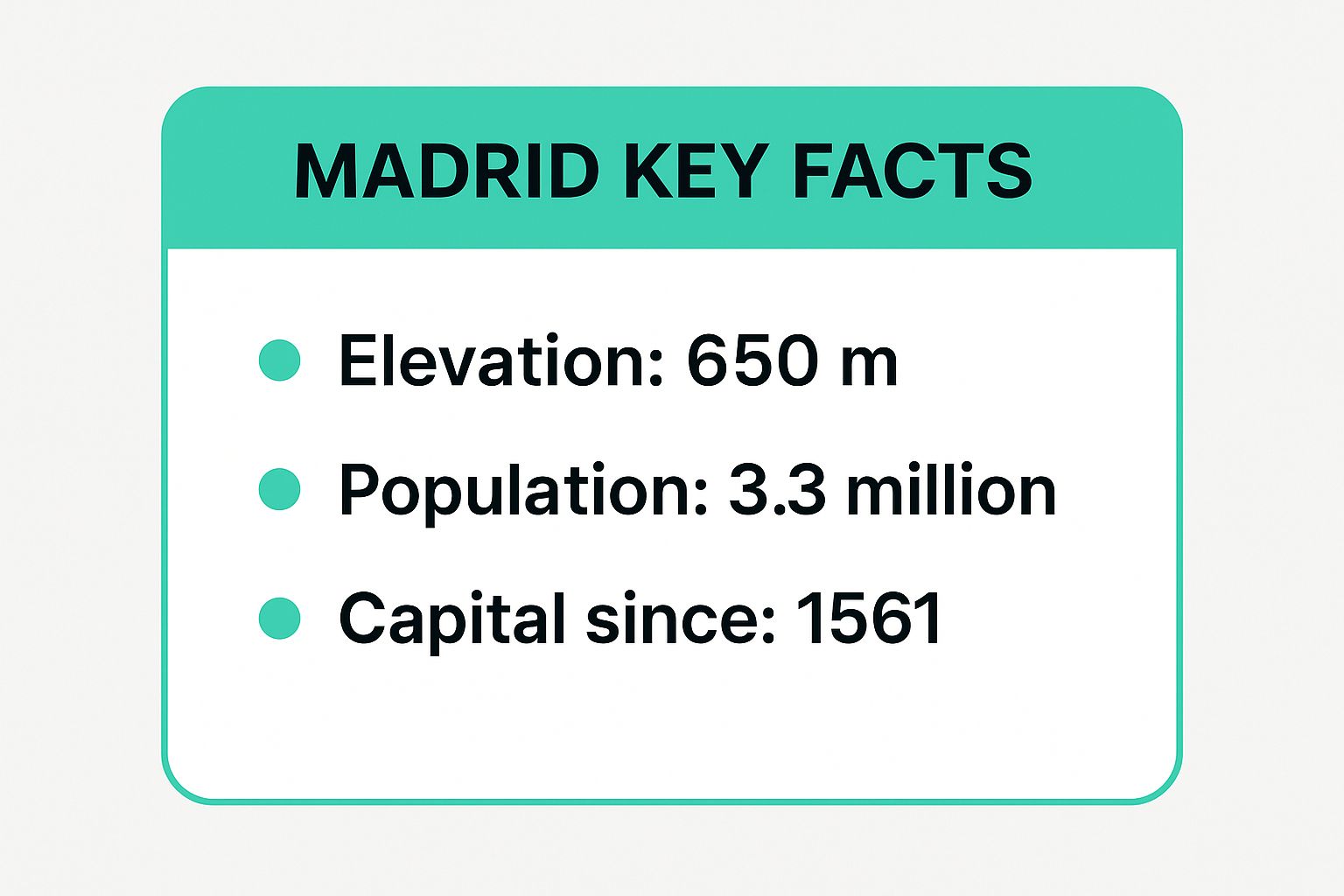
These key facts highlight Madrid's unique status as one of Europe’s highest capitals and its long-standing role since the 16th century. For those interested in exploring more global capitals, you can find a comprehensive visual guide to a map of world capitals.
How to Add Difficulty
Pro Tip: To elevate this basic question, add follow-up queries. Ask about the year Madrid became the capital (1561) or name one of its famous museums, like the Prado Museum or Reina Sofía. Using a visual aid, such as a photo of the Royal Palace, can also add an engaging layer to the challenge.
2. Which European country has Bern as its capital?
This question is a clever trick in any quiz on European countries and capitals, designed to catch participants who might assume a country's largest or most famous city is its capital. The correct answer is Switzerland, a fact that often surprises those who would guess Geneva or Zurich. Bern serves as the de facto seat of the Swiss federal government and is officially known as the "federal city."
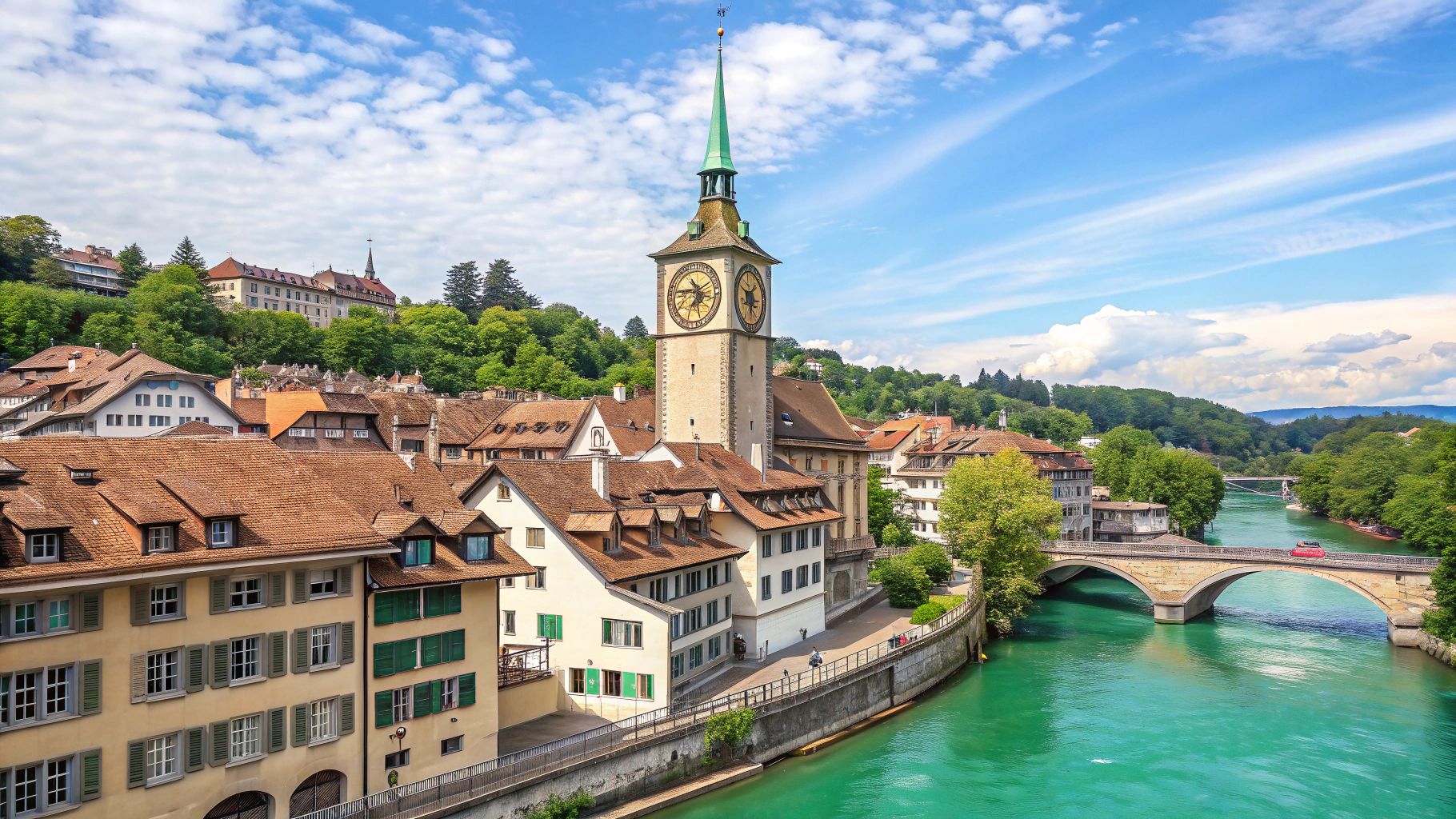
The decision to make Bern the federal city was made in 1848, chosen for its central location and as a compromise between the larger, more powerful cantons. Its stunning medieval old town, characterized by sandstone buildings and covered arcades, is a designated UNESCO World Heritage Site, adding to its cultural significance beyond its political role.
Why This Question Is a Quiz Staple
This question is perfect for an intermediate difficulty round. It separates casual geography fans from those with deeper knowledge by challenging the common misconception that a country's economic hub is always its political capital. Its inclusion tests critical thinking as well as factual recall. You’ll often see this question in:
- Advanced Geography Competitions: Used to differentiate contestants with a nuanced understanding of European civics.
- Travel Knowledge Quizzes: A great way to assess a traveler’s familiarity with Switzerland beyond its major tourist cities.
- Educational Puzzles: A common feature in learning materials focused on federal systems of government.
How to Add Difficulty
Pro Tip: To make this question more challenging, ask a follow-up about Bern’s official title (the "federal city") or why it was chosen as the capital in 1848. You can also add a visual clue, like a photo of the Zytglogge clock tower, or ask about the city's symbol, the bear, which is connected to its founding legend.
3. What is the capital of the Czech Republic?
This question probes a slightly more modern understanding of European geography, touching on the continent's post-Cold War landscape. The correct answer is Prague, the historic and vibrant heart of the Czech Republic. Often called the "City of a Hundred Spires," Prague’s significance makes this an essential item for any quiz on European countries and capitals.
The Czech Republic itself is a relatively new state, formed in 1993 following the peaceful dissolution of Czechoslovakia. Prague, however, has been a political, cultural, and economic center of central Europe for over 1,100 years. Its well-preserved historic center, a UNESCO World Heritage site, showcases centuries of architectural evolution, making it a capital of immense historical weight.
Why This Question Is a Quiz Staple
This question is a great way to test knowledge beyond the largest Western European nations. It assesses whether participants are familiar with the geopolitical changes that reshaped Central Europe in the late 20th century. Its inclusion ensures a well-rounded geography round. You’ll often see it in formats like:
- Modern History Quizzes: Used to connect geography with pivotal events like the Velvet Revolution.
- Travel and Culture Shows: Featured to highlight one of Europe's most visited and iconic cities.
- International Relations Materials: Included in studies focusing on post-Soviet states and European integration.
How to Add Difficulty
Pro Tip: To make this question more challenging, ask about the country's official short name, Czechia. You can also add layers by asking about Prague's role in the Velvet Revolution of 1989 or by showing a picture of its famous Astronomical Clock and asking for the city it's located in. Clarifying the difference between the Czech Republic and the former Czechoslovakia can also serve as a tricky follow-up.
4. Oslo is the capital of which Scandinavian country?
This question narrows the focus to Northern Europe, specifically testing knowledge of Scandinavian geography. The correct answer is Norway, and its capital, Oslo, is a city rich in history and modern innovation. This query moves beyond the more common Western European capitals, adding a layer of regional specificity to any quiz on European countries and capitals.
Oslo’s history is distinctive; it was founded around 1040 and even went by a different name, Kristiania, from 1624 until 1925. Today, it’s not only Norway's governmental and economic hub but also a major center for maritime trade and industries in Europe. Situated at the head of the Oslofjord, the city is celebrated for its blend of natural beauty and striking modern architecture.
Why This Question Is a Quiz Staple
This question is effective at gauging a slightly deeper level of European geographical knowledge. It's specific enough to challenge participants but common enough to be fair game in most trivia settings. It serves as a great bridge between beginner and intermediate-level questions. You'll often see this question in:
- Educational Quizzes: Especially in modules covering Scandinavian culture or history.
- Themed Trivia: Common in rounds about winter sports, the Vikings, or Nobel Prizes.
- Travel and Culture Apps: Used to test familiarity with Nordic destinations.
For those looking to sharpen their skills further, an interactive countries map quiz can provide excellent practice in identifying nations like Norway on a map.
How to Add Difficulty
Pro Tip: To make this question more challenging, ask about Oslo's connection to the Nobel Peace Prize, which is awarded there annually. You could also introduce a visual element by showing a picture of the iconic Oslo Opera House and asking participants to name the city or country. A follow-up about Norway’s massive sovereign wealth fund, fueled by its oil reserves, adds an interesting economic dimension.
5. Which tiny European country has Valletta as its capital?
This question challenges participants by focusing on one of Europe's smallest nations, moving beyond the continent's larger, more familiar countries. The correct answer is Malta, and its capital, Valletta, is a historical gem. This query is a fantastic addition to any quiz on European countries and capitals because it tests deeper knowledge of Mediterranean geography and history.
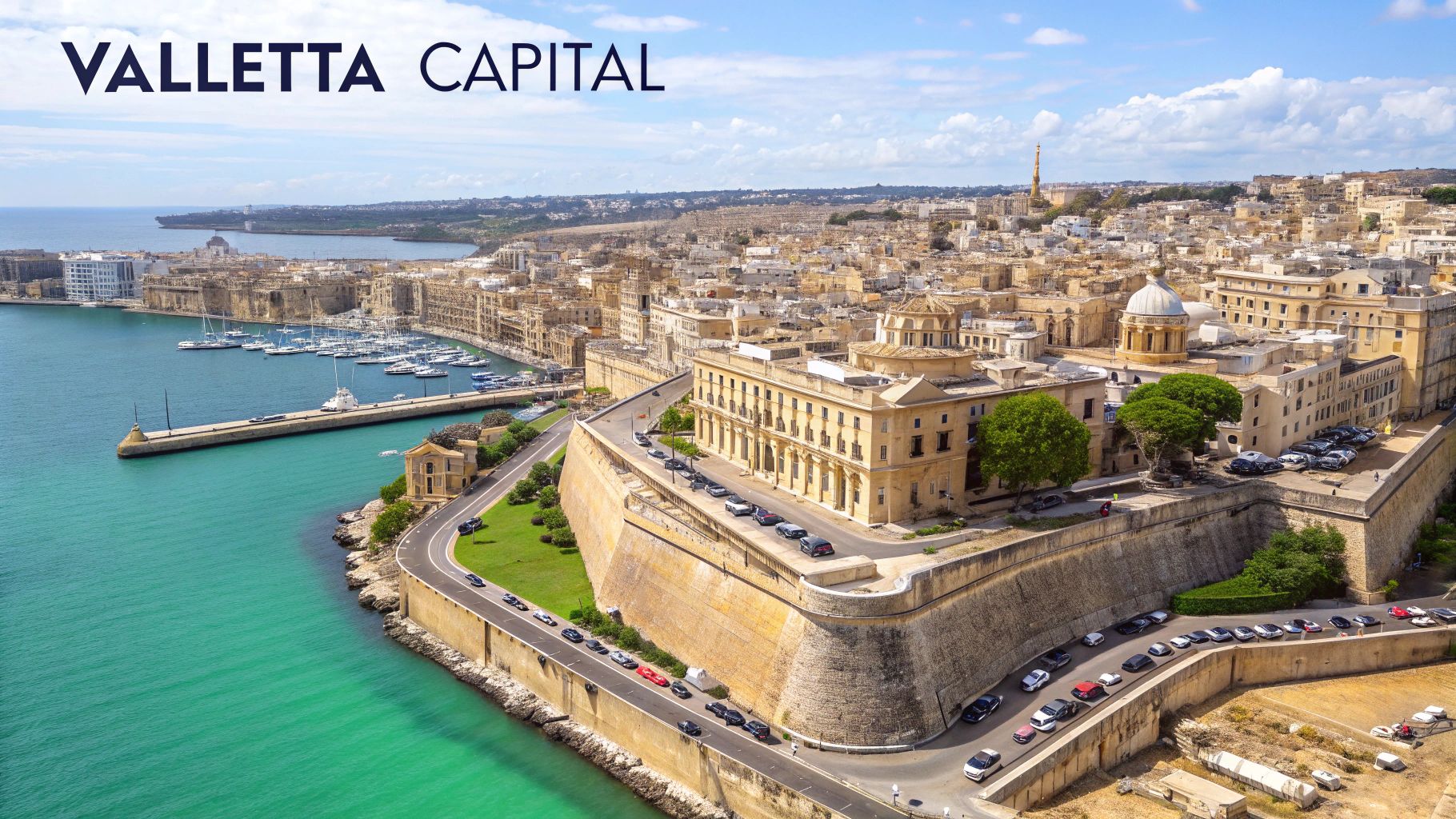
Valletta is a fortified city built by the Knights of St. John in the 16th century following the Great Siege of 1565. Despite its tiny size of just over half a square kilometer, the entire city is a designated UNESCO World Heritage Site. It boasts an incredible density of historical sites, with over 320 monuments packed into its compact grid of streets.
Why This Question Is a Quiz Staple
This question is perfect for a mid-level difficulty round, filtering out casual guessers from true geography buffs. It highlights the importance of island nations and microstates in the European landscape. Its historical richness also provides ample opportunity for bonus points and follow-up questions. You'll often find this question in:
- Mediterranean History Courses: To highlight the strategic importance of the Maltese archipelago.
- European Union Quizzes: As Malta is the smallest EU member state by population.
- Trivia on Island Nations: Where its unique capital and history make it a standout choice.
These contexts demonstrate its value in testing specialized knowledge beyond mainland Europe. For those curious about the continent's layout, an interactive map of Europe can be a helpful resource.
How to Add Difficulty
Pro Tip: Make the question more challenging by asking about Valletta's unique history. Inquire about the Knights of Malta, who founded the city, or reference Malta's crucial role in World War II, which earned the island the George Cross for its bravery. Another great follow-up is to ask for the name of Valletta's co-cathedral, St. John's Co-Cathedral, famous for housing Caravaggio's masterpiece.
6. What is the capital of Portugal?
This question shifts the focus to the Iberian Peninsula's western coast, testing knowledge of one of Europe’s oldest and most historically significant cities. The correct answer, Lisbon, is not only Portugal’s capital but also its largest city and the westernmost capital on the European mainland. It's a key piece of information for any well-rounded quiz on European countries and capitals.
Lisbon's history is deeply intertwined with maritime exploration. Built on seven hills overlooking the Tagus River, the city was the heart of the Portuguese Empire and the launching point for legendary voyages during the Age of Discovery. Its rich heritage, from its iconic yellow trams to its colorful azulejo tiles, makes it a memorable and essential capital to know.
Why This Question Is a Quiz Staple
This question is an excellent mid-level challenge that often separates those with basic knowledge from more seasoned geography buffs. It tests more than just a name; it often evokes images of exploration and naval history, making it a more engaging query. You will commonly find this question in quizzes focusing on:
- World History: Especially in rounds covering the Age of Discovery.
- Travel and Culture: Used to test knowledge of iconic European travel destinations.
- Iberian Geography: A standard question when focusing on the geography of Spain and Portugal.
Lisbon's unique coastal position and historical significance ensure its place in trivia competitions. It represents a different facet of European history compared to landlocked capitals, focusing on seafaring power and global trade.
How to Add Difficulty
Pro Tip: To make this question more challenging, ask about Lisbon's connection to famous explorers. For example, ask which famous explorer's expedition to India departed from Lisbon (Vasco da Gama). You could also ask quizzers to name the famous custard tart pastry originating from the city's Belém district, the pastéis de nata.
7. Which Eastern European country has Budapest as its capital?
This question shifts the focus of a quiz on European countries and capitals to Central/Eastern Europe, testing knowledge beyond the more commonly quizzed western nations. The correct answer is Hungary, a country with a rich and complex history. Budapest itself is a fascinating city, often called the "Pearl of the Danube" for its stunning architecture and riverside setting.
Budapest was officially formed in 1873 through the unification of three distinct cities: Buda, Pest, and Óbuda. The mighty Danube River famously divides the hilly, historic Buda side from the flat, bustling Pest side. This unique geographical and historical origin makes the city a memorable entry in any geography quiz.
Why This Question Is a Quiz Staple
This question adds a layer of depth to any quiz, moving beyond the most obvious capital cities. It assesses a more nuanced understanding of European geography and history. You’ll often see this question used in quizzes that aim to challenge participants slightly more, such as:
- History Quizzes: Often included in rounds covering the Austro-Hungarian Empire or the Cold War.
- Travel Trivia: A popular question due to Budapest’s status as a major tourist destination, famous for its thermal baths.
- Educational Contexts: Used in high school and university courses on Central European studies.
How to Add Difficulty
Pro Tip: To make this question more challenging, ask about the year Budapest was unified (1873) or the names of the three cities that merged to form it (Buda, Pest, and Óbuda). Another excellent follow-up is to ask about Hungary's language family, as Hungarian is a Finno-Ugric language, making it unique among its Indo-European neighbors.
8. What is the capital of Belgium?
A question with dual significance, asking for the capital of Belgium tests more than just basic geography. The correct answer, Brussels, is not only the nation's capital but also the de facto capital of the European Union, making it a cornerstone of any comprehensive quiz on European countries and capitals.
Brussels is a uniquely complex city, officially bilingual with both French and Dutch as its official languages, reflecting the country's broader linguistic landscape. Its historical heart, the Grand Place, is a UNESCO World Heritage site celebrated for its stunning guildhalls and ornate architecture, showcasing the city's historical wealth and importance in European trade.
Why This Question Is a Quiz Staple
This question adds a layer of political and cultural depth to a standard geography round. Its dual role as a national and European capital makes it a fascinating and important fact for quiz participants to know. The question is a favorite in many different quiz formats:
- European Union Civics Courses: Used to highlight the administrative center of the EU.
- International Relations Studies: A key piece of information for understanding European diplomacy.
- Culinary and Gastronomy Quizzes: Often used as a lead-in to questions about Belgian waffles, chocolate, or beer.
How to Add Difficulty
Pro Tip: To make this question more challenging, focus on Brussels' international role. Ask contestants to name one of the major EU institutions headquartered there, such as the European Commission or the Council of the European Union. You could also ask them to identify the iconic Atomium structure or name the famous statue of a small boy, Manneken Pis.
9. Which Nordic country has Helsinki as its capital?
This question shifts the focus of a quiz on European countries and capitals to the northern part of the continent. The answer is Finland, and its capital, Helsinki, is often called the "White City of the North" due to its distinctive neoclassical architecture. This query tests a more nuanced knowledge of European geography, moving beyond the more common Western European nations.
Helsinki was founded in 1550 but only gained prominence after Finland declared independence from Russia in 1917. The city's design reflects a fascinating blend of both Scandinavian and Russian influences, a direct result of its complex history. Including this question provides a great opportunity to explore the unique cultural identity of the Nordic region.
Why This Question Is a Quiz Staple
This question is excellent for intermediate rounds, as it requires knowledge beyond the most frequently quizzed countries. It’s specific enough to be challenging but accessible to those with a decent grasp of European geography. You'll often find it in contexts that require more specialized knowledge, such as:
- Design and Architecture Education: Highlighting Helsinki's famous neoclassical and Art Nouveau styles.
- Nordic Studies Courses: A foundational question for students learning about the region.
- European Union Trivia: Testing knowledge of member states and their capitals.
These varied applications make it a versatile and informative addition to any geography quiz. For those looking to make learning geography more interactive, exploring educational games about geography can be an engaging way to master facts like these.
How to Add Difficulty
Pro Tip: To make this question more challenging, ask about Finland’s unique linguistic roots. Unlike its Scandinavian neighbors, the Finnish language belongs to the Finno-Ugric family. You could also ask participants to name a famous Finnish design brand like Marimekko or Iittala, or reference its famous Nokia heritage to add a modern twist.
European Countries & Capitals Quiz Comparison
| Capital Question | Implementation Complexity 🔄 | Resource Requirements ⚡ | Expected Outcomes 📊 | Ideal Use Cases 💡 | Key Advantages ⭐ |
|---|---|---|---|---|---|
| What is the capital of Spain? | Low - basic geography | Minimal - general knowledge | Basic geography knowledge; cultural discussion | Beginner quizzes; elementary lessons | Easy starter; connects to landmarks & history |
| Which European country has Bern as its capital? | Medium - requires political distinction | Moderate - needs federal system context | Advanced knowledge of political geography | Advanced geography contests; civics lessons | Tricky question; teaches federal vs economic capitals |
| What is the capital of the Czech Republic? | Medium - modern political context | Moderate - post-Cold War history | Understands recent European state changes | Modern history and international relations quizzes | Connects history with architecture and politics |
| Oslo is the capital of which Scandinavian country? | Medium - regional geography knowledge | Moderate - Scandinavian culture | Knowledge of Norway and peace initiatives | Peace studies; environmental topics | Nobel Prize link; highlights sustainability focus |
| Which tiny European country has Valletta as its capital? | Medium - small size and history focus | Moderate - historic and military context | Awareness of small states and Mediterranean history | Mediterranean history; EU quizzes | Rich history; intense cultural heritage |
| What is the capital of Portugal? | Low to Medium - historical and cultural | Minimal to moderate | Knowledge of maritime history and European geography | Maritime history; travel quizzes | Links to Age of Discovery; unique cultural traits |
| Which Eastern European country has Budapest as its capital? | Medium - geographic and historical | Moderate - complex political history | Understanding of multi-ethnic history and culture | Eastern European history; wellness tourism classes | Unique bath culture; rich historical depth |
| What is the capital of Belgium? | Medium - political and cultural layers | Moderate - EU and language knowledge | Knowledge of EU institutions and linguistic diversity | EU politics; culinary and cultural quizzes | EU political hub; culinary and diplomatic richness |
| Which Nordic country has Helsinki as its capital? | Medium - Nordic design & language focus | Moderate - Finnish culture and design | Insight into Nordic geography and Finnish distinctiveness | Nordic studies; design education | Unique language; modern design leadership |
Continue Your Global Exploration
So, how did you fare on our journey through Europe's vibrant capitals? Whether you breezed through the questions like a seasoned globetrotter or discovered a few new destinations for your bucket list, you've successfully tested your knowledge. This quiz on European countries and capitals is more than just a test of memory; it’s a celebration of the rich tapestry of cultures, histories, and geographies that make up the continent.
Knowing that Valletta is the capital of Malta or that Bern is the heart of Switzerland is the first step. The real magic happens when you connect these facts to the stories they represent. Each capital is a living museum, a hub of innovation, and a gateway to understanding a nation's identity. Mastering this knowledge doesn't just make you a trivia champion; it deepens your appreciation for the interconnected world we live in.
From Knowledge to Adventure: What's Next?
The end of this quiz marks the beginning of a new chapter in your geographical journey. Don't let your curiosity fade. Use the momentum you've built to dive deeper and transform this passive knowledge into an active passion. Here are some actionable steps to keep your global exploration going:
- Target Your Weak Spots: Did you struggle with Eastern European capitals or get stumped by the Nordic nations? Focus your learning on those specific regions. Create flashcards, watch travel documentaries, or read articles dedicated to the areas you found most challenging.
- Plan a Themed Quiz Night: Challenge your friends and family to your own quiz on European countries and capitals. You can create different rounds, such as "Capitals on the Coast" or "Former Soviet Bloc Capitals," to make it more engaging. This is a fantastic way to reinforce what you've learned.
- Explore Beyond the Capitals: For every capital like Lisbon or Brussels, there are dozens of other fascinating cities and landmarks. Pick a country from the quiz that intrigued you and research its other major cities, natural wonders, and historical sites. This broadens your understanding beyond just the primary political centers.
Ultimately, the value of this knowledge lies in its ability to inspire. It encourages you to look at a world map not as a collection of lines and dots, but as a mosaic of human experience. Every capital you can name is a potential adventure, a story waiting to be heard, and a culture waiting to be understood. Keep that spark of curiosity alive, and continue to challenge what you know about the world. Your journey of discovery has only just begun.
Ready to turn your quiz knowledge into a hands-on adventure? Explore the very streets of Paris, Rome, and Oslo in stunning 3D with EarthChasers. Put your geography skills to the ultimate test with interactive challenges and virtual travel experiences that bring the world to your screen. Start your expedition today with EarthChasers