
what is economic geography: Concepts that Shape the World
what is economic geography? Explore how location, resources, and trade shape economies around the world.
Ever wonder why some places boom while others bust? That’s the core question economic geography tries to answer.
It’s the study of where economic activities happen, why they happen there, and what the consequences are. Think of it as the "where" and "why" behind the global economy, explaining everything from the location of your neighborhood coffee shop to the rise of global tech hubs.
Unpacking the Economic Map of Our World
Imagine the world economy as a massive, sprawling city. Some neighborhoods are all about finance (like Wall Street), others are known for making cars (like Detroit in its heyday), and some are dedicated to farming. Economic geography is the discipline that acts as the city planner, historian, and sociologist all rolled into one, explaining how and why these districts formed where they did.
It goes way beyond simple economics, which often treats location as just another variable. Instead, this field puts geography right at the center of the story. It investigates the real-world distribution of wealth, poverty, resources, and industries, connecting the dots between a place and its economic fate.
Basically, it's about asking the big questions:
- Why did the tech revolution explode in Silicon Valley and not, say, Omaha?
- How does having a coastline supercharge a country's ability to trade?
- What makes one city a better spot for a corporate headquarters than another?
By digging into these questions, we start to see the invisible forces that shape our economic lives.
Connecting People, Places, and Economies
At its heart, economic geography is a deeply human story. It's not just about abstract market forces; it's about how people, culture, and decisions interact with the physical world. This is where it overlaps with its parent field—you can get the bigger picture in our guide on what human geography is.
The core idea is that economic processes don't just happen in a void. They're grounded in real places with unique histories, resources, and people. For example, a major university can create a deep pool of skilled graduates, which in turn attracts specific high-tech industries. It’s a chain reaction.
Economic geography reveals that prosperity isn't random. It’s the result of a complex dance between location, resources, infrastructure, and human ingenuity, creating an uneven landscape of opportunity across the globe.
This perspective helps explain why some regions thrive while others get left behind. It looks at the networks—like shipping lanes, internet cables, and flight paths—that connect or isolate places from the global economy.
Understanding this is key to grasping why nearly 70% of global net wealth is concentrated in the top quintile of households, a pattern with deep geographical roots. It’s the study of the world's economic pulse, mapped out across its arteries.
How Our Understanding of Economic Space Evolved
To really get what economic geography is all about, we need to look at how it got here. This isn’t some dry history lesson; it's a story about how our perspective has shifted over time, usually kicked into gear by massive changes in the way the world works. The field has always been playing catch-up to explain the economic map of its day.
Way back in the beginning, the questions were pretty basic. Thinkers like Johann Heinrich von Thünen in the early 19th century were just trying to figure out why certain farms grew certain things. He came up with one of the very first economic models, showing that stuff that spoils quickly, like milk, was produced right next to the city. Grain, which keeps for a while, could be grown much farther out. It was a simple, elegant attempt to find a logical pattern in where economic activity happens.
The Industrial Revolution Changes Everything
Then, the Industrial Revolution hit, and it completely rewired the economic map. Smokestacks, not just farm fields, started popping up everywhere. This forced geographers and economists to ask a whole new set of questions: Why did huge factories all seem to clump together in places like Manchester or Pittsburgh?
This era gave us fresh ideas about industrial location. Alfred Weber’s theories, for example, boiled a factory's placement down to a simple but powerful calculation. He argued that businesses were always trying to find the sweet spot that minimized three key costs:
- Transportation: The price of getting raw materials in and finished products out.
- Labor: How much you had to pay your workers and how many of them were around.
- Agglomeration: The sneaky benefits companies get just by being near each other, like having a pool of skilled workers or specialized repair shops right down the road.
This kind of thinking explained the rise of industrial belts and manufacturing hubs. It showed their locations weren't random at all—they were the result of cold, hard economic calculations grounded in geography.
Data, Globalization, and Modern Challenges
By the mid-20th century, a “quantitative revolution” swept through the field. Economic geographers started arming themselves with statistical data and computer models to test and sharpen these older theories. They were hunting for universal laws that could explain why one city booms while an industry in another region dies out.
But the world, as it always does, kept changing. The explosion of globalization in the late 20th century threw a wrench in the works. Suddenly, it wasn't just about where a single factory was located. It was about massive, sprawling global supply chains that connected a worker in Vietnam with a shopper in Ohio. The focus had to shift to understanding networks, the flow of money, and the power of multinational corporations.
Today, economic geography is grappling with a world defined by technology, knowledge, and growing political tension. It’s less about where the coal mines are and more about why all the code gets written in Silicon Valley or why capital zips through London.
This modern focus is essential for making sense of our often-chaotic global economy. The field digs into how trade patterns, resource distribution, and geopolitical friction are redrawing supply chains. We've seen trade break apart recently, driven by economic nationalism and unpredictable tariffs. For instance, the average effective U.S. tariff rate hit 18.2% in 2025—its highest point since 1934. You can dig into more of this data on global shifts at the World Economic Forum.
From farmland patterns to complex global networks, the journey of economic geography proves it’s more relevant than ever. It keeps giving us the tools to understand the “where” behind wealth, work, and our ridiculously interconnected world.
The Core Theories That Explain Economic Location
To really get what economic geography is all about, we need to peek under the hood at the big ideas that drive the whole field. These aren't just stuffy academic theories; they're the invisible blueprints that explain why a tech hub pops up in one city and why a certain kind of farm thrives just outside another. Once you understand them, you start seeing the hidden logic everywhere.
This infographic gives a great visual summary of how economic geography has evolved, shifting its focus from early trade routes to the Industrial Revolution and now to our hyper-connected global economy.
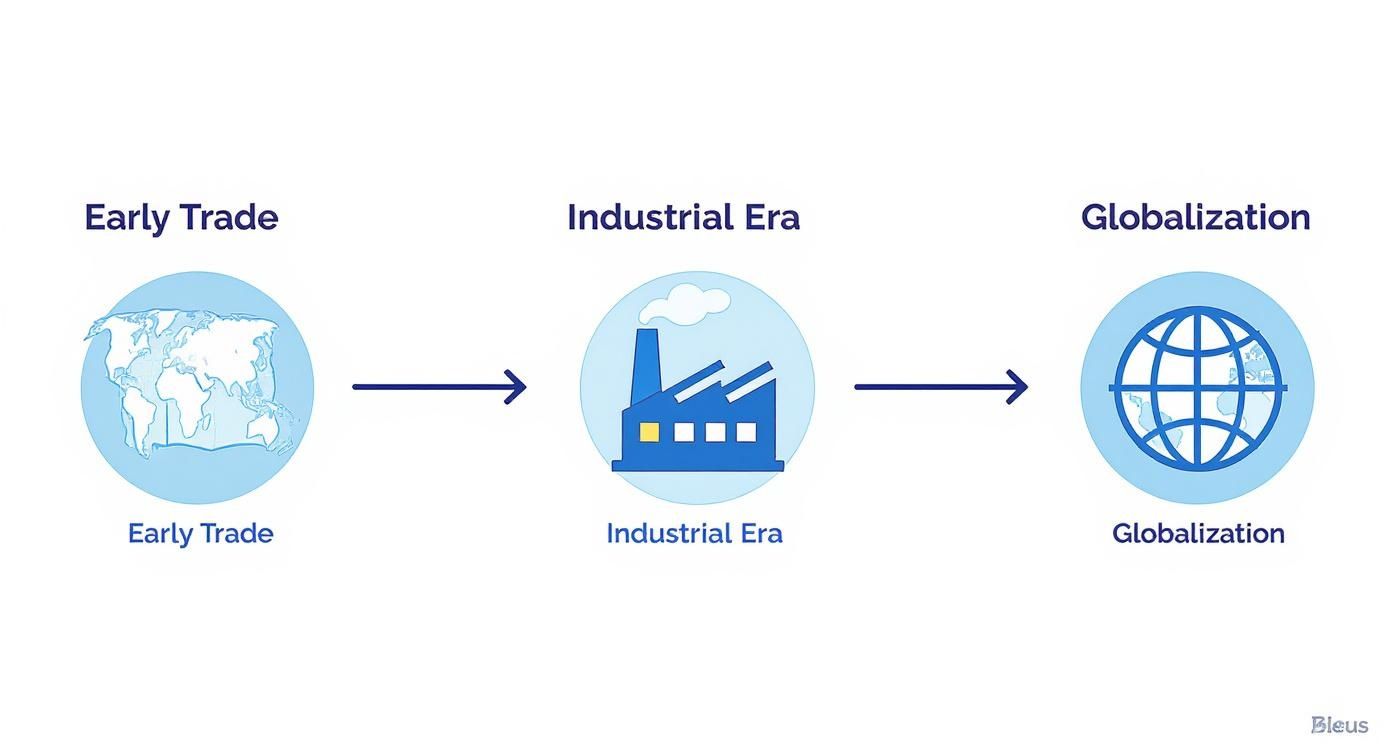
As you can see, the discipline has always adapted, developing new tools and frameworks to make sense of the dominant economic forces of the time.
Von Thünen’s Agricultural Land Use Model
Let's start with one of the classics. Way back in the 19th century, a German farmer and economist named Johann Heinrich von Thünen had a simple question: why do different types of farms end up at specific distances from a city? His model was a brilliant explanation based on two simple factors: the cost of land and the cost of getting goods to market.
Think of a city as the bullseye on a dartboard. Von Thünen figured the land right next to the city is super expensive. So, it only makes sense to use that pricey real estate for things that are costly to transport or spoil quickly, like dairy products or fresh vegetables for the city market.
As you move further out from the center, land gets cheaper. This is where you’d find crops that are less expensive to ship and last longer, like grain or lumber. The result is a neat pattern of concentric rings of different agricultural activities, all organized by pure economic logic. It's a powerful lesson in the trade-off between land costs and transportation costs.
Christaller’s Central Place Theory
Another giant of the field is Walter Christaller. His central place theory tackles a question you’ve probably wondered about yourself: Why does your small town have a gas station and a grocery store, but you have to drive to the next biggest city for a major hospital or an Apple Store?
The theory hangs on two key ideas:
- Threshold: This is the minimum number of people needed to keep a business afloat. A tiny village can easily support a small convenience store, but it doesn't have nearly enough people for a professional sports stadium.
- Range: This is the maximum distance you'd be willing to travel for something. You might drive five minutes for your morning coffee, but you’d probably travel for hours to see a world-famous specialist doctor.
These principles create a natural hierarchy of settlements. Small towns offer basic goods with a low range, while big cities provide all sorts of specialized goods and services that people are willing to travel much farther for. The theory neatly explains the almost hexagonal pattern of towns and cities you often see on a map, especially in rural areas. It’s a foundational piece of spatial thinking in geography.
Modern Theories of Agglomeration
While the classic models are still incredibly useful, a lot of modern economic geography zooms in on agglomeration. This is the powerful, magnetic tendency for businesses in the same industry to cluster together. Think Silicon Valley for tech, Hollywood for movies, or Wall Street for finance. It’s no accident they all grew in one spot.
Agglomeration demonstrates that in a knowledge-based economy, proximity still matters. Companies cluster not just to save on transport costs, but to tap into a shared ecosystem of talent, ideas, and specialized services.
This clustering effect creates a powerful feedback loop. A couple of successful tech companies set up shop, which attracts skilled software engineers to the area. This growing talent pool then makes the city more attractive to other tech companies, who move in and attract even more talent. Suddenly, you have a dense network where new ideas spread like wildfire, specialized suppliers are just down the road, and there's a deep pool of expert labor—giving the whole cluster an unbeatable competitive advantage.
Mapping the Uneven Global Economy
Embedded content
One of the biggest takeaways from economic geography is a simple but powerful one: economic activity isn't spread out evenly. Far from it. It's intensely concentrated. Some places are flush with capital and opportunity, while others are left on the margins. Let's dig into the stark realities of this global economic map to see where wealth clusters and why.
To really get it, you can't just look at a standard world map. We have to think in terms of economic "cores" and "peripheries." Core regions are the planet's economic command centers—think New York, London, and Tokyo. These are the hubs where the biggest financial decisions get made, where corporate headquarters cluster, and where game-changing innovation tends to spark.
On the flip side, peripheral regions are often plugged into the global system in a secondary role. They might supply the raw materials, cheap labor, or manufacturing muscle for the core, but a huge slice of the wealth they help create flows right back to those economic centers. This creates a deeply lopsided landscape of development.
The Shifting Centers of Economic Gravity
For a long time, the economic map was dominated by the West. North America and Europe called the shots, controlled global finance, and were home to the world's most powerful companies. But the 21st century has kicked off a dramatic and rapid rebalancing of that old order.
The rise of emerging markets, especially the BRICS nations (Brazil, Russia, India, China, and South Africa), has created entirely new centers of economic gravity. This isn't just a small tweak; it's a seismic shift that's redrawing the lines of global power right before our eyes.
When you look at purchasing power parity (PPP), which accounts for price differences between countries, China's economy is now bigger than that of the United States by about $10.4 trillion. This geographic rebalancing is part of a larger trend where the BRICS nations are on track to match the original G-7's share of global GDP by 2040-2050, as detailed in this report on global trends.
This shift forces us to ask new questions. How do these new economic cores interact with the old ones? What does this mean for global supply chains, investment patterns, and political alliances? The map is changing fast.
Forces Redrawing the Economic Map
So, what's driving this transformation? A few powerful forces are constantly reshaping the map, pushing some regions up and others down. Getting a handle on these drivers is the key to seeing the big picture.
- Technological Leaps: In some ways, the internet flattened the world, letting a company in India seamlessly serve a client in Indiana. But technology also reinforces concentration, creating powerful tech hubs like Silicon Valley. Visualizing these complex data flows is a huge part of working with geographic information systems.
- Population Dynamics: Demographics are destiny, as they say. Population growth in some regions and aging in others completely reshapes labor markets and consumer demand, redrawing the lines of economic potential.
- Resource Distribution: The discovery—or depletion—of natural resources can change a region's fortunes overnight. Whether it's a new oil field or a massive lithium deposit for batteries, these resources can put a place on the map, for better or worse.
- Infrastructure and Policy: Never underestimate the power of government decisions. Building a new port, investing in high-speed rail, or creating a special economic zone can fundamentally alter a location's trajectory. Exploring resources like UK planning maps gives you a practical look at how these spatial policies shape the economic landscape.
Economic Geography in the Real World
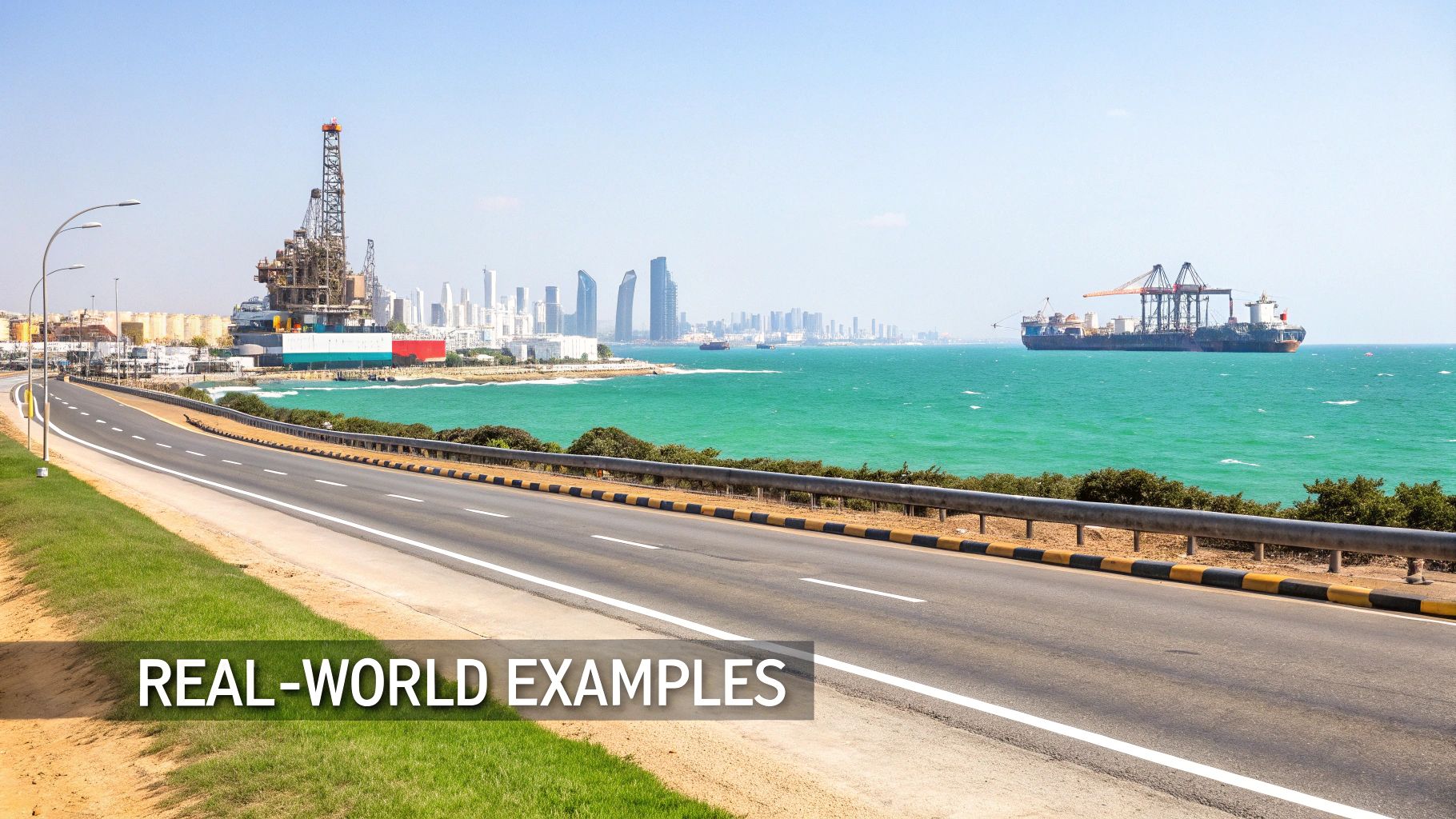
Theories and models are one thing, but the real magic of economic geography happens when we use it as a lens to see the world around us. It helps us move from abstract ideas to the real-life stories of success, failure, and incredible transformation.
These examples bring the principles of location, resources, and connections to life. They show exactly how the forces of geography shape the economic destinies of entire regions. Let's look at a few case studies that make these invisible forces crystal clear.
Silicon Valley: The Power of Agglomeration
Silicon Valley is the textbook example of economic agglomeration. It wasn't just a happy accident that turned this slice of Northern California into the global hub of technology. It was a perfect storm of geographic advantages that created a self-feeding cycle of innovation.
The seeds were planted by Stanford University, which cultivated a culture of entrepreneurship and pumped out a steady stream of top-tier engineering talent. Early tech giants like Hewlett-Packard set up shop, and before long, a critical mass was reached. This ignited a powerful feedback loop:
- Talent Pool: Companies flocked to the area, drawn by the deep, concentrated supply of world-class engineers, designers, and marketers.
- Venture Capital: An entire financial industry, laser-focused on funding risky tech startups, grew right alongside the tech firms.
- Knowledge Spillovers: Ideas flowed freely. Employees jumped between companies, collaborated on new projects, or simply brainstormed over coffee.
This dense network of talent, capital, and ideas gave the region an almost unbeatable edge. It’s a living, breathing demonstration of how clustering companies together creates something far greater than the sum of its parts—it builds an economic powerhouse.
The Strait of Malacca: A Global Chokepoint
Now, let's shift from a region to a route. The Strait of Malacca shows us the immense power—and fragility—of our global supply chains. This narrow, 580-mile stretch of water between Malaysia and Indonesia is one of the most important shipping lanes on the planet.
Roughly 25% of all traded goods pass through this chokepoint every year, including a huge share of the oil headed for China and Japan. Its strategic location makes it the shortest sea route between the Indian and Pacific Oceans, saving ships a massive amount of time and fuel.
The Strait of Malacca is a powerful reminder that global commerce still hinges on physical geography. A disruption in this single, narrow passage could send shockwaves through the entire world economy, highlighting the critical link between trade and territory.
This heavy reliance also creates a massive vulnerability. Piracy, accidents, or geopolitical flare-ups in this one spot could snarl supply chains worldwide, causing prices to soar and factories to grind to a halt. It’s a stark example of how a single geographic feature can hold disproportionate economic power.
Dubai: From Desert Port to Global Hub
Dubai’s story is a masterclass in how to weaponize a strategic location. Perched at the crossroads of Europe, Asia, and Africa, the city's leaders saw its potential to become a central hub for global trade and finance. They didn't just sit on their geographic advantage; they amplified it with colossal investments in world-class infrastructure.
They built one of the world's busiest airports and the gigantic Jebel Ali Port, creating a seamless logistics machine. They set up special economic zones with friendly tax laws to lure in multinational corporations. This is economic geography in action, recognizing the timeless importance of physical infrastructure, much like analyzing the relevance of bank branch networks as physical economic locations in an increasingly digital world.
By taking these bold steps, Dubai engineered its own economic fate. It transformed a quiet port into a global heavyweight for aviation, shipping, tourism, and finance—a powerful lesson in how smart policy can harness geography to completely rewrite a region's economic story.
Why This Field Is More Important Than Ever
So, why should you care about economic geography right now? Simple. Its core questions about location, resources, and connections are the keys to unlocking our world’s biggest challenges. It gives us a critical lens for making sense of the complex issues that flood our news feeds and shape our daily lives.
From tangled global supply chains to the very real economic bite of climate change, a geographic perspective isn't just an academic exercise anymore—it's a practical necessity. It reveals the "where" behind the economic "why," bringing some much-needed clarity to a turbulent global economy.
Untangling Our Modern Challenges
The insights from economic geography are vital for leaders, policymakers, and really anyone trying to make sense of the modern world. Its principles help us get a handle on pressing, real-world problems by forcing us to look at where they’re happening.
Think about these critical areas where a geographic lens is a must-have:
- Building Resilient Supply Chains: The COVID-19 pandemic threw a harsh spotlight on how fragile our global production networks are. Economic geography helps businesses and governments map out those weak points and build more robust, localized, or diversified supply chains that can actually withstand the next big shock.
- Planning Smarter Cities: As more of us pack into cities, planners use geographic principles to design urban spaces that are more efficient, equitable, and sustainable. They analyze where to put housing, transit, and jobs to boost quality of life and spark genuine economic growth.
- Addressing Regional Inequality: Why do some regions boom while others get left behind? This field gives us the tools to dig into the root causes of that uneven development, helping leaders create targeted strategies to breathe life back into struggling local economies.
In an increasingly interconnected and volatile world, understanding the spatial dynamics of the economy isn't just helpful—it’s non-negotiable. It provides a roadmap for building a more stable and equitable future by showing that where things happen matters just as much as what happens.
This approach grounds abstract economic problems in the reality of physical places and the people who call them home.
The Future Economic Map
And the relevance of economic geography is only going to grow as new forces redraw the economic map yet again. The rise of remote work, for example, is blowing up long-held assumptions about where economic activity has to happen.
Will talented workers keep clustering in expensive coastal cities, or will they spread out to smaller towns, bringing economic vitality with them? This shift is one of the biggest geographic experiments in modern history, and we're all living through it.
At the same time, the explosion of artificial intelligence promises to completely reshape industries and create new economic hubs built on data and computing power. The "where" of AI innovation and implementation will define the next generation of economic winners and losers.
These ongoing shake-ups prove just how essential this discipline is. By constantly adapting to explain massive global shifts—from the first trade routes to the age of AI—economic geography provides a timeless framework for understanding our world.
Got Questions? We've Got Answers
Diving into economic geography can spark a lot of questions. Let's tackle some of the most common ones to help you get a clearer picture of what this field is all about.
What’s the Main Goal of Economic Geography, Really?
At its heart, the main goal of economic geography is to answer the big "why there?" question. It's all about understanding and explaining why economic activities—from tech startups to coffee farms—pop up in certain places and not others.
It’s about decoding the hidden logic of our economic map. The field looks at how location, natural resources, and human choices all mix together to shape the economic world we live in.
The real mission is to pull economic theories out of the clouds and plant them firmly on the ground. It's about recognizing that you can't understand the "why" of money and markets without first understanding the "where."
This perspective is essential for solving real-world puzzles, like figuring out the best way to plan a city, tackling regional inequality, or building global supply chains that don't fall apart during a crisis.
How Is Economic Geography Different From Economics?
While they're definitely related, the key difference comes down to focus. Think of it this way: traditional economics often works with abstract models where location is an afterthought, like a perfectly flat, featureless playing field. It's focused on the mechanics of supply, demand, and markets in a general sense.
Economic geography flips that script and puts place front and center. It argues that where things happen is not just a detail—it's a critical piece of the puzzle.
- Economics: Tends to ask what economic decisions are made.
- Economic Geography: Asks where those decisions are made and why that location matters.
For instance, an economist might analyze why the global price of a smartphone is what it is. An economic geographer would dig into why the chips are made in Taiwan, why the phone is assembled in Vietnam, and why the retail store you bought it from is on that specific high-traffic corner in your city.
Is Economic Geography a Good Career Path?
Absolutely. If you're curious about how the world works—the intersection of people, places, and prosperity—then economic geography can open up some really interesting and impactful career paths. The skills you gain in spatial analysis, seeing the big picture, and interpreting complex data are in high demand across many industries.
Graduates often land roles in fields like:
- Urban and Regional Planning: Shaping the future of cities and helping local communities thrive.
- Market Research: Helping companies like Starbucks or IKEA figure out the perfect spot for their next location.
- Real Estate Development: Identifying the next hot neighborhood for investment and building projects.
- International Development: Working with global organizations to fight poverty and promote sustainable growth.
- Logistics and Supply Chain Management: Being the mastermind who figures out the most efficient way to get products from a factory to your doorstep.
It's a field that gives you a unique lens to solve important problems, making it a pretty rewarding way to make a living.
Ready to see the world in a new way? At EarthChasers, we turn geography into an adventure. Explore global economic hubs, natural wonders, and cultural landmarks in an exciting 3D game that makes learning about our planet fun. Start your journey with EarthChasers today!