
Your Ultimate Guide to the Country Guessing Game
Master the country guessing game with our complete guide. Learn the rules, explore popular variations, and discover strategies to boost your geography skills.
At its heart, a country guessing game is a puzzle that challenges you to identify a nation based on a set of clues. Instead of just testing your ability to point to a country on a map, these games give you hints—like a flag, an outline, or even population data—and ask you to piece them together.
It’s less about memorization and more about deduction.
What Is a Country Guessing Game
Think of it like being a geographical detective. You're presented with a mystery—an unknown country—and a file of evidence. A clue might be the country's climate, its neighbors, or its primary exports. This simple twist turns a boring quiz into a genuine puzzle to be solved.
The real fun is in the process of elimination. A single clue, like "this country is in Africa," immediately cuts down the possibilities from nearly 200 to just 54. Another hint, like "its flag contains the color green," narrows it down even further. That step-by-step logic is what makes landing on the right answer so satisfying.
The Rise of Digital Geography Puzzles
What started as a classroom activity has exploded into a global digital pastime. Trivia and geography apps have turned this simple concept into big business—the global trivia games market, where these games are a major player, pulled in US$203.01 million in 2022. There's a good reason for this boom: these games make learning feel like playing.
The numbers don't lie. A staggering 72% of users report better global awareness after just 10 sessions, and these games have helped boost geographic literacy among Gen Z players by an incredible 28%. You can dig deeper into the trivia market data in this Statista report.
This shift from staring at static maps to solving interactive puzzles is what makes modern country guessing games so addictive. They tap into our natural curiosity. While clue-based games like Worldle test your deductive skills, others like GeoGuessr throw you into real-world imagery and ask you to figure out where you are. You can learn more about how these visual puzzles work in our complete guide to GeoGuessr.
The best country guessing games don't just test what you know; they teach you how to think geographically. They encourage you to connect disparate pieces of information—a flag's design, a nation's economic output, and its physical location—to build a complete picture of a place.
Popular Country Guessing Game Modes at a Glance
Not all country guessing games play the same. Different modes focus on different clues and will put different skills to the test. Knowing the common types can help you find a game that clicks with how you like to solve problems.
Here’s a quick look at the most common formats.
| Game Mode | Primary Clue | Skills Tested | Example |
|---|---|---|---|
| Silhouette/Outline | The physical shape or border of a country. | Visual recognition, spatial awareness, and memory of world maps. | A player sees the outline of Italy and must identify it. |
| Flag Identification | The national flag of the target country. | Vexillology (study of flags), color and pattern recognition. | Guessing Brazil based on its distinct green, yellow, and blue flag. |
| Statistical Clues | Data points like population, area, or climate. | Analytical reasoning, knowledge of global demographics and stats. | Identifying Canada from clues like "large land area" and "low population density." |
| Proximity Hints | Distance and direction to the target country from a guessed country. | Spatial reasoning, mental mapping, and process of elimination. | Guessing Japan, then being told the answer is 2,000 km southwest. |
Whether you're a visual thinker who loves outlines or a data nerd who thrives on statistics, there's a game mode out there for you.
Understanding the Core Rules and Gameplay
At its heart, a country guessing game is a fun process of elimination. The game gives you a mystery nation, and your job is to figure out what it is using a series of clues. With every guess you make, you get feedback that helps you close in on the right answer. It’s a great mix of logic and geography know-how.
Let’s break down the mechanics by walking through a typical round. It usually starts with an initial clue, maybe something as simple as the country’s silhouette. From that point on, every guess you make—right or wrong—unlocks new information to guide your next move. This feedback loop is what makes the game so addictive.
This simple cycle of clues, guesses, and reveals is the foundation for almost every country guessing game out there.
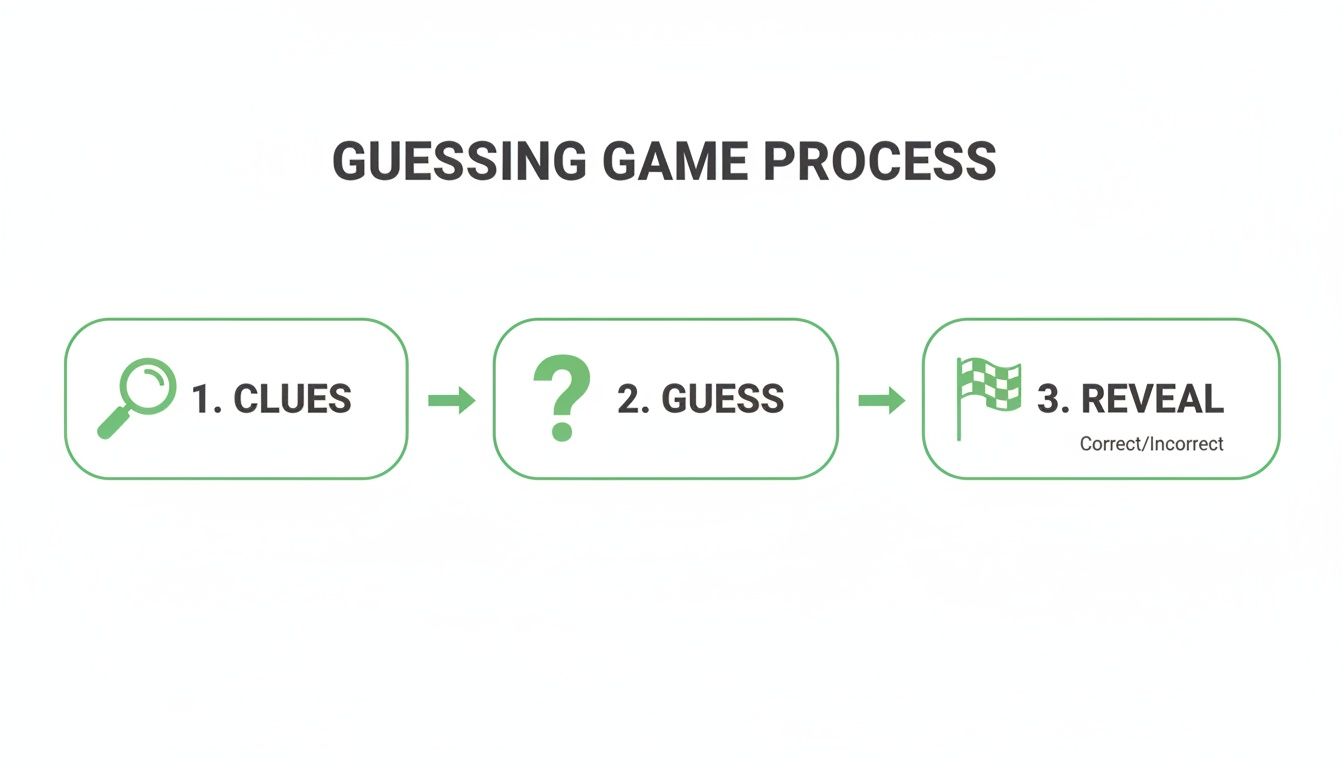
The image above really simplifies this three-step cycle, showing how you get info, make an educated guess, and then receive feedback to fine-tune your next attempt.
Demystifying Proximity and Directional Hints
Two of the most common and powerful types of feedback are proximity hints and directional arrows. Think of them as your personal GPS, guiding you toward the target country. They turn a random shot in the dark into a calculated move.
A proximity hint tells you how close your guess was to the correct answer, usually in kilometers or miles. A directional arrow points you in the general direction you need to travel on the world map.
For example, if the mystery country is Germany and you guess Spain, the game might show you:
- Proximity: 1,485 km (923 miles) away
- Direction: Northeast (↑)
This feedback is pure gold. You now know to look for countries northeast of Spain, which immediately shrinks the playing field. You can safely cross all of South America, Africa, and most of Asia off your list for the next guess.
A Step-by-Step Gameplay Example
To see how these rules come together, let's play an imaginary round where the secret country is Japan. We’ll have six guesses to get it right.
Guess 1: Brazil We'll start with a big, recognizable country just to get our bearings.
- Feedback: The correct country is 17,350 km away to the Northeast.
- Analysis: Wow, that tells us the target is on the complete opposite side of the planet. We can immediately rule out the Americas.
Guess 2: India Using that feedback, we'll shift our focus to Asia.
- Feedback: The correct country is 4,900 km away to the Northeast.
- Analysis: We're getting much warmer! The answer is definitely in East or Southeast Asia.
Guess 3: Thailand Let's keep moving northeast.
- Feedback: The correct country is 3,200 km away to the Northeast.
- Analysis: Closer still. The country has to be further east. Maybe it's an island nation?
This is the "aha!" moment in any good country guessing game. You stop making random stabs and start connecting the dots. The clues aren't just data anymore; they’re pieces of a puzzle clicking into place.
Guess 4: Philippines Let's try another island nation in that region.
- Feedback: The correct country is 1,300 km away to the North.
- Analysis: We are incredibly close now. We just need to go straight north of the Philippines. There’s really only one major country that fits that description.
Guess 5: Japan Our logic leads us straight to the final answer.
- Feedback: Correct! You guessed it in 5 tries.
This example shows how a country guessing game is so much more than luck. Each step builds on the last, turning broad geographical knowledge into a sharp, focused search. Once you get the hang of reading proximity and directional clues, you can build a strategy that makes every single guess a smart move toward victory.
How Daily Challenges Create Global Competition
The simple concept of a daily puzzle has launched the country guessing game from a quiet pastime into a full-blown global event. Platforms like Worldle and Countryle cracked the code: give thousands of people the exact same challenge every day.
This simple tweak creates an incredible sense of shared experience. Suddenly, you're not just playing a game; you're part of a massive, worldwide huddle trying to solve the same mystery. It’s a daily ritual, a quick moment where you can compare scores, trade strategies, and even share frustrations with friends and total strangers.
This shared puzzle turns a quick geography quiz into a global conversation, all powered by a bit of friendly competition.
Understanding Daily Scoring Systems
To really fan the competitive flames, these daily challenge games use clever scoring systems that reward both accuracy and speed. It’s not just about getting the right answer—it’s about how you get there. Most systems are built to punish random guessing and reward a thoughtful, step-by-step approach.
A popular model starts you off with a bank of points that drains with every wrong guess. In a game like Countryle, for example, you might start with 100 points, and each attempt chips away at your total. This design forces you to use the feedback from each guess to make your next one smarter.
This point-deduction system is the heart and soul of the daily challenge. It creates a risk-reward dynamic where every single guess matters, pushing you to think critically instead of just throwing darts at a map.
And it works. This approach keeps players hooked. In daily quizzes that use real-world data, a whopping 62% of users find the correct country within five tries simply by analyzing clues like life expectancy and population. The scoring system is what drives that analytical habit.
The Power of Streaks and Leaderboards
What really turns a daily game into a daily habit? Streaks and leaderboards. These two features tap directly into our natural drive for consistency and recognition.
- Daily Streaks: This is just a simple counter tracking how many days in a row you’ve solved the puzzle. But it's a powerful psychological hook. No one wants to break a long streak, giving you a great reason to log in and play every single day.
- Leaderboards: By ranking players on their daily scores or overall performance, leaderboards add a public layer to the competition. You can finally see how your geography chops stack up against others in your city, country, or even across the globe.
Together, these elements create serious long-term engagement. The numbers don't lie. Some platforms see incredible loyalty, with streaks over 100 days held by more than 12,000 players. Across 1.5 million daily sessions in 2024, the top players averaged a score of 68, proving that daily practice really does make perfect. You can dig into how these games are becoming a real force for global awareness at GeoWorldle.
Tips for Improving Your Daily Performance
Getting better at the daily country guessing game is all about building a system. Ditch the random guesses and start approaching each puzzle with a strategy that boosts your odds and your score.
Here are a few tips you can use right away:
- Establish a Baseline Guess: Always start with a large, centrally located country like Turkey or China. This gives you a great geographical anchor and provides a ton of information no matter where the mystery country is.
- Think in Regions, Not Just Countries: After that first clue, don't just guess another random country. Think about which massive regions you can completely rule out. If the arrow points northeast from Turkey, you can safely ignore all of Africa and South America for your next guess.
- Use Statistical Clues Systematically: When the game gives you data like population or area, use it to build a mental shortlist. A country with over a billion people? You're down to just two options. A tiny land area? Start thinking about microstates or island nations.
By weaving these strategies into your gameplay, you can turn a casual distraction into a rewarding daily ritual, climb those leaderboards, and build a streak you can be proud of.
Exploring Innovative Game Variations
Once you've nailed guessing countries from their outlines and flags, you'll discover a whole world of creative spin-offs ready to test your brain in totally new ways. The classic country guessing game has grown up, moving far beyond simple visual recall. The most interesting versions today are swapping out traditional clues for things like economic data, satellite imagery, and even global trade patterns.
These advanced formats challenge a completely different part of your mind. Instead of just asking, "What does this country look like?" they pose a much more interesting question: "How does this country work?" It’s a shift that turns the game from a simple memory test into a fascinating puzzle of global economics, culture, and infrastructure.
From Trade Maps to Satellite Views
Imagine trying to identify a country just by looking at its major exports. That's the kind of challenge you'll find in some of the most unique game variants out there. These games give you unconventional clues that force you to think about geography more analytically.
- Economic Data Games: You might get a country’s GDP, main industries, or top trading partners as clues. To win, you have to connect economic profiles to specific nations.
- Satellite Imagery Puzzles: Some games show you a satellite view of a capital city or a major landmark, but with no labels. You have to recognize the urban layout or geographic features to figure it out.
- Export-Based Challenges: This format tests your grasp of global trade by showing you a visual breakdown of a country’s top exported goods.
These variations are incredibly rewarding for players who can think beyond borders and flags, pushing for a more complete picture of how countries fit into the global puzzle.
The world of country guessing games offers a rich variety of challenges that go beyond simple recognition. Different game variants use unique clues to test specific areas of your geographical and cultural knowledge. The table below breaks down some popular formats, the types of clues they use, and what they teach you.
Country Guessing Game Variants and Their Unique Clues
| Game Variant | Clue Type | Knowledge Focus | Popular Example |
|---|---|---|---|
| Export-Based | Treemaps of exports | Global Trade, Economics | Tradle |
| Map Pinpointing | Blank world map | Spatial Awareness, Precise Location | EarthChasers (Custom Quizzes) |
| Satellite Imagery | Unlabeled satellite views | Urban Planning, Landmark Recognition | GeoGuessr, EarthChasers |
| Economic Data | GDP, population, industries | Economic Geography, Data Analysis | Various online quizzes |
Each variant offers a distinct way to engage with the world, turning abstract data and images into a thrilling intellectual puzzle. By trying different types, you can round out your understanding of global dynamics in a fun, competitive way.
A Deep Dive Into Export-Based Games
One of the most intellectually satisfying twists on the country guessing game is the export-based format. Games like Tradle challenge players to identify a nation from a treemap—a cool visual chart that breaks down its top exported goods by value. It’s a brilliant way to test your knowledge of global commerce.
Here’s an example of what you might see in a round.
This treemap gives you a visual snapshot of a country's entire export economy. The bigger the box, the more valuable that export category is.
Spotting these patterns is how you win. For instance, in 2022, China's treemap was dominated by electronics, making up a massive 28% of its $3.59 trillion in exports. Germany’s chart, on the other hand, heavily featured vehicles, which accounted for 20% of its $1.59 trillion total. This game-based approach is so effective that schools in the EU have reported 35% better retention of trade facts when using it. What’s more, 40% of US players aged 18-34 say these games have improved their economic literacy.
Pinpoint Precision in Map-Based Games
Another exciting variation ditches the abstract clues and puts your pure mapping skills to the test. In these games, you aren’t just naming a country—you have to physically pinpoint its location on a map. This format demands a much higher level of geographical precision.
These map-based challenges test your mental atlas like nothing else. It’s one thing to know that Chad is in Africa; it’s another to accurately click within its borders on a blank world map under pressure.
These games usually run on a point system where the closer your pin lands to the center of the target country, the more points you rack up. This format is perfect for players who take pride in knowing exactly where countries are and how they connect to their neighbors.
If you enjoy this style of play, you can even take it a step further. Platforms like EarthChasers offer tools that let you build your own challenges. Check out our guide on how to create a map quiz to design custom games that test your friends on specific regions or themes.
Bringing the Game into the Real World
The fun of a country guessing game doesn't have to be glued to a screen. With just a bit of creativity, you can easily pull this digital puzzle into the real world for a lively, interactive game night perfect for any group. It’s a fantastic way to get people talking, spark some friendly competition, and connect with each other—no internet required.
When you take the game offline, you become the game master. You get to tweak the rules, clues, and difficulty to match the vibe of the room. This makes it an incredibly flexible activity, whether you’re planning a loud party, a focused classroom lesson, or a cozy family game night.
Party Mode Rules and Setup
For a party, you want fast-paced, team-based fun. The goal is to keep the energy high and the rules simple enough for anyone to jump right in.
- Team Up: Split everyone into two or three teams. This gets people collaborating and keeps the energy up, even when it’s not their turn to guess.
- Pick a Moderator: Designate one person as the "Quiz Master." Their job is to pick the secret country for each round and dish out the clues.
- Rapid-Fire Rounds: Set a timer for each round—something quick like 60-90 seconds. The guessing team just shouts out answers as the moderator fires off clues.
For scoring, give one point for each correct answer. Want to spice it up? Add a "steal" rule: if the guessing team runs out of time, other teams get one shot to confer and lock in a final guess. It keeps everyone on their toes.
The Classroom Edition
In a school setting, the country guessing game becomes a fantastic tool for making geography lessons stick. Here, the focus shifts from pure speed to critical thinking and connecting the dots.
The real learning happens in the discussion after each clue. It pushes students to connect different bits of information—a country's climate, its major exports, and its neighbors—to build a complete geographical profile in their minds.
To get it ready for the classroom, try these tweaks:
- Student Moderators: Let a student or a small group choose a country and prep the clues ahead of time. This gives them ownership over the material and encourages deeper research.
- Visual Clues: Use a projector to show images of flags, famous landmarks, traditional foods, or even a blank map highlighting the country's neighbors.
- Thematic Rounds: You can structure the game around specific curriculum topics, like "Countries of the Silk Road" or "Nations with Major Rainforests," to reinforce what you’re teaching.
Scoring can be participation-based, or you could award points for both the right answer and for explaining the logic behind a guess.
Family Game Night Version
When it's family game night, the key is making sure the game is accessible and fun for every age. You'll want flexible rules and clues balanced enough for both kids and adults to feel like they can contribute.
- Clue Variety: Mix up your clues. Include simple ones for the younger players ("This country is shaped like a boot") and trickier ones for the adults ("This country is a member of the G7").
- Play Together: Instead of competing, why not play as one big team against a "challenge"? Set a goal to guess 10 countries in under 15 minutes.
- Personal Touch: Weave in clues related to your family’s own history or travels. Think, "This is the country where Grandma was born" or "We went to this country on our last big vacation."
This approach turns the game into a shared experience, creating fun memories while everyone secretly gets a little better at geography.
Level Up: Tools and Resources for the Aspiring Geography Pro
Once you get the hang of the daily challenges, you'll probably find yourself wanting more. This is where you move from being a casual player to a true geography enthusiast, and the right tools can make all the difference. A whole world of platforms exists to help you sharpen specific skills, deepen your knowledge, and even build your own games.
These resources are built for more than just playing—they’re designed for active learning. Instead of waiting for the next daily puzzle, you can take control and target your weak spots. Want to finally master the island nations of Oceania or nail down the borders in Central Europe? The right tools put that power in your hands.
From Player to Creator
The ultimate way to master the country guessing game is to become a creator yourself. When you design your own quizzes, you're forced to think like a puzzle maker. You start looking for the unique features that make a country instantly recognizable, a process that cements your knowledge way more effectively than just playing ever could.
Many platforms offer custom quiz makers, letting you design games around specific regions, themes, or even types of clues. You could build a quiz on landlocked African nations or one using only economic data for G20 members. For anyone looking to practice, many hubs let you explore various educational games and discover new ways to challenge yourself.
Creating your own geography game is a powerful learning shortcut. It flips your perspective from being a consumer of information to a producer of challenges, forcing a much deeper understanding of global patterns and distinctions.
This creative shift totally changes your relationship with geography. You stop seeing the world as just a map to be memorized and start seeing it as a collection of fascinating puzzles waiting to be designed and shared.
Designing Your Own Custom Map Quizzes
Imagine creating a personalized geography challenge for your friends, family, or students. You could build a quiz around your last family vacation, a major historical event, or a specific geographic feature like the world's longest rivers. This kind of customization makes the whole learning experience more personal, engaging, and memorable.
Modern tools have made this incredibly easy. For instance, with a dedicated custom map creator, you can build a pinpointing quiz in just a few minutes. You pick the locations, write the questions, and share a simple link. Players then have to accurately click on the map to answer, testing both their knowledge and their spatial precision in a fun, interactive way.
This hands-on approach is the perfect way to share your passion for geography and challenge others to see the world through your eyes. Find it on EarthChasers at https://earthchasers.com/custom-map-creator.
Still Have Questions?
Even after getting the rules down, you might still have a few questions about how it all works in practice. Let's tackle some of the most common ones so you can jump right in, whether you're playing for the first time or looking to sharpen your skills.
What Are the Best Free Country Guessing Games for Beginners?
When you're just starting, you want a game that's straightforward and gives you helpful feedback, not one that leaves you feeling lost after the first guess.
Two of the best free options out there are Worldle and Countryle. Worldle gives you a country's silhouette and then nudges you in the right direction with distance and directional hints. On the other hand, Countryle provides statistical clues like continent, population, and even average temperature to help you narrow it down. Both have great daily communities, making them super easy to pick up without feeling intimidated.
How Can I Use These Games to Actually Improve My Geography Knowledge?
The trick is to be an active learner, not just a passive guesser. Don't just fire off an answer and immediately move on, especially when you get it wrong.
After each round, take 30 seconds to actually look up the correct country on a map. Get a feel for where it is, who its neighbors are, and learn one quick, interesting fact about it. Lots of these games even link directly to Wikipedia to make it painless. This little habit—playing consistently and doing these "micro-learns"—will build a powerful mental map of the world way faster than you'd think.
The goal isn't just to win today's game; it's to remember that country tomorrow. Tying a nation to a clue—its unique shape, a surprising statistic, or its location—is what makes the knowledge really stick.
Are There Any Country Guessing Games I Can Play Offline?
Absolutely! A DIY country guessing game is a fantastic activity for a road trip, a party, or even a classroom. It’s a breeze to set up and you can tweak the rules however you like.
Just pick one person to be the "Quiz Master." They secretly choose a country and start feeding clues to the other players, one at a time. You can start broad ("This country is in South America") and get more specific ("It's famous for its coffee," and finally, "Its flag is yellow, blue, and red"). It’s a great, engaging way to get everyone involved without a screen.
What’s the Difference Between Worldle and GeoGuessr?
This is a great question because while they’re both geography games, they test completely different skills. Think of it like a detective solving a case with documents versus one analyzing a crime scene.
- Worldle (and games like it) is a logic puzzle. You’re using abstract data—shape, stats, distance—to deduce the answer.
- GeoGuessr is all about visual investigation. It drops you into a random spot on Google Street View, and you have to figure out where you are by decoding visual clues like road signs, architecture, and even the types of trees.
Basically, Worldle tests your abstract knowledge of countries, while GeoGuessr tests your ability to interpret the visual world around you.
Ready to create your own challenges or join a global community of geography fans? EarthChasers offers everything from a daily hunt to custom map creation tools, letting you play, learn, and build in immersive 3D. Start your adventure today.