
Learn the Countries of Africa With This Visual Guide
Ready to learn the countries of Africa? Our visual guide uses maps, memory tricks, and proven methods to help you master all 54 nations.

Trying to memorize all 54 countries of Africa at once is a surefire way to get overwhelmed. I've seen countless people try and fail with that brute-force approach. The single most effective strategy is to break the continent down into smaller, more digestible regions.
Instead of staring at a massive map, focus on one area at a time—maybe start with North Africa, then move to West Africa. This method lets you build a strong mental map, piece by piece, without the burnout.
Why Bother Learning the Map of Africa?
Before you pull out the flashcards, let's talk about why this is such a valuable skill. Learning the countries of Africa is so much more than a party trick; it's about genuinely understanding a continent buzzing with immense diversity, rapid economic growth, and ever-increasing global influence.
Knowing the individual nations gives you the context needed to make sense of world events, spot business opportunities, and appreciate cultural trends. It completely transforms your perspective. You'll stop seeing Africa as a single, monolithic place and start recognizing it for what it is: a vibrant mosaic of distinct countries, each with its own story.
A Continent of 54 Diverse Nations
The political map of Africa we use today is surprisingly modern. Most of its 54 sovereign states were formed during the "Decolonization Era" of the mid-20th century, a period of massive, rapid change.
This history created a continent of incredible variety. You have giants like Nigeria, with over 237 million people, and tiny island nations like Seychelles, with fewer than 200,000 residents. Acknowledging this sheer diversity is the first real step toward a genuine understanding. You can explore more about the populations of African countries and their unique histories.
Knowing geography is about more than just places. It’s about knowing the world, understanding its cultures, and seeing the connections between people and the land they inhabit.
Thinking this way makes the effort much more meaningful. It connects the rote memorization to a deeper appreciation of the world, turning a simple exercise into an enriching journey.
You'll be better equipped to:
- Follow Global News: Finally understand the context behind headlines coming from Addis Ababa to Accra.
- Identify Opportunities: Recognize emerging markets and economic powerhouses across the continent.
- Appreciate Culture: Distinguish between the rich traditions of Mali and the unique heritage of Madagascar.
Staring at a map of Africa's 54 countries can feel completely overwhelming. I get it. Trying to memorize them all in one go is a recipe for frustration.
The single best piece of advice I can give is to "divide and conquer." Break the massive continent down into its smaller, more familiar regions.
This simple shift in approach turns an impossible task into a series of small, achievable wins. When you focus on just one group of countries at a time, you start building a mental framework. It's much easier to recall where each nation is, what its neighbors are, and how the whole puzzle fits together. You're not just memorizing names; you're building a real map in your mind.
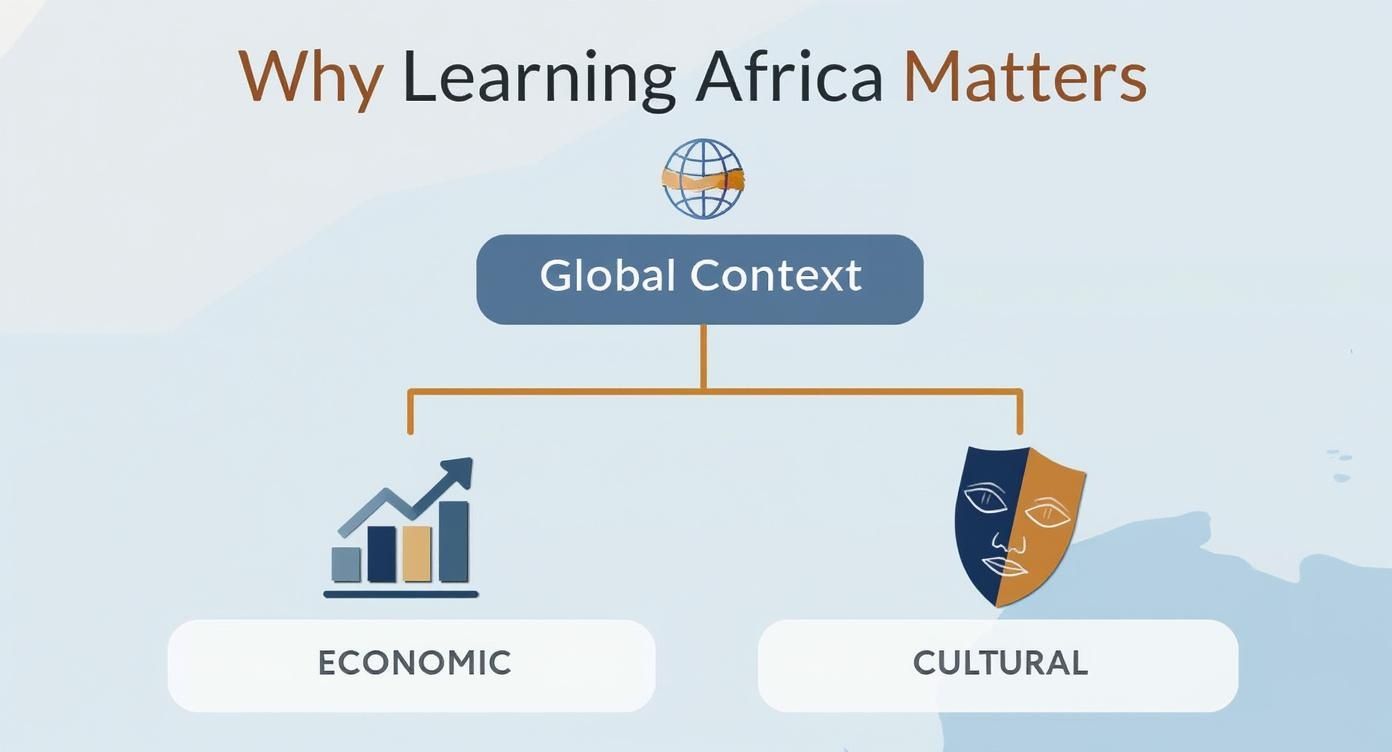
As you can see, this kind of geographic knowledge isn't just for trivia night. It gives you a much deeper appreciation for the continent's growing economic influence and incredible cultural diversity.
The Five Main Regions of Africa
Most geographers group the continent into five main regions. This isn't random—these areas often share distinct geographic features, historical arcs, and cultural threads. Learning them this way gives you that crucial context that makes the information stick.
The table below lays out all 54 countries, organized into their respective regions. It's the perfect cheat sheet to use as you start tackling the continent one chunk at a time.
Africa's Five Geographic Regions and Key Countries
| North Africa | West Africa | Central Africa | East Africa | Southern Africa |
|---|---|---|---|---|
| Algeria | Benin | Angola | Burundi | Botswana |
| Egypt | Burkina Faso | Cameroon | Comoros | Eswatini (Swaziland) |
| Libya | Cape Verde | Central African Republic | Djibouti | Lesotho |
| Morocco | Côte d'Ivoire (Ivory Coast) | Chad | Eritrea | Malawi |
| Sudan | Gambia | Congo, Dem. Rep. of | Ethiopia | Mozambique |
| Tunisia | Ghana | Congo, Republic of the | Kenya | Namibia |
| Western Sahara | Guinea | Equatorial Guinea | Madagascar | South Africa |
| Guinea-Bissau | Gabon | Mauritius | Zambia | |
| Liberia | São Tomé & Príncipe | Rwanda | Zimbabwe | |
| Mali | Seychelles | |||
| Mauritania | Somalia | |||
| Niger | South Sudan | |||
| Nigeria | Tanzania | |||
| Senegal | Uganda | |||
| Sierra Leone | ||||
| Togo |
Using this regional breakdown is your foundational strategy. It provides the structure you need to turn a jumbled list of names into a logical, interconnected puzzle.
The key is to master one region before you even think about the next. For example, once you feel confident with West Africa, you can use those countries as anchor points to learn the bordering nations in Central and North Africa. It's a natural, progressive way to learn.
From here, you're ready to start using specific memory techniques to lock in the names and locations within each of these regions. You've built the scaffolding—now it's time to fill in the details.
Use Proven Memory Techniques for Each Region

Okay, now that we've chunked the continent into manageable regions, it's time for the fun part: applying some powerful memory tricks to make the names and locations actually stick.
Forget staring at a map until your eyes glaze over. The real key is active recall. This is where you move from just seeing the information to actively trying to pull it out of your brain. Techniques like mnemonics, storytelling, and even the famous "memory palace" method work wonders here.
These strategies are effective because they create vivid, sticky mental connections. Instead of a dry, disconnected list of facts, you're building a rich story or a clever puzzle in your mind—something your brain is much better at holding onto.
Create Simple Mnemonics
A mnemonic is just a fancy word for a memory device. It can be an acronym, a song, or a funny phrase that helps you remember a sequence of information.
For North Africa, try the simple acronym MELTS. This one word helps you instantly recall Morocco, Egypt, Libya, Tunisia, and Sudan. It's short, sweet, and gives you a hook for each country.
For a bigger region like West Africa, a silly sentence often works best. Picture this: "Some Green Monkeys Make Nice Big Burgers." This ridiculous image can help you remember Senegal, Guinea, Mali, Mauritania, Niger, Burkina Faso, and Benin, often in a rough geographic order. My personal rule? The more absurd the sentence, the more unforgettable it becomes.
The goal is to build a mental pathway. Instead of trying to recall a country from a vacuum, you're just remembering the next step in your story or the next letter in your acronym.
Build a Geographic Story
Another one of my favorite methods is to weave a story that travels through the countries in a logical order. Let's imagine a road trip across Southern Africa.
- You kick off your adventure spotting elephants in the wilds of Botswana.
- Next, you drive east into Zimbabwe to feel the spray from the mighty Victoria Falls.
- From there, you head south into the economic powerhouse of South Africa.
- Finally, you travel up the coast to relax on the stunning beaches of Mozambique.
See how that works? The narrative links the countries together geographically, giving each one a purpose and a place on your mental map. These kinds of techniques are a cornerstone of any solid strategy for how you can how to learn world geography.
This contextual learning also helps you better appreciate the continent's incredible diversity. The 54 countries of Africa are vastly different, and just four of them—Nigeria, Ethiopia, Egypt, and the DR Congo—account for nearly half of the continent's entire population. Nigeria is a true giant, with a projected population of 237.5 million people. Weaving these kinds of details into your stories will only make your learning journey richer.
Turn Your Practice Into a Game
Memory tricks are a great start, but the real secret to making this knowledge stick is practice. And let's be honest, staring at a map gets old fast. The best way to lock in what you've learned is to make it a game.
When you add a timer, a high score to beat, or a friendly leaderboard, learning becomes addictive. You're not just passively looking at a map anymore; you’re actively digging through your memory to find the right answer before the clock runs out. This process, called active recall, is far more powerful for building strong neural pathways than just rereading a list.
Platforms like Seterra and Sporcle are brilliant for this. They turn the chore of memorizing Africa's countries into something you'll actually want to do.
Find the Right Quizzing Platform
There are tons of tools out there, but I always come back to Seterra for its simple, clean map quizzes. It lets you zero in on specific regions, which fits perfectly with the "divide and conquer" strategy we talked about earlier. Sporcle is another favorite, offering a massive library of user-made quizzes that go from basic "name the country" games to some really creative challenges.
Here’s a look at Seterra’s interface—it’s clean, straightforward, and gets you right into the action.
You can see how easy it is to just pick a region and start practicing. No fuss, no friction.
Here's a pro tip from my own experience: Start with the untimed quizzes on Seterra. Just focus on getting the locations right. Once you're consistently hitting 90% or more, switch to timed mode. The pressure forces you to get faster and really solidifies that mental map.
Ready to get started? Try this simple routine:
- Daily Challenge: Just 10-15 minutes a day. That’s it. Pick your target region and do a quick quiz. A little bit every day is way more effective than a long, draining session once a week.
- Mix It Up: Don't just do map quizzes. One day, try to identify countries by their flags. This adds another layer to your knowledge and keeps things interesting.
- Track Your Progress: Jot down your scores and times. Seriously, seeing yourself get faster and more accurate is a huge motivator.
By making practice a game, you’ll be shocked at how quickly you can master all 54 countries. If you get hooked and want to find more ways to play with maps, check out our guide to the best geography games online free. This approach turns a massive task into a rewarding daily habit.
Go Beyond Names on a Map
Embedded content
Give yourself a pat on the back! Mastering the locations of all 54 African nations is a huge accomplishment. But don't stop now—your journey to truly understanding this incredible continent has only just begun.
Think of it this way: the names on the map are the foundation. Now, it's time to build on it.
This newfound geographic knowledge unlocks a much deeper appreciation for Africa's staggering diversity. You can finally start to contextualize the continent's dynamic growth and its rich tapestry of cultures, economies, and histories. The key is to keep that curiosity burning and continue exploring.
What to Learn Next
Now that you've got the countries down, you can start adding more layers to your mental map. This is where you connect names to real places, people, and cultures.
Here are a few ideas for what to tackle next:
- Capital Cities: Can you place Abuja, Cairo, and Kinshasa correctly?
- National Flags: Learn to recognize the vibrant colors and symbols of each nation's flag.
- Major Landmarks: Pinpoint iconic features like Mount Kilimanjaro, the Nile River, or Victoria Falls.
This process transforms abstract shapes on a map into a living, breathing picture of the continent. If you want to go a step further, understanding the basics of how maps work can be a game-changer. Resources like Cartography for Kids: Understanding Maps and Unlocking Creativity offer a great starting point for all ages.
Diving into demographics also reveals fascinating stories. Africa is the world's fastest-growing continent, with an estimated population that will soon hit 1.56 billion people. Nigeria leads the pack with over 235 million inhabitants, followed by Ethiopia and Egypt. Grasping these population dynamics is vital to understanding the continent’s future.
Don't forget the core strategies that got you this far—regional breakdowns, memory aids, and consistent practice. They work just as well for capitals and landmarks as they do for countries.
Keep practicing and layering your knowledge. You can continue honing your skills with our printable blank map of Africa, which is perfect for quizzing yourself on your next challenge.
Frequently Asked Questions
Even with a solid game plan, you're bound to have questions pop up while trying to memorize the countries of Africa. Here are some quick answers to the most common sticking points I see people run into.
What Is the Best Way to Start Learning?
Whatever you do, don't try to tackle all 54 countries at once. It’s a recipe for burnout.
The most reliable method is to break the continent down into its five major regions: North, West, Central, East, and Southern Africa. Get one region completely locked in before you even think about moving on to the next. This regional approach makes the massive task feel manageable and helps you build a solid mental map from the ground up.
How Long Does It Take to Memorize Them All?
It’s probably faster than you think. If you dedicate just 15-20 minutes a day using the regional method and some interactive quizzes, most people can confidently name and locate every country in about two to four weeks.
Consistency is far more important than trying to cram for hours on a Saturday. Little and often is the key.
Remember, this is a process, not a race. The real goal is confident recall, not just speed. Celebrate the small wins, like finally nailing down all of West Africa, to keep your motivation high.
What Are the Best Apps for Learning Geography?
Gamifying the process makes a huge difference. Here are a few of the best tools out there:
- Seterra is my go-to recommendation for its simple, effective map quizzes. You can easily isolate your practice to specific African regions.
- Sporcle has an endless supply of user-made quizzes in all sorts of formats, which is great for keeping your practice sessions from getting stale.
- World Map Quiz and similar mobile apps are perfect for squeezing in a quick practice session when you have a few minutes to spare.
If you’re curious about the principles behind breaking down large amounts of information into smaller chunks, you might find more answers in a helpful FAQ on reading order, which touches on similar learning strategies.
Ready to put your knowledge to the test in a whole new way? Explore the world with EarthChasers, the ultimate 3D geography game that turns learning into an adventure. Discover new places, compete in global challenges, and master the map. Start your journey with EarthChasers today!