
Master the World with a Map Quiz Game
Discover how a great map quiz game can sharpen your geography skills. Learn winning strategies, explore game mechanics, and find your next challenge.
A map quiz game is more than just a test—it's an interactive challenge that drops you into the role of a global detective. Your mission? To identify countries, cities, or landmarks using visual cues on a map. It turns the often-dry subject of geography into a captivating adventure.
This approach makes learning about the world genuinely fun and engaging.
So, What Exactly Is a Map Quiz Game?
Think of it as piecing together the world, one location at a time. A map quiz game is designed to test and sharpen your geographical knowledge in a way that feels dynamic, not static. Instead of just reading names on a page, you’re actively involved in the discovery.
These games forge a real connection to the world around us. They don't just teach you facts; they build curiosity and help you become a more informed global citizen.
It's About More Than Just Memorization
A truly great map quiz game pushes you beyond simply memorizing capitals. It helps you develop a deeper geographical intuition by honing a few key skills:
- Spatial Reasoning: You start to understand where countries are in relation to each other, the continents, and major oceans.
- Visual Recognition: Soon enough, you'll be able to identify countries just by their shape—no labels needed.
- Contextual Clues: You learn to use surrounding geography, like neighboring countries or a distinctive coastline, to figure out the answer.
This multi-layered approach helps you build a mental map of the world that actually sticks. It’s the difference between knowing isolated facts and truly understanding the relationships between places.
The real magic of a map quiz game is how it makes learning almost invisible. You're so focused on beating your high score or challenging a friend that you don't even realize you're mastering world geography.
A Huge Trend in Modern Learning
The explosion in popularity of these games is no accident. It’s part of a massive shift toward using games for education. The global game-based learning market was valued at USD 19.55 billion and is expected to hit USD 64.54 billion by 2030.
Map-based challenges are a huge piece of this growth, proving that fun and education are a perfect match. You can learn more about the rise of game-based learning from this detailed market report.
The Journey from Board Games to GeoGuessr
The human fascination with maps isn't a new thing. Long before we had screens in our pockets, geography games were a staple of family game nights, spread out across dining room tables. Think of classics like Risk, where knowing the map wasn't just for points—it was the key to world domination. These games were our first introduction to continents and countries, taught through the simple act of moving pieces across a board.
Then came the digital age, and with it, a whole new way to play. Early pioneers like Where in the World Is Carmen Sandiego? turned learning into a thrilling global detective chase. We were hooked, proving that a map quiz game could be way more than just memorization; it could be a real adventure.
But the real revolution came with the internet. Suddenly, we had access to a world of real-time data and challenges that was unimaginable just a few years earlier.
The Rise of Online Geography Games
Browser-based games like Seterra popped up, offering quick, addictive quizzes that let you master hundreds of locations in short bursts. They nailed the digital format, using repetition and speed to burn geographical facts into your brain. But one game was about to change everything by using a powerful new tool: satellite imagery.
This timeline really puts into perspective how we've interacted with world maps over the years.
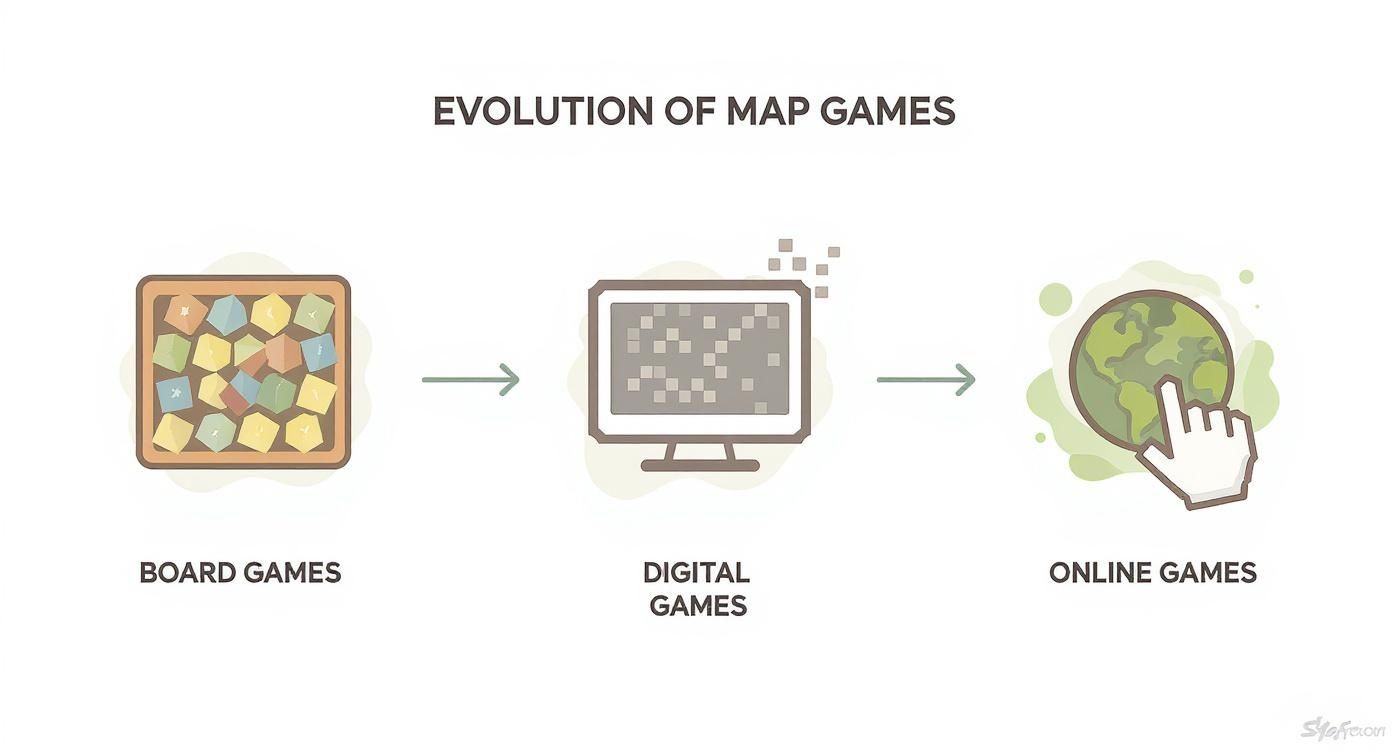
You can see the clear jump from slow, turn-based board games to the instant, immersive exploration we have today.
GeoGuessr was the game that flipped the script. It dropped players right into Google Street View, and all of a sudden, the game wasn't about recognizing a country's outline anymore. It was about becoming a detective, piecing together clues from road signs, architecture, and even the position of the sun. If you want a deeper look at this phenomenon, we have a complete guide that explains what GeoGuessr is and how it works.
This journey from cardboard continents to panoramic street views shows a consistent human desire for discovery. Technology has simply provided us with ever more powerful tools to explore, compete, and connect with our world.
This evolution shows just how far the map quiz game has come. It’s grown from a simple classroom tool into a global stage for deduction, discovery, and intense online competition, paving the way for even more creative ways to explore our planet.
How Map Games Build a Smarter Brain
Playing a map quiz game is so much more than a fun way to kill time—it’s a full-on workout for your brain. Each round you play engages a complex set of mental muscles that go way beyond simple memorization of capitals and countries.
Think about what happens when a game like GeoGuessr drops you in a random location. You aren't just guessing. You're kicking off a powerful problem-solving process, instantly turning into a detective trying to piece together a puzzle with very little information.
Your brain starts working fast, scanning for clues and patterns. Is that architecture Spanish or Portuguese? What language is on that street sign? Even something as simple as the type of trees or the quality of the road becomes a critical clue. This process is a direct exercise in critical thinking and analytical reasoning, forcing you to create and test theories on the fly.
Strengthening Your Mental Toolkit
This "detective work" is what makes these games so powerful. Each session is like hitting a mental gym, where different exercises strengthen specific cognitive abilities.
You're actively sharpening your:
- Spatial Reasoning: Just figuring out which way is north based on shadows or the sun's position is a fantastic exercise for understanding your place in the world.
- Visual Memory: You start to recall tiny details from past games, like the distinct yellow license plates in the Netherlands or the unique telephone poles common in Japan.
- Pattern Recognition: Your brain gets better at spotting recurring clues, like specific road markings or those little posts (bollards) that are unique to certain countries.
These aren't just in-game skills; they transfer directly to the real world. You’ll find yourself getting better at everything from navigating a new city on vacation to solving complex problems at work. If you're interested in how interactive platforms build these abilities, you can explore various tools for cognitive development that use similar principles.
We've broken down how map quiz games target and improve specific cognitive skills in the table below.
Cognitive Skills Enhanced by Map Quiz Games
This table shows exactly which mental skills get a boost from playing map games and links them to specific in-game actions.
| Cognitive Skill | How Map Games Develop It | Example Game Mechanic |
|---|---|---|
| Problem-Solving | Synthesizing diverse, incomplete clues (language, climate, architecture) to form a logical conclusion. | Identifying a country based on a combination of a car's license plate, a snippet of text, and the landscape. |
| Spatial Awareness | Mentally mapping your surroundings and understanding directional relationships without a compass. | Using the sun's position in the sky to determine if you are in the Northern or Southern Hemisphere. |
| Attention to Detail | Training the brain to filter out noise and focus on small but decisive visual information. | Spotting the specific design of a bollard or a trash can that is unique to a single country. |
| Working Memory | Holding multiple pieces of information in your mind simultaneously to make a decision. | Remembering the style of road markings while also analyzing the type of vegetation and local architecture. |
| Decision Making | Evaluating evidence under pressure (often with a time limit) to make the most accurate guess possible. | Choosing a final location on the map based on the probability of a few likely countries, even without certainty. |
As you can see, the gameplay mechanics are designed to push these skills, making learning a natural and exciting outcome.
Playing a map quiz game trains your brain to find order in chaos. It teaches you to filter out irrelevant information and focus on the small, critical details that lead to the correct answer, sharpening your focus and observational abilities.
Ultimately, the educational benefits come from this fun, engaging process. This is the core idea behind gamification: turning learning into a rewarding challenge. We dive deeper into how gamification works in education in our dedicated guide.
Map quizzes make learning geography an exciting side effect of a genuinely fun experience.
The Mechanics of a Great Map Quiz Game
So, what separates a map quiz game you play once from one you can't put down? It all comes down to the mechanics—the engine running under the hood that makes the whole experience click. A truly great game is more than just a pop quiz; it’s a finely-tuned system built to challenge you, reward you, and keep you coming back.
The most obvious ingredient is a good mix of game modes. Sure, a simple "name that country" quiz is a classic for a reason, but the best platforms offer a whole menu of ways to play. Think high-stakes time trials that test your reflexes, or tense streak modes where one wrong move sends you back to zero. Throw in some multiplayer battles, and you've got something for everyone, from the casual learner to the hardcore geography buff.
Core Components of an Addictive Experience
Beyond just having options, a few key elements have to work together to create that "just one more round" feeling. First up, a clean and intuitive user interface is non-negotiable. You should be able to jump right in without needing a dense instruction manual. The map data itself also has to be on point—crisp, accurate, and high-quality, whether it’s a basic political map or a stunningly detailed satellite view like you’d find in GeoGuessr.
A smart scoring system is just as crucial. It needs to be clear and fair, rewarding not just for getting the right answer, but for things like speed and precision. This gives you direct feedback and a real reason to hone your skills.
The best map quiz games make you feel like a detective, not just a student. The mechanics are designed to reward deduction and observation, turning each round into a new puzzle to solve rather than a simple test of memory.
Replayability and Community Engagement
What keeps a game interesting for the long haul often comes down to one thing: replayability. This is where community-created content really shines. When a platform lets players design and share their own maps and quizzes, it creates a virtually infinite stream of fresh challenges. If you're inspired to build your own, our guide on how to create a map quiz is a great place to start.
This community angle builds a real sense of shared discovery and friendly competition. It's a model that works, too. The global mobile gaming market is expected to hit a staggering $166.64 billion, and map games are part of that. As you can discover more insights about mobile game statistics, many top platforms use premium subscriptions to keep the lights on and deliver a high-quality, ad-free experience. Seterra, for example, reported $2.1 million in revenue with its premium model. At the end of the day, a great map quiz game is the perfect cocktail of solid mechanics, great content, and a passionate community.
Proven Strategies to Dominate the Map
Ready to climb the leaderboards in your favorite map quiz game? To go from casual player to a real contender, you need to shift your thinking. It’s less about memorizing every city and more about building a deep, intuitive sense of the world.
Start with the fundamentals. First, master the distinct shapes of major countries. Think of Italy as a boot or Chile as a long, skinny chili pepper. These visual hooks are far more memorable than just rote memorization.
Once the shapes click, start layering in the major landmarks. Get a feel for where the Nile River snakes through Africa, where the Andes create a spine for South America, and where Madagascar sits off the coast. These features become your anchors, helping you orient yourself and eliminate wrong answers in a flash.
Mastering the Meta Game
To truly level up, you have to look beyond the map itself and master the "meta." This is the art of spotting the subtle clues hidden in the game’s environment, a skill that's absolutely critical in games like GeoGuessr that use real-world imagery. This is where the pros really shine.
You need to become a geographic detective. Every picture is packed with clues if you just know what to look for. The style of a license plate, the language on a sign, or even the shape of a power outlet can instantly give away the country or region.
Here are a few of the big ones:
- Road Markings: Every country has its own traffic laws, and that includes road paint. Yellow center lines scream North America, while most of Europe sticks to white.
- Bollards and Poles: It sounds obscure, but the design of roadside posts (bollards) and utility poles is often unique to a single country.
- Sun Position: This is a classic. If you can spot the sun or even clear shadows, you can figure out which hemisphere you're in. The sun hangs out in the southern sky in the Northern Hemisphere, and in the northern sky in the Southern Hemisphere.
The secret to dominating a map quiz game isn't just knowing geography; it's about learning how to see. The best players can identify a location from the quality of the Google Street View camera or the color of the soil.
Training for Precision
Getting good requires practice, but not just any practice—it has to be focused. Instead of jumping into random maps, dedicate whole sessions to drilling specific skills. For example, spend an entire week just trying to identify countries based on their plant life and climate.
Here’s a simple training plan to get you started:
- Region-Specific Drills: Play maps locked to a single region, like Southeast Asia or Scandinavia. This forces you to learn the tiny differences that separate neighboring countries.
- Clue Association: Start building your own mental "cheat sheet." When you learn that Ghana often has black tape on its utility poles, make a conscious effort to look for it in the next rounds.
- Review Your Guesses: This is huge. After a round, don't just click to the next one. Take a second to analyze your mistakes. Why did you guess Argentina when it was actually South Africa? Figuring out why you were wrong is the fastest way to get it right next time.
By combining this foundational knowledge with sharp meta-gaming strategies, you'll develop a keen eye for detail. Your scores will jump, and you’ll start to see the unique visual fingerprints that make every corner of our world distinct.
Exploring the Next Generation of Map Games
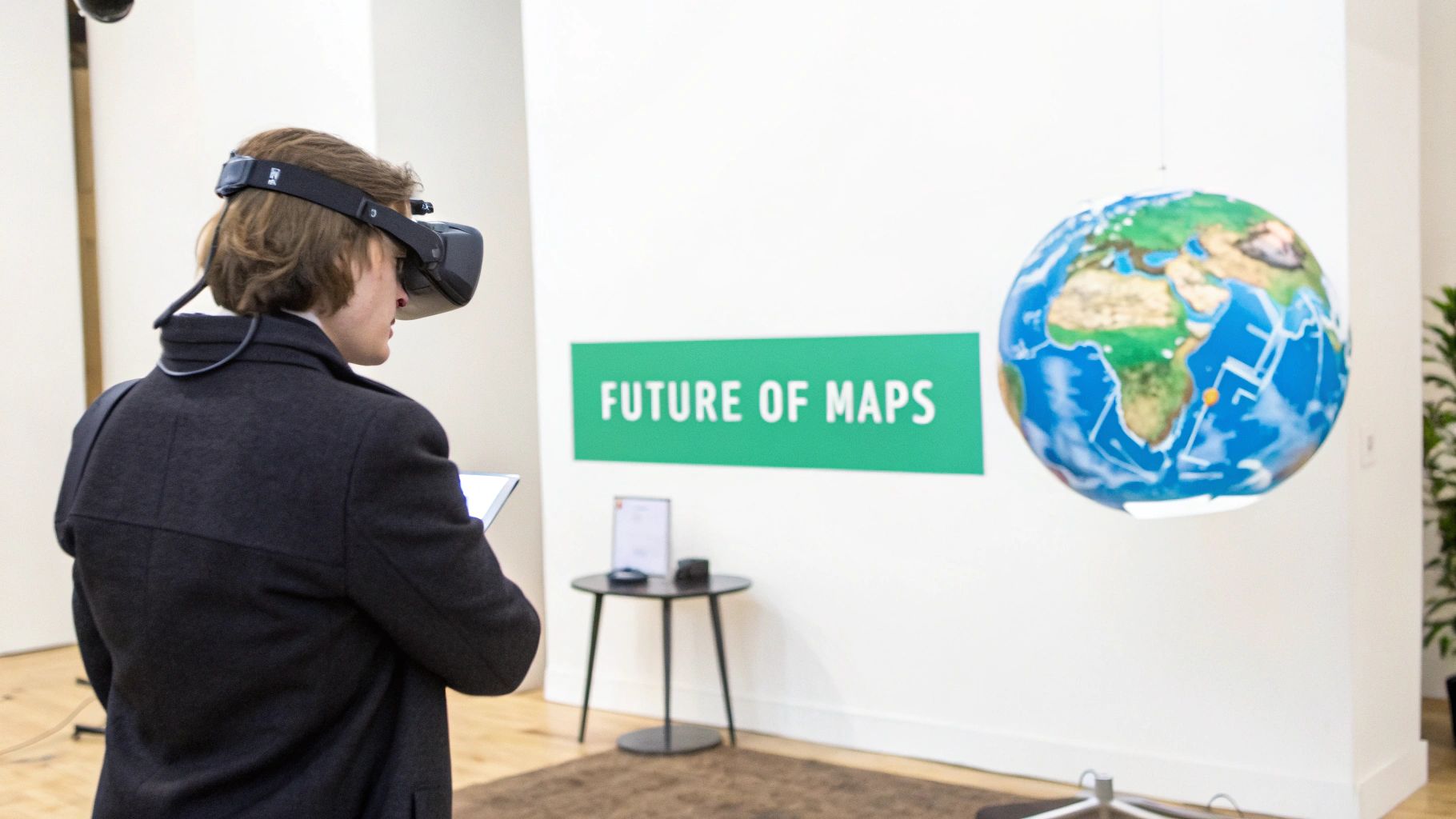
The world of map quiz games is getting a serious upgrade, moving far beyond the simple point-and-click challenges we’re used to. The next generation of geography games is shaping up to be more immersive, social, and intelligent than ever—and innovators like EarthChasers are paving the way.
Imagine a game that uses AI to build challenges specifically for you. If you’re constantly mixing up your Eastern European countries, the game would notice and generate custom quizzes focused on that region, helping you nail down your weak spots. This kind of adaptive learning is a huge leap forward.
More Immersive and Social Experiences
The future isn't just smarter; it's way more interactive. Augmented reality (AR) is on the verge of bringing the globe right into your living room. You could project a full 3D Earth onto your coffee table, walking around it to pinpoint locations. This tech turns a flat-screen game into a true hands-on exploration.
At the same time, gameplay is becoming a team sport. Forget just climbing a solo leaderboard—the next wave of map games is all about working together. We're starting to see platforms introduce features like:
- Collaborative Team Challenges: Squads team up to solve complex geographical puzzles against the clock.
- Live Data Integration: Quizzes could pull in real-time events, like tracking a hurricane's path or following a global shipping route.
- Shared Map Creation: Players can build and share their own custom maps, creating a never-ending stream of fresh content.
The evolution of map games is about transforming a solitary hobby into a connected, shared adventure. It’s no longer just about what you know, but how you can work with others to explore and understand the world.
As map quiz games keep growing, understanding current mobile app marketing trends is key for developers who want to get their games in front of a wider audience. The focus is shifting from simple quizzes to building active communities around a shared love of discovery. It’s this social element that will define the future of digital exploration and how we connect with our planet.
Got Questions? We've Got Answers
Even after getting the hang of the basics, a few questions always pop up when people first dive into the world of geography games. Let's tackle some of the most common ones.
Think of this as your quick-start FAQ to get you on the right path.
How Long Does It Take to Get Good?
This is probably the number one question we hear, and the answer is simpler than you think: it’s all about consistency, not cramming. You don’t need to block out hours of your day.
Seriously, just 15-20 minutes of daily play will do wonders for your geographic knowledge and recall. The real trick is to stop worrying about "getting good" and just focus on the fun of discovery. When you're genuinely enjoying the game, the skills just... happen.
Think of it like learning an instrument. A little bit of practice every day builds muscle memory far better than one long, frustrating session on a Sunday afternoon. Consistency is everything.
Every round you play adds another piece to your mental puzzle of the world. Before you know it, all those little pieces will connect into one big, surprisingly detailed picture.
Are Map Quiz Games Good for Kids?
Absolutely. In fact, they're one of the best ways to get kids excited about geography. These games are masters of disguise, wrapping up valuable learning in a package of pure fun. It’s a classic "stealth learning" approach that works wonders.
Instead of a boring textbook, a map quiz turns geography into an adventure. Most good platforms are built with younger players in mind, offering features like:
- Adjustable Difficulty: You can dial the challenge up or down to match a child's skill level, keeping them engaged instead of frustrated.
- Focused Quizzes: Start small! Kids can learn continents first, then major countries, or even just the states in their own country.
- Visual Learning: Interactive, colorful maps make abstract ideas like borders and capitals feel real and tangible.
Do I Have to Pay to Play?
Not usually. The vast majority of map quiz games run on a "freemium" model. What does that mean? You get the full, challenging core game completely free.
For most players, the free version offers more than enough content to keep you busy for hundreds of hours. If you see a paid option, it’s typically for extras like removing ads, getting unlimited plays on a specific mode, or accessing niche community-made quizzes. You can become a geography whiz without ever opening your wallet.
Ready to put what you've learned into action? EarthChasers brings geography to life with a unique 3D map quiz experience that turns learning into an unforgettable journey. Start your global adventure today!