
What Is Collaborative Problem Solving Explained
Discover what is collaborative problem solving with our clear guide. Learn key skills and strategies to improve teamwork and solve complex challenges.
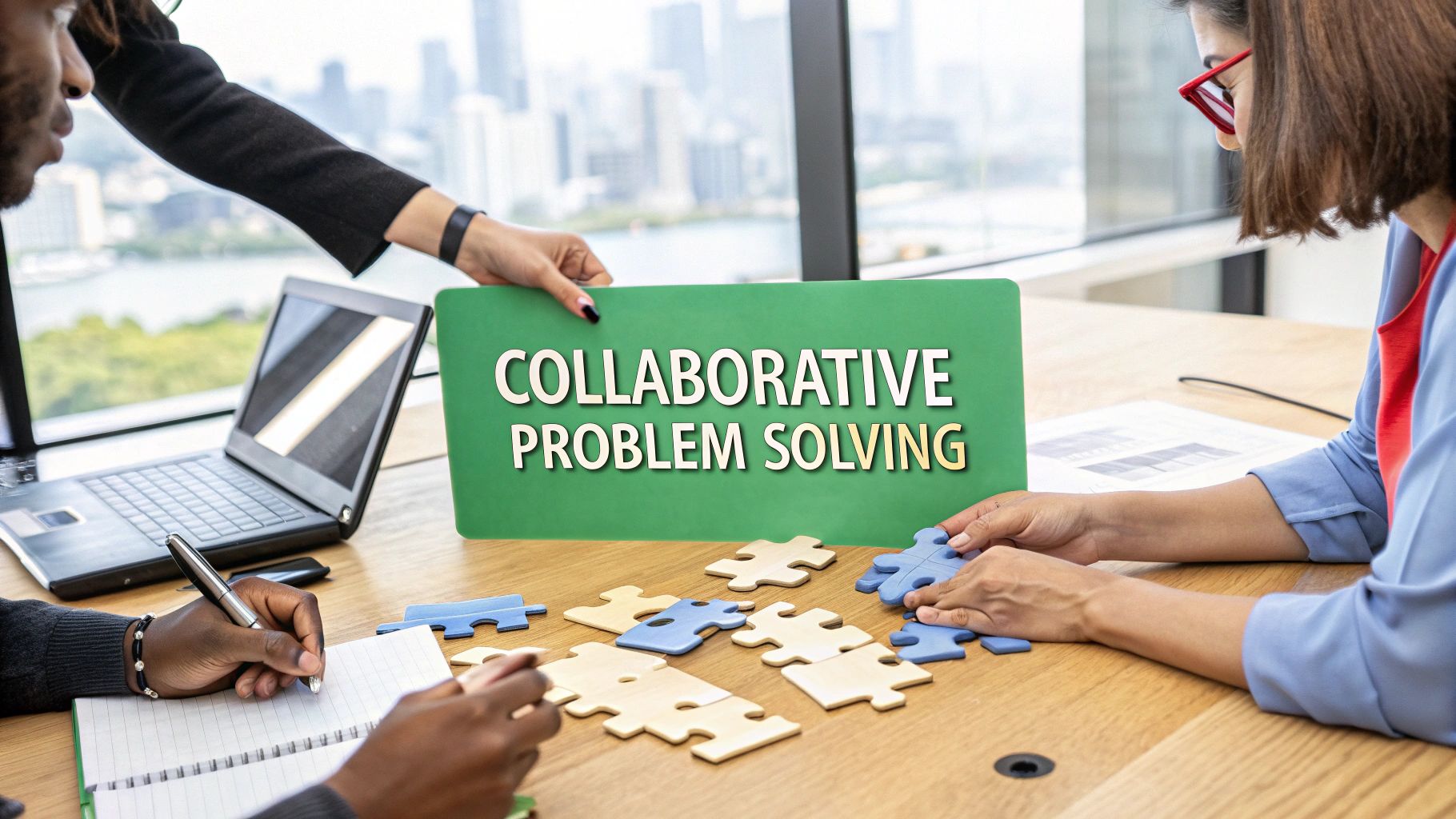
At its core, collaborative problem solving (CPS) is what happens when a group of people pools their knowledge, skills, and unique perspectives to solve complex problems—the kind of challenges no single person could crack alone.
It’s not just basic teamwork. CPS requires real-time interaction and the co-creation of a solution from the ground up. Think of it like a jazz ensemble improvising on stage. Each musician brings their talent, but the magic happens when they listen, react, and build on each other's ideas to create something entirely new and powerful.
What Is Collaborative Problem Solving, Really?
Imagine a classic detective story. You have a forensic expert, a sharp-witted interrogator, and a data analyst who can spot patterns a mile away. Each one holds a piece of the puzzle. But the case only gets solved when they all get in a room together, lay their findings on the table, debate theories, and connect the dots. That messy, brilliant process is collaborative problem solving.
It’s so much more than just splitting up a to-do list. It’s a deliberate approach that fuses two different, but equally important, skill sets:
- Collaboration Skills: This is the human element. It’s about clear communication, navigating group dynamics, setting a shared vision, and handling disagreements without derailing the project. It’s the trust and respect that holds the team together.
- Problem-Solving Skills: This is the analytical side. It’s about defining the real problem (not just the symptoms), digging into the data, brainstorming solutions, and then rigorously testing the outcomes. This is the methodical engine that drives progress.
When you blend these two, you create a kind of superpower for your team. The group isn't just working alongside each other; they're thinking together, creating a shared intelligence that’s far more creative and resilient than any one person's.
The Core Components at a Glance
To really get what collaborative problem solving is all about, it helps to see how all these moving parts fit together.
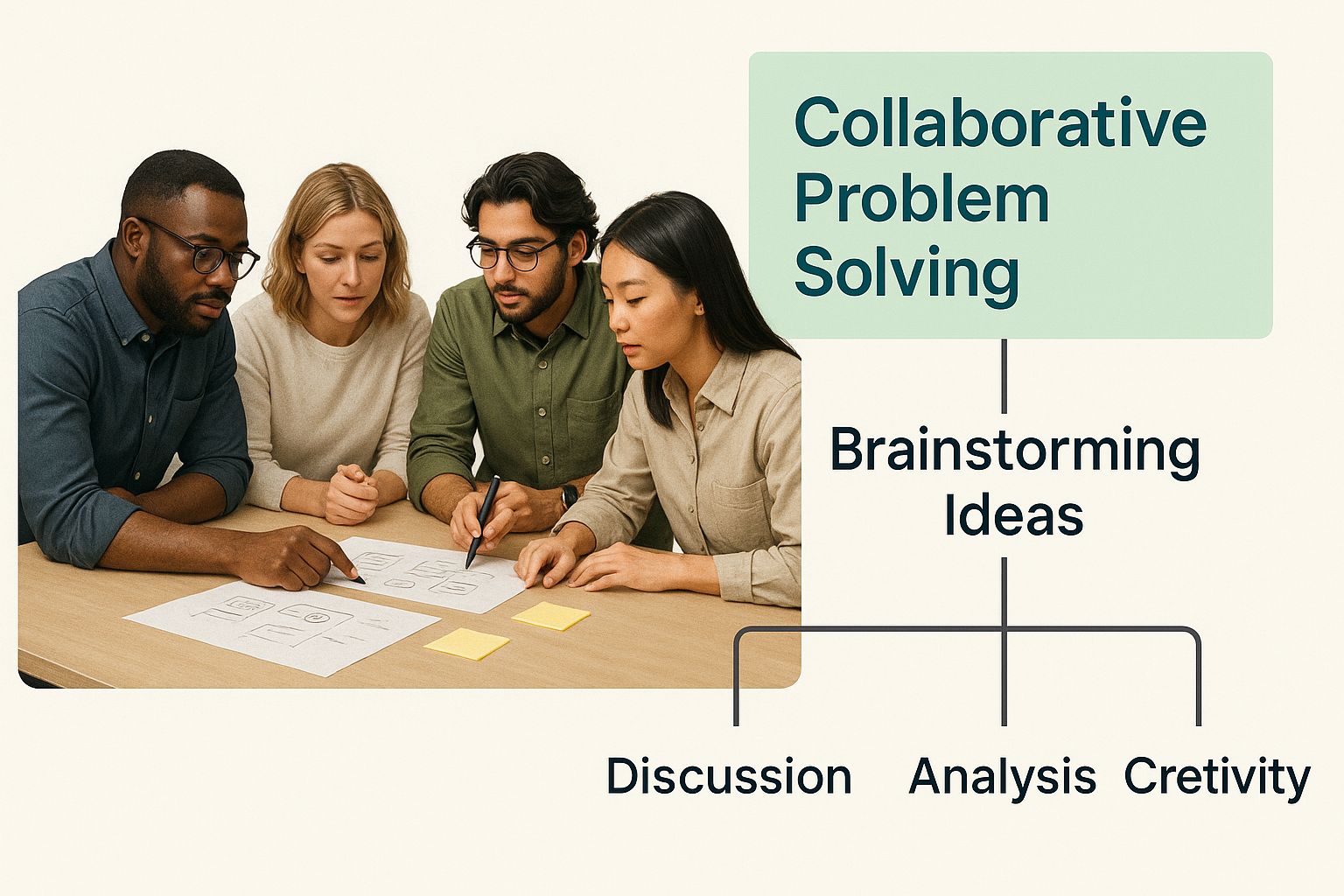
This process is all about creating an environment where different ideas can collide and spark something new. The journey—how the team arrives at the solution—is just as important as the solution itself.
To break it down even further, here's a quick look at the three pillars that hold up any successful collaborative effort.
Core Components of Collaborative Problem Solving
| Pillar | Purpose | Key Activities |
|---|---|---|
| Establishing Shared Understanding | To ensure everyone is on the same page and working toward a unified goal. | Defining the problem together, setting clear objectives, and identifying all constraints and resources. |
| Taking Coordinated Action | To actively work together to explore, develop, and refine potential solutions. | Brainstorming ideas, assigning roles based on strengths, and running experiments or building prototypes. |
| Negotiating and Communicating | To maintain group cohesion and navigate the inevitable disagreements and challenges. | Giving and receiving constructive feedback, resolving conflicts, and adapting the plan based on new information. |
Each pillar supports the others. Without a shared goal, action is chaotic. Without coordinated action, good ideas go nowhere. And without great communication, the whole thing falls apart.
At the end of the day, collaborative problem solving is about a fundamental shift in mindset.
The goal is to move beyond a "divide and conquer" mentality toward a "unite and create" approach. This distinction is crucial because true CPS produces outcomes that are fundamentally different—and often better—than what individuals could achieve on their own.
Grasping this concept is the first real step toward building teams that can tackle the messy, modern challenges we all face, whether it’s in business, science, or our own communities.
The Three Pillars of Effective CPS
Collaborative problem solving isn't just a fluffy term for "teamwork." It’s a real discipline built on three core pillars. Think of it like a three-legged stool—if one leg is wobbly, the whole thing topples over. For CPS to work, you need a balanced mix of Social Skills, Cognitive Skills, and Process Management.
Each pillar represents a critical skill set a team needs to bring to the table. They aren't just nice-to-haves; they're what turn a group of smart individuals into a high-functioning problem-solving machine.
Let's break down what each one looks like in practice.
The Social Pillar: Communication and Cohesion
This first pillar is all about people. It’s the human element that governs how we interact, share ideas, and work through the friction that’s bound to pop up in any group project. Social skills are the oil that keeps the gears of collaboration turning smoothly.
Without them, even a room full of brilliant minds can grind to a halt.
Key components of the social pillar include:
- Active Communication: This is more than just talking—it's about listening to actually understand what someone is saying, clearly articulating your own thoughts, and making sure everyone feels heard.
- Conflict Resolution: Disagreements aren't just expected; they're often a sign of a healthy team. This skill is about turning those differences of opinion into productive debates instead of personal attacks.
- Shared Awareness: This is the team's "spidey sense." It’s the ability to read the room, notice when a teammate is struggling, or recognize when the group is getting off track and needs to reset.
Imagine a marketing team brainstorming a new ad campaign. They're using social skills when they debate taglines without anyone getting defensive, building on each other's ideas until the best one emerges. This foundation of psychological safety is what allows people to take creative risks.
The Cognitive Pillar: Critical Thinking and Creativity
While social skills keep the team connected, the cognitive pillar provides the brainpower. This is where the real analytical work gets done. Cognitive skills are the tools the team uses to take a problem apart, look at it from all angles, and build an innovative solution.
These abilities are what push a group beyond the easy, obvious answers to find something truly insightful.
This approach has a lot in common with student-centered learning, which encourages active thinking over just memorizing information. You can read more about it in our guide on what is student-centered learning.
The Process Pillar: Structure and Direction
Great ideas and great attitudes don’t mean much without a plan. The third pillar, process management, is the roadmap that guides the team from the initial problem to a finished solution.
It's the structure that keeps everyone on track, focused on the goal, and accountable for their part. This involves planning the work, checking in on progress, and being ready to change course if something isn’t working. It’s what makes sure all that collaborative energy leads to real, tangible results.
Why CPS Is a Critical Modern Skill
As routine jobs get handed over to automation, the skills that make us uniquely human are becoming more valuable than ever. Collaborative problem solving (CPS) isn't just another soft skill to pad a resume anymore—it’s a core competency for anyone who wants to succeed in today's complex, interconnected world. It's the engine that powers real innovation.
An algorithm can crunch data at incredible speeds, but it can’t replicate the magic that happens when a diverse team gets together to tackle a tough problem. That messy, brilliant process of debating ideas, building on each other's insights, and creating something no single person could have imagined alone? That's fundamentally human, and it's where the real breakthroughs happen.
Measuring a Crucial Competency
But how do we know if we're actually good at this? Recognizing its growing importance, the Program for International Student Assessment (PISA) rolled out its first-ever collaborative problem-solving test back in 2015. The results were eye-opening. They revealed a huge gap between individual academic smarts and the ability to work effectively in a group.
Take the United States, for example. While ranking 39th in math, its students jumped up to 13th place in CPS. On the flip side, students in parts of mainland China ranked 6th in math but dropped to 26th in collaborative problem solving. The lesson here is clear: being a star student in traditional subjects doesn't automatically make you a great collaborator. You can dive deeper into the PISA assessment on collaborative skills to see the full picture.
The PISA study uncovered a sobering global statistic: a mere 8% of students could handle complex problems while successfully managing group dynamics. This points to a massive skills gap we need to address.
This data is a wake-up call for educators and business leaders alike. We can't just assume that putting a bunch of smart people in a room will lead to success. Building true collaborative skill takes intentional practice, the right tools, and a supportive environment.
Cultivating Collaboration in Education
To close this gap, schools have to get proactive about teaching these skills. This means moving past rote memorization and designing learning experiences that require students to talk, negotiate, and reason together. It’s about teaching them how to think as a team, not just what to think as an individual.
The good news is, there are plenty of proven ways to build these abilities right in the classroom.
- Structured Group Projects: Design tasks where every student’s contribution is truly essential. No one can sit on the sidelines; the project succeeds or fails as a group.
- Role-Playing Scenarios: Use simulations to let students practice tough conversations, active listening, and conflict resolution in a low-stakes setting.
- Digital Collaboration Platforms: Modern tech offers incredible ways for students to work together, share ideas, and see their collective progress. You can explore some of the best educational technology tools for teachers to get started.
By focusing on these practices, we can equip the next generation with the tools they need to solve the messy, complex challenges of tomorrow. After all, the ability to solve problems with others isn't just a work skill—it's a life skill.
Blending Individual Smarts with Group Synergy
Ever been in a meeting where one person dominates, thinking they're the smartest in the room? That’s not how real breakthroughs happen. In collaborative problem solving, the magic isn't about having one genius—it’s about what happens at the intersection of individual smarts and dynamic group interaction. This process blends independent thinking with a kind of interactive energy, creating something far greater than anyone could achieve alone.
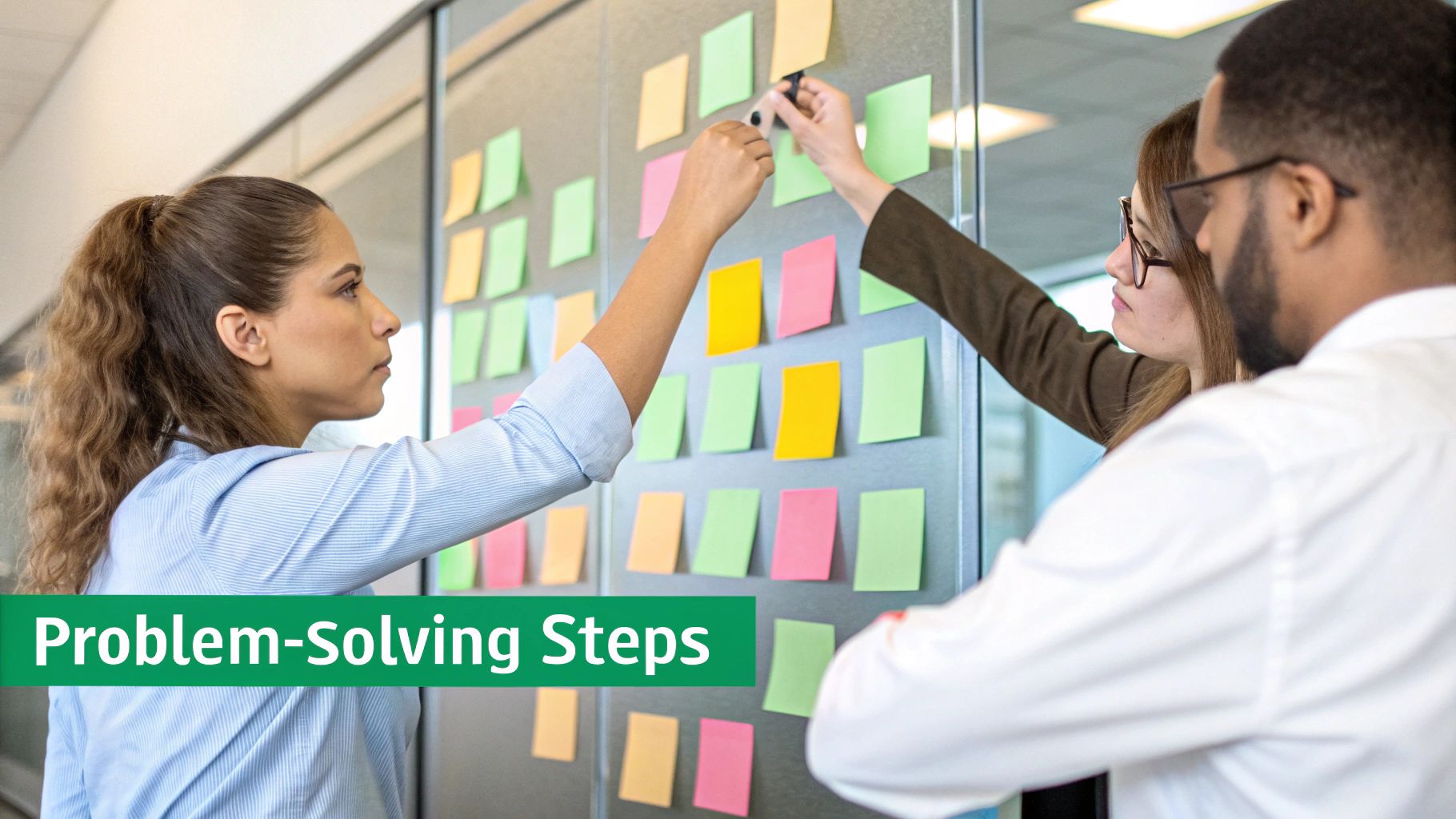
Think of it like building a high-performance engine. Foundational strengths in subjects like science, reading, and math are the high-quality parts—the pistons, the gears, the circuits. These individual skills are the essential building blocks. One person's ability to analyze data, another's knack for understanding complex texts, or a third's logical reasoning—these are the raw materials.
But a pile of parts doesn't make an engine roar to life. That's where social and communication skills come in. They are the skilled hands that assemble the pieces, the technical manual guiding the construction, and the oil that keeps everything running smoothly. Things like shared reasoning, active listening, and negotiation are the forces that transform individual knowledge into powerful, collective intelligence.
The Synthesis of Thinking and Interacting
Collaborative problem solving isn't just about parallel processing, where everyone works on a different piece of the puzzle alone. It’s an integrated approach where individual insights are constantly shared, challenged, and refined by the group. This creates a positive feedback loop: one person's idea sparks another's, leading to solutions no single member could have cooked up on their own.
A 2017 OECD report drove this point home, emphasizing that this skill is a fusion of both social and cognitive abilities. Their research found a strong link between a student's performance in core subjects and their ability to solve problems collaboratively. Yet, it required an extra, distinct skill set focused on communication and coordination. You can explore the full OECD findings on collaborative skills to dig into the data yourself.
This really highlights a critical point: strong academic knowledge is necessary, but it’s not enough. You need both the intellectual horsepower and the collaborative finesse to turn that potential into real results.
In collaborative problem solving, the group’s collective intelligence isn't just an addition of individual IQs. It's a multiplication of skills, where social competencies act as the critical multiplier, amplifying the impact of each person's knowledge.
Understanding Key Group Dynamics
That same OECD assessment uncovered some fascinating social dynamics, with one standing out: gender differences. Across all participating countries, girls significantly outperformed boys in collaborative problem solving. This suggests that certain social learning styles and communication habits might just be more effective for great collaboration.
This finding encourages us to look closer at what makes group interactions click:
- Empathy and Perspective-Taking: The ability to genuinely understand and consider a teammate's viewpoint, especially when it’s different from your own.
- Constructive Communication: The practice of sharing ideas clearly and respectfully, while giving feedback that builds on others' contributions instead of tearing them down.
- Shared Responsibility: A collective sense of ownership over the process and the outcome, where every person feels accountable for the group's success.
Ultimately, mastering collaborative problem solving means getting good at both sides of the coin. It's about being sharp enough to bring valuable insights to the table and socially skilled enough to weave those insights into a coherent, powerful, and unified solution with others.
How to Cultivate Stronger Collaboration Skills
Knowing the theory is one thing, but putting collaborative problem solving into practice is where the magic really happens. Developing these skills isn't about memorizing a textbook. It’s about intentionally creating an environment where a group can think, build, and solve problems as a single unit.
This requires a careful touch from facilitators, whether they're teachers in a classroom or leaders of a team.
The real art is guiding the process without dictating the outcome. Think of a great facilitator as a conductor, not a soloist. Their job is to make sure every instrument gets to play its part beautifully. They set the stage, ask the right questions to get people thinking, and keep the team on track—but they let the group find its own rhythm and create its own solutions.
Research backs this up, showing that the timing and type of support a facilitator provides are critical. The wrong kind of help, or even help offered at the wrong time, can actually get in the way of a group learning to collaborate on its own. The trick is to provide just enough structure for their thinking while giving them the freedom to interact. This is a powerful way to make learning effective and engaging, a concept we explore in our guide on how to make learning fun.
Practical Strategies for Building CPS Skills
You don't need complicated theories to build a collaborative culture. It really comes down to implementing a few specific, actionable habits that promote open communication and shared responsibility. These are simple yet powerful techniques you can introduce to any team or classroom.
Here are a few strategies you can start using today:
- Define Clear Roles: Assign simple roles like "Timekeeper," "Note-Taker," or even "Devil's Advocate." This gives everyone a specific job and prevents one or two loud voices from dominating the conversation.
- Practice Active Listening: This one is huge. Encourage team members to paraphrase what someone else said before they share their own point. It confirms understanding, cuts down on miscommunication, and makes people feel genuinely heard.
- Use Structured Brainstorming: Instead of a chaotic free-for-all, try a method like round-robin brainstorming. Each person contributes one idea at a time, going around the circle. This gives quieter folks an equal shot to share their thoughts without being interrupted.
The point of these structures isn't to kill creativity. It's to build a psychologically safe space where every single person feels empowered to contribute their best ideas without fear of being judged.
Avoiding Common Collaboration Pitfalls
Even with the best intentions, group projects can easily go off the rails. Just knowing what the common pitfalls are is the first step toward avoiding them and building a more resilient, high-performing team.
One of the biggest hurdles is the fear of healthy debate. When a team avoids constructive conflict, it almost always settles for the safest and least innovative ideas. This is a classic case of "groupthink." Encouraging respectful disagreement is absolutely essential for stress-testing ideas and finding the best possible solution.
Another common roadblock is the leader who accidentally smothers the conversation. Real collaborative leadership means knowing when to step back and create space for others to shine. This takes confidence and a focus on the team's success over any one person's ego, laying the groundwork for true collaborative problem solving.
Common Questions About Collaborative Problem Solving
Embedded content
Even when you get the core idea, putting collaborative problem solving into practice brings up a lot of questions. Let’s walk through a few of the most common ones to clear up any confusion and give you a better feel for how it works in the real world.
These answers should help you handle the subtleties of bringing this powerful approach to your team.
How Is Collaborative Problem Solving Different from Teamwork?
This is a great question because the two are easily confused. While all collaborative problem solving is definitely a form of teamwork, not all teamwork is collaborative problem solving. The real difference is in how the team interacts and creates together.
Typical teamwork often uses a "divide and conquer" strategy. A project gets broken down, tasks are handed out, and everyone goes off to do their own part. The pieces are then stitched together at the end. It's like building a bookshelf where one person builds the frame while someone else assembles the drawers—they're working in parallel, but not necessarily together.
Collaborative problem solving is much more tangled and dynamic. It requires constant back-and-forth, shared thinking, and building on each other's ideas in the moment. The group creates a solution that no single person could have come up with on their own. The focus isn't just on working in parallel; it's about thinking together.
What Are the Biggest Challenges in Collaborative Problem Solving?
For all its benefits, this approach isn't always easy. It comes with a unique set of hurdles, and the best teams are the ones who learn to navigate them effectively.
Here are the most common roadblocks:
- Poor Communication: This is the classic pitfall. Ideas get lost in translation, feedback isn't delivered well, or people just aren't on the same page, leading to frustration and wasted time.
- Dominant Personalities: When one or two people do all the talking, it shuts down other valuable perspectives. Quieter team members have great ideas, but they get drowned out.
- Social Loafing: You've probably seen this one. It’s when a few people sit back and let others do the heavy lifting, which kills morale and creates resentment.
- Fear of Healthy Conflict: To avoid rocking the boat, teams sometimes shy away from constructive debate. This leads to "groupthink," where everyone agrees on a weak idea just to keep the peace.
Getting past these issues means setting clear ground rules, having a good facilitator to manage group dynamics, and building a culture of psychological safety where everyone feels they can speak up without fear.
The goal is to build an environment where open debate is seen as a tool for strengthening ideas, not as a personal attack. This shift in perspective is vital for true collaboration.
Can Collaborative Problem Solving Skills Be Taught?
Absolutely. This is probably the most important thing to understand. Collaborative problem solving isn't some magical talent you're born with—it’s a collection of teachable skills.
Think of it like learning to play guitar or a new sport. You get better with focused practice and the right kind of training. Any team can systematically improve these abilities.
For instance, you can use structured group projects that force people to negotiate roles and share the load. Role-playing exercises are great for building confidence in navigating tough conversations or disagreements. Even a workshop on active listening can make a huge difference in how a team communicates.
The key is to apply these skills consistently. Organizations that weave collaborative challenges into their regular work and training see a huge jump in their teams' ability to solve tough problems together. It's a muscle that gets stronger every time you use it.
At EarthChasers, we believe in the power of learning through exploration and interaction. Our 3D geography game is designed to bring people together to discover the world in a fun, engaging, and collaborative way. Start your adventure and see how much you can learn when you explore together.