
world geography curriculum homeschool: A Complete Guide
world geography curriculum homeschool: Discover teaching styles, hands-on activities, and digital tools to engage your family.
Building a world geography curriculum homeschool plan is about so much more than memorizing capitals. It's about handing your child a lens to understand the entire world—a framework that builds empathy, sharpens their critical thinking, and gets them ready for a deeply interconnected future.
Why Geography Is Essential for Your Homeschool
If you're like me, you might remember geography as a dry subject—a blur of maps and lists of countries. But when you reframe it, geography is really the "operating system" for understanding just about everything. It answers the "why" behind the "where," connecting people, places, and environments in a way that just makes sense.
A solid world geography curriculum doesn't just teach facts; it cultivates a global perspective. It helps kids see how a monsoon in Southeast Asia can impact the price of rice on their dinner table or how ancient trade routes shaped the cities we know today. This big-picture view is what turns them into informed and compassionate global citizens.
More Than Just Maps
The real magic happens when geography tells a story. When students learn not just that the Amazon rainforest exists, but how it influences the world's climate and supports unique cultures, the information actually sticks. This narrative approach turns learning from a chore into a genuine exploration.
That's why modern homeschooling is all about blending geography with other subjects. When you weave it into history, literature, and cultural studies, engagement and comprehension skyrocket. It's about sparking environmental awareness and fostering a sense of global connection, turning our kids into curious explorers for life.
Fostering Empathy and Critical Thinking
One of the most powerful outcomes of studying geography is the empathy it builds. By exploring how different communities adapt to their surroundings—whether it’s the Arctic tundra or a bustling city—children learn to appreciate diverse ways of life. Understanding the "why" behind different cultural practices is a key part of what cultural geography is (you can read more on that here: https://earthchasers.com/blog/what-is-cultural-geography), and it's a skill they'll carry with them forever.
This journey also makes them better thinkers. They learn to look at a map and ask deeper questions:
- Why did this city pop up here and not over there?
- How does this river system shape farming and trade for an entire region?
- What are the ripple effects of this area's natural resources?
Ultimately, fostering a love for geography delivers huge lifelong learning benefits. It gives kids a foundation of curiosity, encouraging them to ask thoughtful questions and see the connections in the world around them long after they've finished their formal schooling. You're not just teaching them about the world; you're setting them up for a richer, more engaged understanding of our planet.
Finding Your Family's Geography Teaching Style
Picking a world geography curriculum for your homeschool can feel like you're standing in a massive library, totally overwhelmed. Where do you even start? The secret isn’t finding the one “best” curriculum—it’s about finding the one that fits your family’s natural rhythm.
Think of it like finding the right pair of hiking boots for a long trek. What works for one person could be a disaster for another. Every family has its own teaching style. Some kids are drawn to big stories, while others need structure and facts. Figuring out what clicks for you is the first step to building a geography plan that’s exciting, not exhausting.
Let’s walk through some of the most popular approaches to see which one feels like home.
The Literature-Based "Living Books" Approach
This philosophy, made famous by educator Charlotte Mason, ditches dry textbooks in favor of incredible stories, biographies, and compelling narratives. It’s all about learning through what she called “living books.”
Imagine learning about the Andes Mountains not from a list of elevations, but by following a character on an adventure through Peru. This method makes places and cultures come alive.
- Core Idea: Kids connect deeply with information when it’s wrapped in a great story. Geography becomes part of the human experience.
- Best For: Imaginative learners who love to read and soak up information through characters and emotional connection.
- Potential Challenges: This approach can be less structured. You’ll often need to piece together resources yourself to make sure you’re hitting all the key geographical concepts.
The Immersive Unit Study Method
Unit studies are a fantastic way to go all-in on a single topic. You don’t just learn about a place; you experience it from every angle.
Let’s say you’re doing a unit on Japan. You wouldn’t just pull out a map. You’d cook Japanese food (culture), try your hand at haikus (literature), build a model of a pagoda (art and engineering), and study the Pacific Ring of Fire (physical geography).
This approach shows how geography is woven into every part of life. It’s a powerful way to make learning stick, especially for families with kids of different ages who can all join in at their own level.
You’re not alone in loving this style. The global homeschooling community has increasingly embraced unit studies for geography because they work so well for family-style learning. Some curriculum companies now build their entire programs around this idea, creating materials where a 1st grader and a 6th grader can explore the same topic together.
The Classical Education Model
The classical model is all about structure, following a three-stage process called the Trivium. It’s a very intentional, step-by-step way of building knowledge over time.
For geography, it looks like this:
- Grammar Stage (Elementary): This is the memorization phase. Kids learn the "what"—countries, capitals, oceans, and major landforms.
- Logic Stage (Middle School): Now they ask "why." Why are major cities located on rivers? Why is this region a desert? They start connecting the facts.
- Rhetoric Stage (High School): Finally, they learn to express and debate. This is where they might discuss complex global issues or the geopolitical importance of a region.
This style is perfect for families who appreciate a rigorous, time-tested framework that builds a rock-solid foundation of knowledge.
The Digital-First and Game-Based Path
Let’s be honest—we have some incredible tools at our fingertips. A digital-first approach uses things like interactive maps on Google Earth, educational games like EarthChasers, and amazing online videos to make learning dynamic.
Why just read about the Great Barrier Reef when you can take a virtual scuba dive through it?
This method is a game-changer for visual learners and any kid who needs to do something to learn. Gamification, especially, can turn memorizing countries and capitals from a chore into a thrilling challenge. The key is finding high-quality resources that are genuinely educational, not just a distraction.
Before you decide, it helps to see these styles side-by-side. Every approach has its strengths, and knowing them can help you find the perfect match for your homeschool.
Comparison of Homeschool Geography Curriculum Styles
| Curriculum Style | Core Philosophy | Best For Learners Who... | Potential Challenges |
|---|---|---|---|
| Living Books | Learn through compelling stories and narratives. | Love reading, are imaginative, and connect with emotional context. | Can be less structured; may require more planning to ensure full coverage. |
| Unit Studies | Explore one topic deeply from multiple subject angles. | Are hands-on, creative, and thrive in multi-age family learning settings. | Can be time-intensive to prepare and may have gaps if not planned carefully. |
| Classical | Build knowledge systematically through a three-stage (Trivium) process. | Are logical, appreciate structure, and benefit from a fact-first approach. | The early memorization stage may feel dry for some creative learners. |
| Digital/Game-Based | Use interactive tools, games, and technology to explore the world. | Are visual, tech-savvy, and motivated by interactive challenges. | Requires careful screening to ensure educational quality over entertainment. |
Ultimately, the best homeschool geography curriculum isn't something you buy off a shelf—it's something you build. You might even find that blending a few of these styles works best. Maybe you use a classical approach for your core facts but bring it to life with living books and fun geography games. Trust your gut and choose the path that will spark the most curiosity for your kids.
Building a Comprehensive Geography Curriculum
So, what’s the secret to turning a pile of maps and facts into a world geography curriculum homeschool experience that actually sticks? It’s all about building a framework that connects the dots—showing your kids not just what the world looks like, but how it all works together. A truly great curriculum stands on four essential pillars.
Think of it like building a house. You need a solid foundation (Physical Geography), the walls and rooms where people live (Human Geography), a detailed blueprint to make sense of it all (Cartography), and the utilities connecting your home to the wider world (Global Connections). Leave one out, and the whole structure feels wobbly and incomplete.
The Four Pillars of Geography
A robust geography plan doesn't just teach one thing at a time; it weaves these four big ideas together. This approach creates a rich, multi-layered understanding that can grow right alongside your child.
- Physical Geography: This is the nuts and bolts of planet Earth—its mountains, rivers, climates, and ecosystems. It answers the "why" behind the landscape, like why deserts pop up where they do or how volcanoes forge brand-new islands from the sea.
- Human Geography: This pillar is all about people. It explores where and how we live, covering everything from cultures and populations to cities and economies. It's the story of humanity's footprint on the planet.
- Cartography: This is so much more than just reading maps. It’s the art and science of making and understanding them. It teaches spatial reasoning, helping kids grasp scale, symbols, and how information is presented visually.
- Global Connections: Here’s where everything clicks into place. This pillar examines how people, ideas, and goods move across the globe. We’re talking international trade, migration, communication, and big shared challenges like climate change.
For a solid overview of how to structure your home education plan from the ground up, this UK homeschooling curriculum guide is a great resource. It can help you get the foundational planning right before you start building on these pillars.
Progressing Through the Ages
A successful homeschool geography plan isn't a one-and-done binder. It should evolve as your child matures, revisiting the same core concepts with more depth and complexity each time. This "spiral" approach keeps knowledge fresh, constantly reinforcing and expanding on what they already know.
This infographic breaks down a few ways you can adapt these concepts for any age group.
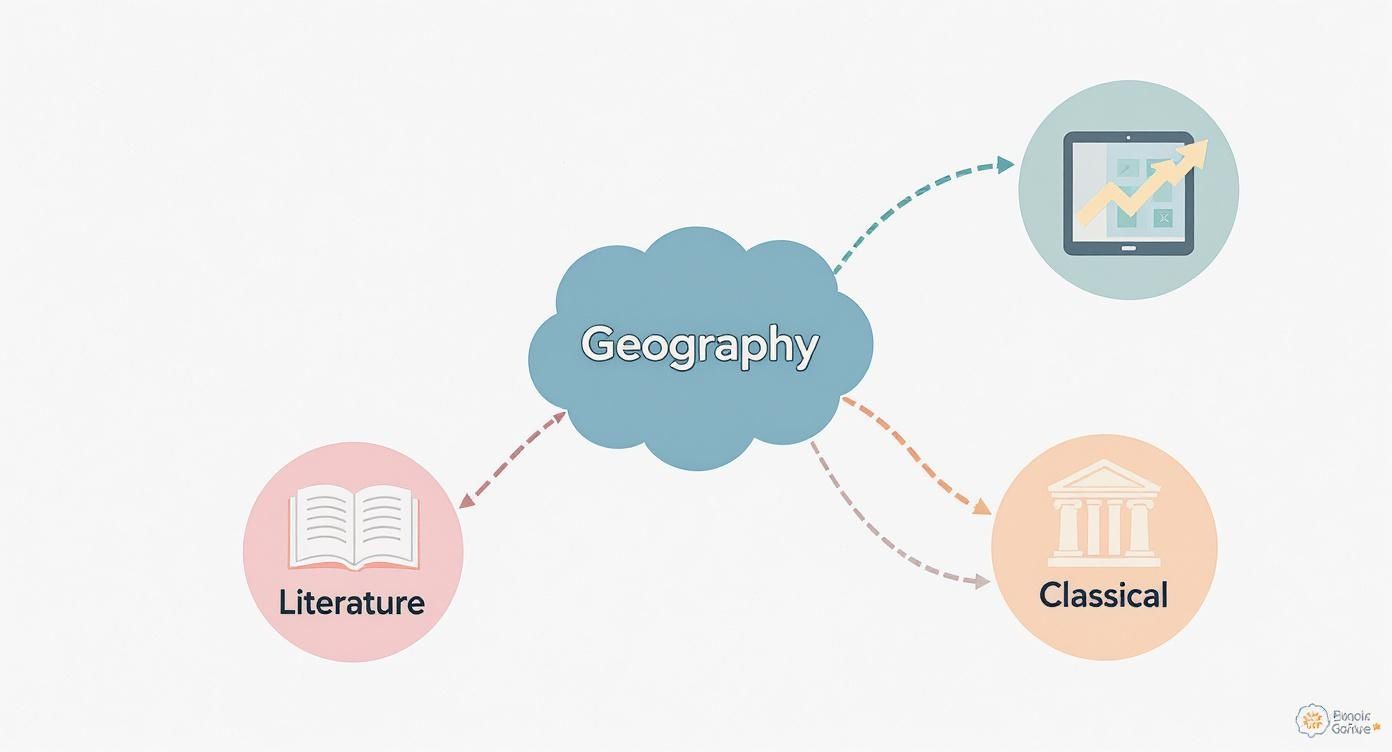
As you can see, whether you're using classic literature or jumping into digital tools, the core geographical ideas can be tailored to fit your family's unique style.
Elementary School (Ages 5-10)
The early years are all about sparking wonder and curiosity. Your main goal is to build a basic sense of place and introduce big ideas in a fun, tangible way.
- Physical: Start with the seven continents and four oceans. Get your hands dirty by making a simple salt dough map to feel the difference between mountains and plains.
- Human: Explore holidays and foods from around the world. Reading folk tales from different cultures is a fantastic way to build empathy and curiosity.
- Cartography: A classic "Me on the Map" activity is perfect here. Start with their bedroom, then their house, street, city, and so on, all the way out to the planet. Don't forget the compass rose!
Middle School (Ages 11-14)
This is when kids start connecting ideas and asking "why?" Now’s the time to shift from simple identification to real analysis, exploring the relationship between people and their environments.
- Physical: Go deeper into climate zones, biomes, and the powerful forces that shape our world, like tectonic plates and erosion. Study major river systems and see how they gave rise to entire civilizations.
- Human: Introduce concepts like population density, urbanization, and the basics of how natural resources drive economies.
- Global Connections: Look at how ancient trade routes like the Silk Road sparked massive cultural exchange, and then compare that to how technology connects our modern world.
The real magic at this stage is showing how physical and human geography are two sides of the same coin. A lesson on the Nile River, for example, is pretty flat without discussing how it was the lifeblood of ancient Egyptian civilization. Weaving these threads together keeps learning from feeling disconnected.
High School (Ages 15-18)
High school geography is about preparing students for informed global citizenship. The curriculum should dive into complex, real-world issues that demand critical thinking and nuanced discussions.
- Physical: Analyze complex environmental challenges like climate change, deforestation, and water scarcity. Go beyond the headlines to understand their scientific causes and real-world impacts.
- Human: Dig into geopolitics, modern migration patterns, and the complexities of economic development across the globe. Explore how our cultural identities are shaped by—and also shape—our geography.
- Cartography: Introduce the basic concepts behind Geographic Information Systems (GIS). Show them how data mapping is used in everything from city planning to disaster relief.
By layering these concepts over the years, your world geography curriculum homeschool plan becomes more than a checklist of topics. It becomes a continuous, enriching conversation about our incredible and deeply interconnected world.
Using Digital Tools to Explore the World
Embedded content
Flat maps and dusty textbooks have their place, but let's be honest—today's digital tools can take a world geography curriculum homeschool plan from a simple subject to a full-blown adventure. Why just read about the Amazon River when you can fly over its entire winding path? Instead of just memorizing a city's name, your kids can actually wander its virtual streets.
Used the right way, technology turns abstract ideas into experiences you can almost touch. It closes the gap between knowing a place exists and truly feeling what it's like. This isn't about ditching hands-on learning; it’s about giving it a massive boost, making geography a living, breathing subject that grabs a child's imagination and doesn't let go.
Taking Virtual Field Trips Across the Globe
The virtual field trip is one of the most powerful arrows in your quiver. With tools like Google Earth, you can instantly transport your homeschool from the kitchen table to almost anywhere on the planet. This shifts learning from passively reading to actively exploring.
Imagine you're studying the Roman Empire. You could start by reading about the Colosseum, and then—bam!—you're "standing" right inside it, looking around in 360 degrees. That kind of spatial context makes history and geography click in a way a textbook photo never could.
The secret is to make these trips purposeful. Don't just wander aimlessly. Give your child a mission: find three specific landmarks, trace an ancient trade route, or compare the layout of a coastal city with a mountain village. Suddenly, screen time becomes a focused, educational quest.
These tools are also amazing for wrapping your head around tricky concepts. You can tilt the globe to finally understand the seasons, zoom in on a volcano to see its raw topography, or follow a river from its tiny source all the way to the sea. The ability to manipulate and interact with the world is a total game-changer.
Gamifying Geography for Deeper Learning
Let's face it: games are fantastic for making practice feel like play. When it comes to geography, gamification can turn the chore of memorizing locations, flags, and capitals into a challenge your kids actually want to take on.
Tons of online games and apps use leaderboards, timed quizzes, and fun visuals to light a fire under learning. A child might spend an hour trying to beat their high score in a continent-labeling game, soaking up dozens of facts without even realizing they're "studying." It taps right into their natural desire to compete and achieve.
- Mapping Games: These challenge players to pinpoint locations on a map, which is huge for building a strong mental map of the world.
- Trivia Challenges: Quizzes on cultural facts, famous landmarks, and physical features are perfect for broadening their knowledge base.
- Exploration Games: Titles like our own EarthChasers are built around discovery, making learning about diverse landscapes and cultures part of an exciting adventure.
Choosing High-Quality Digital Resources
We're seeing a huge shift in how geography is taught at home. Programs like Starry Night and Layered Earth offer interactive 3D simulators and detailed globe data that go way beyond old-school books. With features like adaptive learning and built-in games, these tools are creating much more engaging experiences for students of all ages. You can see how they stack up by checking out resources like this 2025 homeschool curriculum buyers guide.
This screenshot from a popular guide gives you a sense of just how many digital options are out there now.
It's clear that digital learning isn't just a side dish anymore—it's becoming a main course in modern homeschooling.
Many of these tools also introduce students to advanced concepts in a way that's easy to digest. Some platforms, for instance, use simplified versions of Geographic Information Systems (GIS) to show how data can be layered onto maps. This is a great way to help both you and your student understand what Geographic Information Systems are and how professionals use them to solve real-world problems. By weaving these tools into your curriculum, you're not just teaching facts; you're building real technical literacy and analytical skills for the future.
Bringing Geography to Life with Hands-On Projects
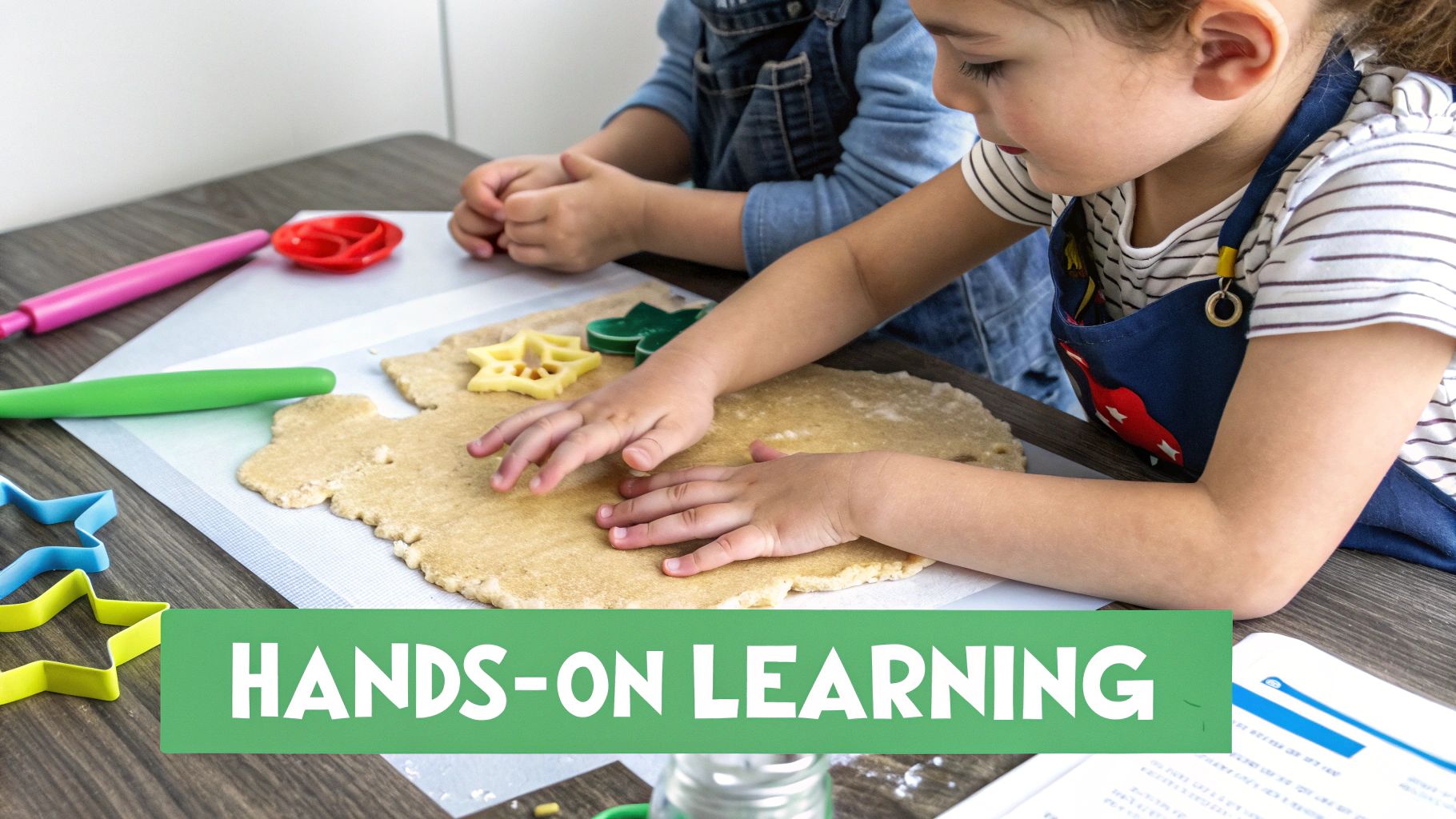
Digital tools are fantastic, but the most powerful lessons often happen away from a screen. A truly great world geography curriculum homeschool plan knows how to balance virtual exploration with tangible, hands-on projects that get all the senses involved.
These activities are what turn abstract concepts into physical memories your kids can see, touch, and even taste.
Think about it like learning to cook. You can watch a hundred videos on baking bread, but you don't really get it until you feel the dough between your fingers. Hands-on geography is the same. It forges a deeper, personal connection to the world and makes knowledge stick in a way that rote memorization never will.
Create an Around the World Kitchen
One of the most joyful ways to dive into a new culture is through its food. Try dedicating one day a week or month to cooking a dish from the country you’re studying. This simple act opens up a universe of conversation.
As you chop and stir, you can talk about native ingredients, the climate needed to grow them, and the story behind the meal. It’s a multisensory lesson that ties together agriculture, culture, and daily life in one delicious, memorable package. For many homeschool families, this becomes a favorite tradition.
Build the World with Salt Dough Maps
Topography can be a tough concept to pull off a 2D map. A salt dough map makes the difference between a mountain range and a river valley perfectly clear because your kids build it themselves.
The process couldn't be simpler: mix flour, salt, and water into a pliable dough. Roll it out over a cardboard cutout of a country or continent, then use your fingers to sculpt mountains, carve out rivers, and flatten plains. Once it’s baked, you can paint it—blue for water, green for lowlands, brown for mountains. Voila, a physical model of the earth.
This is so much more than an arts and crafts project. This tactile experience helps students develop a strong spatial understanding of physical geography. They aren’t just looking at a map; they are physically shaping a landscape, which forges a much stronger mental connection to the information.
Launch a Cultural Exchange
In our hyper-connected world, it's easier than ever to bring global friendships right into your homeschool. Setting up a pen pal exchange or connecting with another family online offers a priceless window into another culture.
This kind of project moves beyond facts and figures. It shows children that kids in other countries have similar hopes and daily routines, even if their surroundings look completely different. A cultural exchange is one of the best ways to foster genuine empathy and global citizenship.
- Pen Pal Programs: Websites that connect students globally offer a safe and structured way to start writing.
- Postcard Swaps: For something simpler, try a postcard exchange. Send cards from your hometown and watch them arrive from all over the world.
- Virtual Show-and-Tell: Hop on a video call with another homeschooling family to share items that represent your respective cultures.
Design Your Own Maps and Flags
Cartography is a huge part of geography, and creating maps from scratch is an amazing way to learn its core principles. You can start small, like a map of your neighborhood, before moving on to fantasy maps for a story or a detailed map of a historical region you're studying.
This project teaches essential skills like using a key, understanding scale, and knowing what a compass rose is for. You can go even deeper with our guide on how to create custom maps, which has plenty of advanced tips.
Likewise, designing a flag for a real or imagined country encourages kids to think symbolically. What colors and shapes best represent the values, history, or geography of a place? It’s a creative exercise that blends art with deep cultural thinking, making your world geography curriculum homeschool feel completely unique.
Designing Your Annual Homeschool Geography Plan
This is where the rubber meets the road—where all those exciting ideas come together to form your family's actual world geography curriculum homeschool plan. Think of this not as a rigid, unchangeable script, but as a flexible roadmap. It’s a guide to make sure you hit the highlights while still leaving plenty of room for those delightful, unexpected detours.
The goal is to create a rhythm, a gentle flow that balances structured learning with the pure joy of discovery. You wouldn't plan a cross-country road trip down to the minute, right? You'd have your main destinations, but you’d also want the freedom to pull over and explore that quirky roadside attraction. That's the spirit we're aiming for.
A Sample Weekly Geography Rhythm
Here's a simple, field-tested structure that works beautifully. You can dedicate one full day to geography or, as many families do, sprinkle these activities throughout your week.
- Monday (Map Day): Kick off the week with the fundamentals. This is the perfect time for a quick textbook reading, a few map drills, or watching a short, engaging video about the region you're studying.
- Wednesday (Digital Dive): Time to power up the devices! Go on a virtual field trip with Google Earth or challenge each other to a game of EarthChasers. This breaks up the week and keeps things feeling fresh and dynamic.
- Friday (Project Day): Let's get our hands dirty! End the week with a memorable, hands-on activity. Maybe you'll cook a regional dish, build a salt dough map of a continent, or chip away at a longer-term project. This is where learning becomes a living, breathing memory.
Assessing Learning Without the Stress
One of the greatest freedoms in homeschooling is ditching the high-pressure tests and quizzes. Assessment shouldn't be about memorizing facts for a test; it should be about discovering what your child has truly absorbed and connected with.
The best assessments are often invisible, woven right into the fabric of your learning. They shine a light on real understanding and personal passion, giving you a much richer picture of your child's progress than any letter grade ever could.
Here are a few of our favorite low-stress ways to see what's sticking:
- Narration: It’s as simple as it sounds. After a lesson, just ask your child to tell you about it in their own words. You’ll be amazed at what this reveals—what they found most exciting, what connections they made, and what they genuinely understood.
- Project Portfolios: Keep a running collection of their work throughout the year. The maps they've drawn, the short reports they've written, photos of their hands-on projects—together, they create a beautiful, tangible record of their learning journey.
- Student-Led Presentations: Flip the script and let them be the teacher. Ask them to prepare a short presentation on any topic that has sparked their interest, whether it's the Amazon rainforest, the construction of the Eiffel Tower, or a specific cultural festival.
At the end of the day, the best plan is a living plan. If a study of the Nile River suddenly sparks a deep fascination with ancient Egypt, lean into it. Spend an extra week or two exploring pyramids and pharaohs. A truly successful world geography curriculum homeschool plan is one that adapts, inspires, and turns discovering the world into your family's next great adventure.
A Few Common Questions
When you're piecing together a geography plan, a few questions always seem to pop up. Here are some quick answers to the most common ones I hear from fellow homeschooling parents.
How Much Time Should We Spend on Geography Each Week?
There’s no magic number here—it really depends on your family's rhythm and your kids' ages. But a great starting point for the elementary and middle school years is two or three times a week, for about 30-45 minutes a pop.
That gives you enough time to dig into a lesson, do a quick map drill, or get your hands dirty with an activity without anyone feeling overwhelmed. Some families prefer to block off one big chunk of time per week, which works great if you're doing a deep dive on a specific country.
Can I Really Teach Multiple Ages at the Same Time?
Absolutely! This is where homeschooling really shines. The trick is to use a "spiral" approach: introduce a big idea to everyone, then give each kid an age-appropriate task.
Let's say you're exploring Brazil together:
- Your younger kids could color the Brazilian flag or learn about the amazing animals in the Amazon rainforest.
- Your older kids could dig into Brazil's economy or research the environmental challenges the Amazon is facing.
Everyone gets to share the core experience, but the depth of the work is right for their level.
The goal is a shared family experience with individualized expectations. You can all journey through the same continent, but what a 7-year-old and a 14-year-old get out of it will (and should!) look very different.
What If I Don't Know Much About Geography Myself?
Then you're in the perfect position to learn! Seriously, you don't need to be an expert to be a fantastic guide. Learning right alongside your kids is one of the best parts of homeschooling.
Just lean on a good curriculum, find some fun resources, and think of yourself as a co-explorer. Your curiosity and enthusiasm are way more important than knowing every single capital city by heart.
Ready to make geography your family's new favorite subject? With EarthChasers, you can explore the globe through friendly competition and awesome adventures. It's the perfect way to bring your world geography lessons to life. Start your global adventure today at EarthChasers!