
Test Your Knowledge with the Countries of Asia Quiz!
Take the countries of asia quiz and challenge yourself with 9 tough questions. Perfect for Asia enthusiasts looking to test their knowledge!
Welcome, geography enthusiasts and curious minds! Asia, the world's largest and most populous continent, is a vibrant tapestry of cultures, histories, and landscapes. From the towering peaks of the Himalayas to the sprawling archipelagos of the Pacific, its diversity is unparalleled. But how well do you truly know the countries that make up this incredible continent? It's time to put your knowledge to the test with our ultimate countries of asia quiz.
This isn't just a simple test of memory; it's an exploration. We have curated a series of questions that go beyond basic capitals and flags, designed to challenge your understanding of Asia's geography, iconic landmarks, and unique national characteristics. Each question is structured to provide not just a challenge but also a learning opportunity, complete with hints and fun facts to expand your knowledge base.
Whether you are a seasoned globetrotter looking to reminisce, a student of world affairs, or someone who enjoys sharpening their map skills, this comprehensive quiz offers a rewarding experience. Prepare to embark on a virtual journey across the vast landscapes of Asia. Let’s see if you can correctly identify everything from the smallest nation to the longest river and earn a perfect score
1. What is the capital of Japan?
This classic question is a cornerstone of any "countries of Asia quiz," serving as an excellent entry point for geography enthusiasts. While seemingly straightforward, it opens the door to a wealth of historical and cultural knowledge about one of the world's most dynamic nations. The answer is, of course, Tokyo, a sprawling metropolis that has been Japan's de facto capital since 1868.
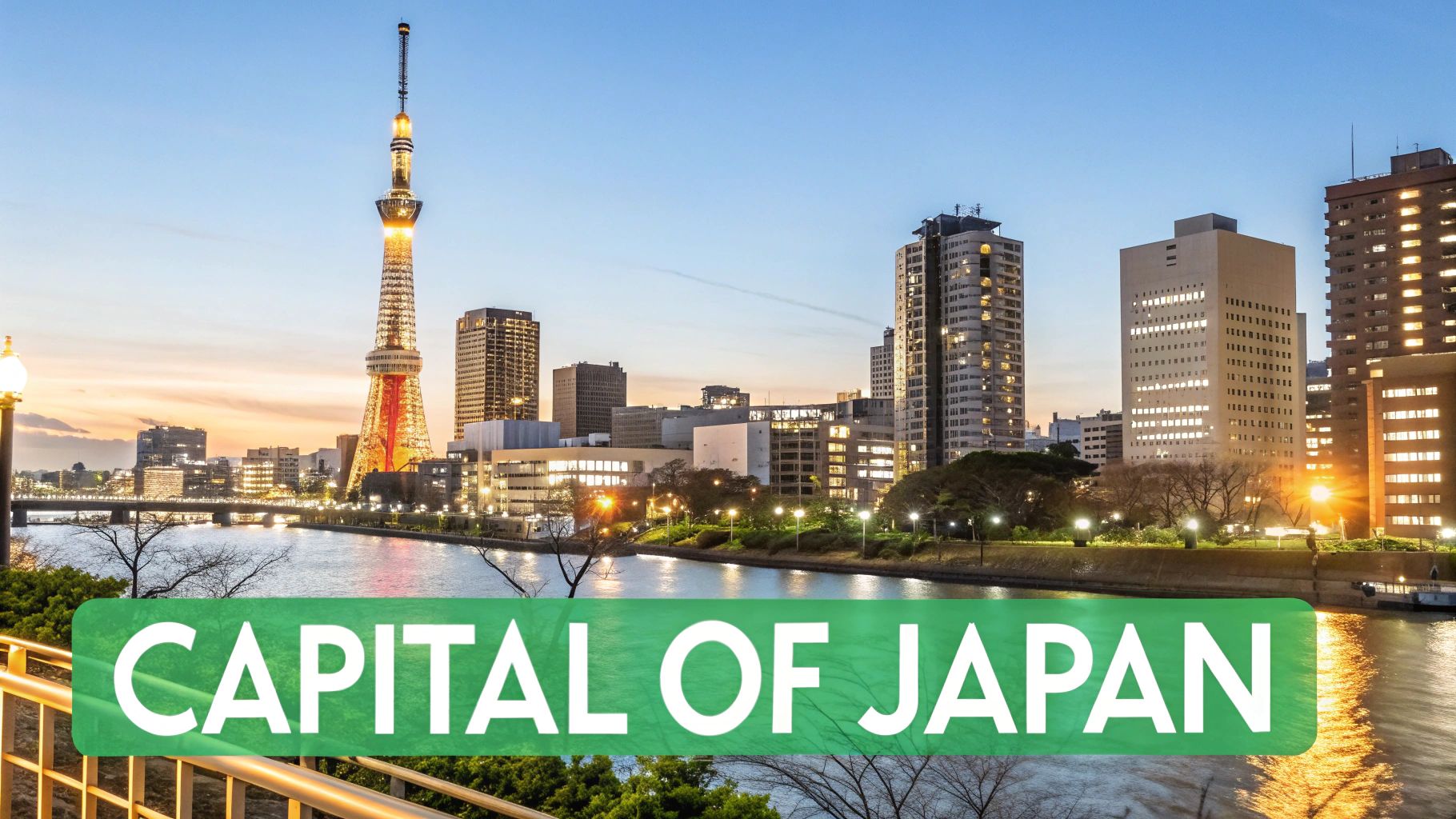
Before the Emperor moved the Imperial Court there during the Meiji Restoration, the city was known as Edo, and the capital was in Kyoto. Today, Tokyo stands as a global powerhouse in finance, technology, and culture, making it a fundamental piece of geographic trivia. After testing your knowledge on the capital of Japan, why not explore an album of Tokyo to see this vibrant city for yourself?
### Difficulty & Variations
- Difficulty: Easy
- Why it's a good question: This question is a perfect warm-up. Its inclusion in countless educational curricula and popular quiz shows like Jeopardy! makes it highly recognizable and accessible to a broad audience, from elementary students to seasoned trivia buffs.
To increase the challenge, consider these variations:
- Historical Twist: Ask, "What was the name of Tokyo before it became the capital of Japan?" (Answer: Edo).
- Comparative Geography: Pose a question like, "Which former Japanese capital is known for its beautiful temples and traditional gardens?" (Answer: Kyoto).
- Demographics: Frame it as, "What is the name of the most populous metropolitan area in the world, which also serves as Japan's capital?" (Answer: Tokyo).
This question is a fantastic starting point for any Asian geography challenge. You can learn more about how to structure similar questions by checking out these geography quiz questions and answers.
2. Which is the largest country in Asia by land area?
This question introduces a fascinating geographical technicality perfect for a "countries of asia quiz," pushing participants to think beyond simple borders. The answer depends on how you frame the question, as it involves the transcontinental giant, Russia. While Russia spans both Europe and Asia, its Asian portion alone is immense, covering approximately 13 million square kilometers. However, if the question specifies the largest country entirely within Asia, the answer is China, with a land area of 9.6 million square kilometers.
The following bar chart provides a clear visual comparison of the land areas of Russia's Asian territory and China, highlighting the scale of these two massive nations.
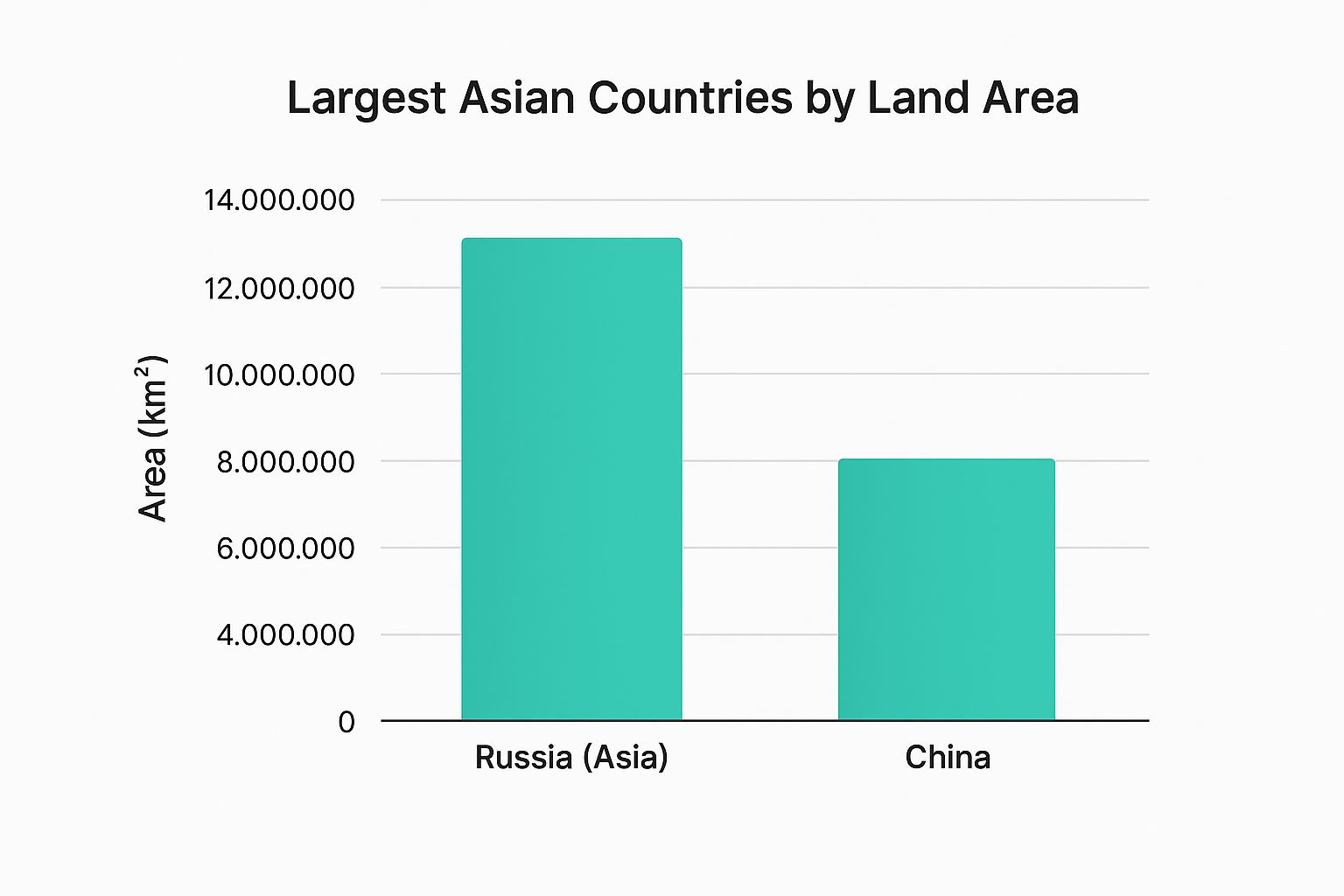
This visualization clearly illustrates that the Asian part of Russia is significantly larger than China, a key detail often overlooked in geography trivia. This distinction makes the question a great test of precise geographical knowledge and is frequently used in advanced geography competitions and university assessments.
### Difficulty & Variations
- Difficulty: Medium to Hard
- Why it's a good question: It tests nuanced understanding rather than rote memorization. The ambiguity surrounding transcontinental countries encourages critical thinking about geographical definitions and the Europe-Asia boundary, making it a staple in international geography olympiads.
To increase the challenge, consider these variations:
- Population Twist: Ask, "Which is the most populous country entirely in Asia?" (Answer: India, having recently surpassed China).
- Clarification: Frame the question precisely, such as, "Excluding transcontinental countries, what is the largest Asian nation by area?" (Answer: China).
- Specific Geography: Pose a question like, "What is the geographical name for the vast Asian part of Russia?" (Answer: Siberia).
3. How many countries are there in Asia?
This question moves from specific capitals to the broader geopolitical landscape, making it a surprisingly tricky entry in any "countries of Asia quiz." Unlike questions with a single, undisputed answer, this one delves into the complexities of international recognition and geographic definitions. The most widely accepted answer is 48 sovereign states, as recognized by the United Nations.
However, the exact number can fluctuate based on the source. Some lists may include transcontinental countries differently or count states with limited recognition, such as Taiwan. This question is a staple in Model United Nations competitions and international relations courses because it forces participants to define their terms and understand the nuances of global politics. It's a fantastic test of a person's understanding of Asia's complex structure.
### Difficulty & Variations
- Difficulty: Medium
- Why it's a good question: It challenges rote memorization and encourages a deeper understanding of what defines a "country." It's an excellent conversation starter that reveals how political and geographical lines are not always clear-cut.
To adjust the difficulty or focus, try these variations:
- Specify the Source: Ask, "According to the United Nations, how many member states are located in Asia?" (Answer: 48).
- Name Game: Use it as a lead-in to a more challenging round, such as, "Name at least 10 of the 48 countries in Asia."
- Geographic Specificity: Frame it as, "Excluding transcontinental countries like Russia and Turkey, how many nations are located entirely within Asia?" (This requires a more specific list).
This question is a great way to gauge a participant's knowledge beyond simple trivia. For a visual aid to this challenge, you can study a printable map of Asia to see all the nations in one place.
4. Which Asian country has the largest population?
This is a fantastic, time-sensitive question for any "countries of Asia quiz" because the answer has recently changed, making it a true test of current events knowledge. For centuries, the undisputed answer was China, but a major demographic shift occurred in 2023. The correct answer, as of 2024, is now India, with a population of approximately 1.44 billion people, narrowly surpassing China's 1.42 billion.
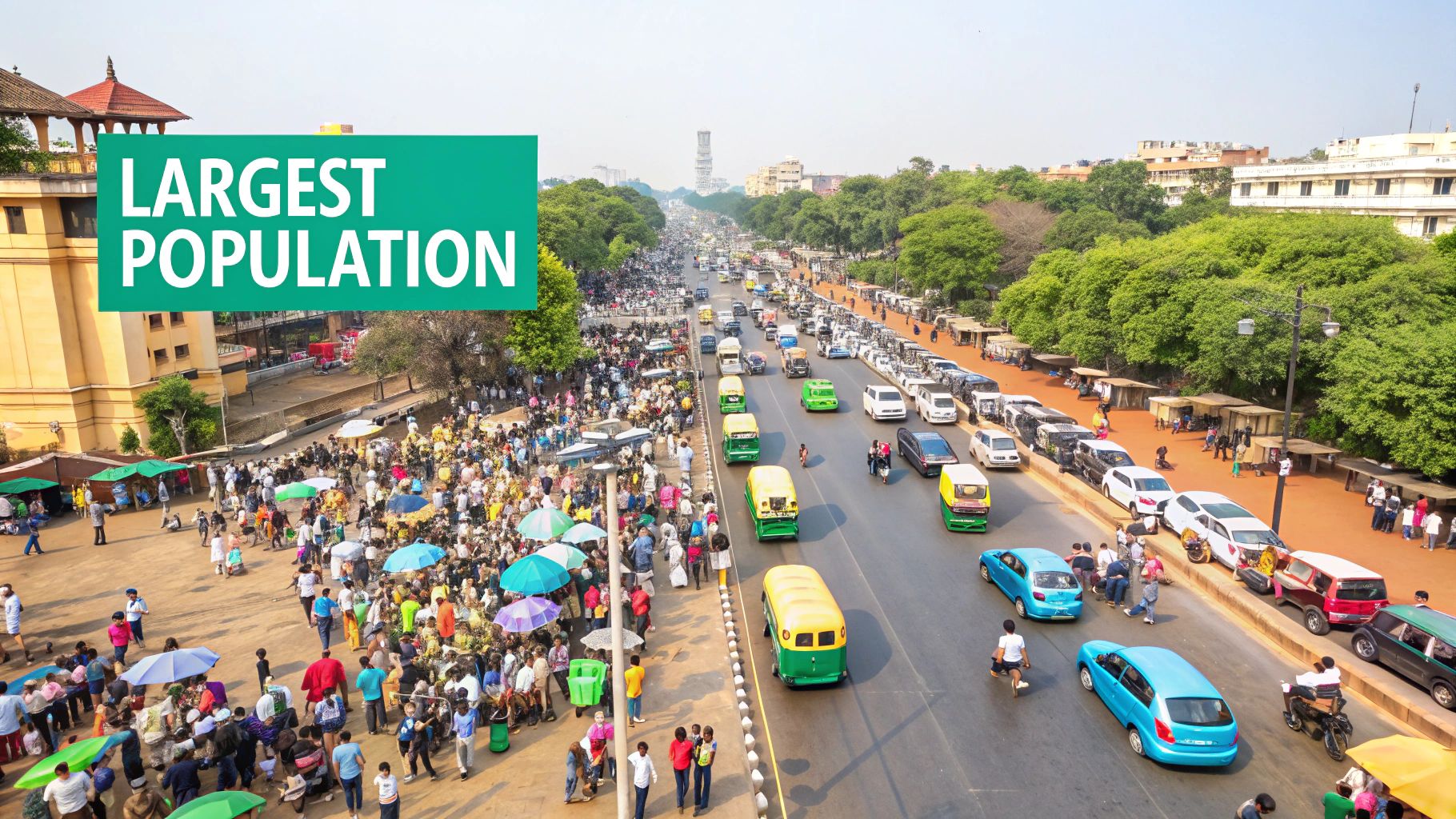
This question is more than just a number; it reflects significant global trends, including differing population growth rates and the long-term effects of national policies like China's former one-child policy. This demographic turning point was widely covered in global news and is a key data point in reports from organizations like the UN Population Division, cementing its place as an excellent and highly relevant quiz item.
### Difficulty & Variations
- Difficulty: Medium
- Why it's a good question: Its recency makes it challenging, filtering out those relying on outdated information. The question is a staple in current affairs quizzes and population studies courses, making it intellectually stimulating and highly relevant to understanding modern Asia.
To increase the challenge, consider these variations:
- Historical Twist: Ask, "Which country held the title of the world's most populous for most of the 20th century?" (Answer: China).
- Demographic Detail: Pose a question like, "Approximately what year did India's population officially surpass China's?" (Answer: 2023).
- Projection-Based: Frame it as, "Besides India and China, which Asian country is projected to have the third-largest population in the continent by 2050?" (Answer: Indonesia).
This question effectively gauges a participant's up-to-date knowledge of world demographics. To explore more about population dynamics, you can review data from the World Bank.
5. What is the smallest country in Asia by land area?
This question challenges quiz-takers to think beyond massive countries like China and India, focusing on the other end of the geographic scale. It's a key piece of trivia for any "countries of Asia quiz" because it highlights the continent's incredible diversity in size. The correct answer is the Maldives, a stunning island nation in the Indian Ocean.
The Maldives holds this distinction by a significant margin, covering only about 300 square kilometers (115 square miles). This territory is spread across approximately 1,200 coral islands grouped into 26 atolls. Its unique geography makes it a world-renowned tourist destination but also dangerously vulnerable to climate change and rising sea levels, adding a layer of environmental significance to this geographic fact.
### Difficulty & Variations
- Difficulty: Medium
- Why it's a good question: It tests specific knowledge beyond just capitals and major nations. The answer is memorable due to the country's unique geography and status as a luxury travel hotspot, making it an engaging and educational question for a broad audience.
To adjust the difficulty or add variety, consider these alternative phrasings:
- Multiple Choice: Offer choices like, "Which of these is Asia's smallest nation by land area: a) Singapore, b) Bahrain, c) Maldives, or d) Brunei?" (Answer: Maldives).
- Environmental Angle: Frame it as, "Which Asian island nation, famous for its luxury resorts, is also the lowest-lying country in the world, facing an existential threat from rising sea levels?" (Answer: The Maldives).
- Geographic Feature: Ask, "What is the name of the smallest Asian country, which is composed of a chain of 26 atolls?" (Answer: The Maldives).
6. Which river is the longest in Asia?
This question shifts the focus of a "countries of Asia quiz" from political borders to physical geography, challenging participants to identify the continent's most significant waterway. It’s an excellent geographical anchor, as major rivers often define civilizations, economies, and ecosystems. The correct answer is the Yangtze River, or Chang Jiang, which flows entirely within China for approximately 6,300 kilometers (3,917 miles).
Originating from the glaciers on the Tibetan Plateau, the Yangtze is the third-longest river in the world, trailing only the Nile and the Amazon. Its basin is a cradle of Chinese civilization and today supports hundreds of millions of people, making its role in history and modern life immense. The river is also home to the monumental Three Gorges Dam, the world's largest power station, adding a layer of engineering and environmental significance to the question.
### Difficulty & Variations
- Difficulty: Medium
- Why it's a good question: This question tests knowledge beyond just capitals and countries, encouraging a deeper understanding of Asia's physical landscape. It’s a staple in geography curricula and competitions, making it a fair but challenging question for many quiz-takers.
To adjust the difficulty or provide a different angle, try these variations:
- Engineering Twist: Frame the question as, "The world's largest hydroelectric dam, the Three Gorges Dam, is located on which major Asian river?" (Answer: The Yangtze River).
- Multiple Choice: Offer choices of other significant Asian rivers like the Yellow River, the Mekong, and the Ganges to test precise knowledge.
- Comparative Geography: Ask, "Which river, Asia's longest, flows entirely within the borders of a single country?" (Answer: The Yangtze River in China).
7. Which Asian country is made up of over 7,000 islands?
This question challenges quiz-takers to think about the vast archipelagos of Asia, focusing on a nation whose identity is intrinsically linked to its thousands of islands. It is a fantastic question for a "countries of Asia quiz" because it tests specific geographical knowledge beyond just capitals and borders. The correct answer is the Philippines, an archipelagic country in Southeast Asia consisting of approximately 7,641 islands, though only around 2,000 are inhabited.
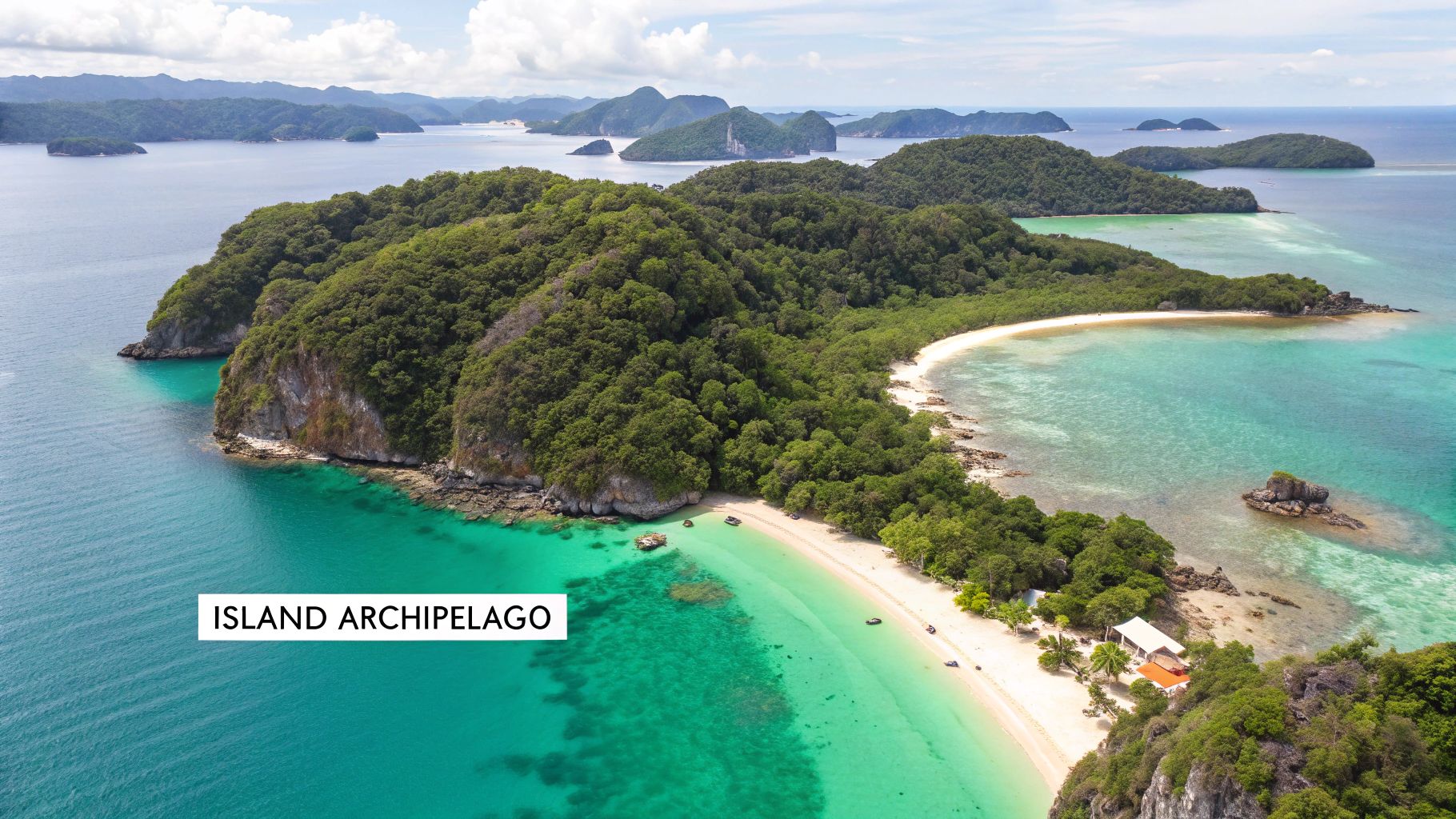
This incredible geography defines the nation's rich biodiversity, diverse cultures, and complex history. The islands are broadly categorized into three main geographical divisions: Luzon, Visayas, and Mindanao. Understanding this feature is key to appreciating the country's strategic importance and its unique environmental landscape, making it a staple in any comprehensive geography challenge.
Embedded content
### Difficulty & Variations
- Difficulty: Medium
- Why it's a good question: This question moves beyond basic trivia and requires a more detailed understanding of Southeast Asian geography. It's often used in cultural geography competitions and tourism courses to highlight how physical landscapes shape national identity.
To increase the challenge, consider these variations:
- Clarifying Detail: Ask, "Which archipelagic nation is often confused with Indonesia but has over 7,000 islands compared to Indonesia's 17,000+?" (Answer: The Philippines).
- Main Island Groups: Pose a more specific question, "The 7,641 islands of the Philippines are divided into what three main geographical groups?" (Answer: Luzon, Visayas, and Mindanao).
- Cultural Context: Frame it as, "The national language of this country, with over 7,000 islands, is based on the Tagalog dialect spoken on its most populous island. What is the country?" (Answer: The Philippines).
8. Mount Everest, the world's highest mountain, is located on the border between which two Asian countries?
This question shifts the focus from capitals to physical geography, a vital component of any well-rounded "countries of Asia quiz." It challenges participants to pinpoint one of the planet's most iconic natural landmarks. The answer is Nepal and China, as the summit of Mount Everest straddles the international border between these two nations.
Known as Sagarmatha in Nepali and Chomolungma in Tibetan, Everest stands at a staggering 8,848.86 meters (29,031.7 feet). Its inclusion in quizzes highlights the dramatic topography of the Himalayan region and its cultural significance. This question also serves as a gateway to discussing exploration, human endurance, and the effects of climate change on glaciers.
### Difficulty & Variations
- Difficulty: Medium
- Why it's a good question: It tests knowledge beyond political boundaries and capital cities, encouraging a broader understanding of Asian geography. Its fame, amplified by figures like Sir Edmund Hillary and Tenzing Norgay, makes it a recognizable but still challenging trivia point.
To increase the challenge, consider these variations:
- Linguistic Twist: Ask, "What is the local Nepali name for Mount Everest?" (Answer: Sagarmatha).
- Exploration History: Pose a question like, "In what year was the first officially confirmed ascent of Mount Everest?" (Answer: 1953).
- Geographical Context: Frame it as, "Mount Everest is part of which major mountain range that spans several Asian countries?" (Answer: The Himalayas).
This question is a peak challenge for geography lovers. You can discover more about incredible landscapes by reading about the natural wonders of the world.
9. Which Asian country is known as the 'Land of the Rising Sun'?
This question shifts the focus from pure geography to cultural etymology, adding a fascinating layer to any countries of Asia quiz. It asks participants to connect a well-known nickname to its country of origin, testing a different kind of knowledge. The answer is, of course, Japan. This moniker is a direct translation of the country's name in Japanese: Nihon or Nippon (日本), which literally means 'sun origin.'
The name reflects Japan's geographical position to the east of the Asian mainland. From the perspective of ancient China, the sun appeared to rise from the direction of the Japanese archipelago. This poetic and powerful name is deeply embedded in Japan's national identity, even appearing on its flag, the Hinomaru (circle of the sun), which represents the rising sun. This question is excellent for exploring how geography shapes a nation's identity and name.
### Difficulty & Variations
- Difficulty: Easy to Medium
- Why it's a good question: It goes beyond simple recall of capitals or locations, prompting players to think about cultural identity and the origins of a country's name. It's a standard question in cultural geography and world history, making it both accessible and educational.
To increase the challenge, consider these variations:
- Etymological Twist: Ask, "What do the Japanese characters for Japan's name (日本) literally translate to?" (Answer: Sun origin).
- Comparative Nicknames: Pose a question like, "While Japan is the 'Land of the Rising Sun,' which nearby country is known as the 'Land of the Morning Calm'?" (Answer: South Korea).
- Symbolism: Frame it as, "What is the name of the Japanese flag, which visually represents the country's 'Land of the Rising Sun' moniker?" (Answer: Hinomaru).
Key Facts Comparison of 9 Asian Country Quiz Items
| Question | Implementation Complexity 🔄 | Resource Requirements ⚡ | Expected Outcomes 📊 | Ideal Use Cases 💡 | Key Advantages ⭐ |
|---|---|---|---|---|---|
| What is the capital of Japan? | Low | Low | Basic geography knowledge confirmation | Entry-level quizzes, educational curricula | High recognition, accessible to all |
| Which is the largest country in Asia? | Medium | Medium | Understanding of continental boundaries | Advanced geography competitions, university tests | Encourages critical thinking, nuanced |
| How many countries are there in Asia? | Medium-High | Medium | Knowledge of geopolitical structure | Model UN, international relations courses | Promotes political geography learning |
| Which Asian country has the largest population? | Medium | Medium | Awareness of current demographic trends | Current affairs quizzes, population studies | Highly relevant, links demographics & economy |
| What is the smallest country in Asia? | Medium | Low | Knowledge of less-known nations | Environmental geography, climate education | Opens environmental & island geography discussions |
| Which river is the longest in Asia? | Medium-High | Medium | Understanding of physical geography | Geography Olympiads, environmental science | Connects geography with economics/ecology |
| Which Asian country has over 7,000 islands? | Medium | Medium | Knowledge of archipelagic geography | Southeast Asian studies, maritime law | Distinctive geographic feature, memorable |
| Mount Everest location border | Low-Medium | Low | Physical & political geography | World geography, adventure education | Iconic landmark, broad educational value |
| Which Asian country is 'Land of the Rising Sun'? | Low | Low | Cultural and linguistic knowledge | Cultural geography, language arts | High recognition, connects culture/history |
How Did You Score? Continue Your Geographic Adventure!
So, how did you fare on our countries of Asia quiz? Whether you're a seasoned geography buff who breezed through the questions or a curious learner who discovered something new, the goal was to ignite your interest in this vast and diverse continent. This quiz wasn't just about testing your memory; it was a journey through Asia's towering peaks, bustling capitals, and unique cultural identities.
From identifying the world's most populous nation to pinpointing the smallest island state, each question offered a snapshot of the continent's incredible scope. Recalling that Russia is the largest country by area or that the Philippines is an archipelago of over 7,000 islands helps build a mental map of our world, transforming abstract names into tangible locations with rich histories.
Key Takeaways from Our Asian Geography Challenge
Our journey through the countries of Asia quiz reinforced several important geographical concepts. It highlighted the continent's extremes, from the highest point on Earth, Mount Everest, to its most populous nations, China and India. Understanding these facts provides a crucial framework for comprehending global current events, cultural dynamics, and economic trends.
For instance, knowing that the Yangtze River is Asia's longest isn't just trivia; it's about recognizing a vital artery that has shaped Chinese civilization for millennia. Similarly, understanding the sheer number of countries in Asia (around 48-50, depending on the classification) underscores the continent's immense political and cultural diversity.
Turning Knowledge into a Global Perspective
Mastering geographic knowledge is more than a hobby; it’s a powerful tool for global citizenship. A strong grasp of geography allows you to connect a news headline to a place on the map, understand regional conflicts, and appreciate the intricate relationships between nations. If you're eager to expand your knowledge beyond quizzes and delve deeper into specific nations, you might find it beneficial to learn how to build a winning MUN country profile. This structured approach helps transform isolated facts into a comprehensive understanding of a country's political, economic, and social landscape.
By continuing to build your knowledge, you are not just memorizing data. You are developing a more nuanced and informed perspective on the world. This journey of discovery is ongoing, and every new fact you learn adds another piece to the complex, beautiful puzzle that is our planet. Keep that curiosity alive and let it fuel your next adventure in learning.
Ready to turn your passion for geography into an epic adventure? Put your knowledge to the test with EarthChasers, the ultimate 3D geography game that lets you explore the globe and compete in exciting challenges. From virtual globetrotting to fast-paced quizzes, it’s the perfect next step for anyone who enjoyed our countries of Asia quiz. Join a community of fellow explorers and start your journey today at EarthChasers