
How to Calculate Map Scale and Read Maps Like a Pro
Learn how to calculate map scale with practical examples. Master the formula, convert units, and avoid common errors to read any map with confidence.
To figure out any map scale, you're essentially finding the ratio between the distance on the map and the actual distance on the ground. The basic formula is Scale = Map Distance / Ground Distance, but the key is converting both measurements to the same unit (like centimeters) before you do the math. This gives you a clean, unitless ratio, like 1:50,000.
So, What Does Map Scale Really Mean?
Before we jump into calculations, let's get a real feel for what map scale represents. At its heart, it's just a simple relationship: how much the real world has been shrunk down to fit onto a piece of paper or a screen. Think of it as the ultimate conversion factor between the map in your hands and the territory it shows.
This relationship gets expressed in a few different ways. Each one tells you the same thing, just in a slightly different style, which makes them useful for everything from a casual road trip to precise technical planning. Getting comfortable with these formats is the first real step to mastering map scale.
The Three Types of Map Scales
Modern maps use a few standard ways to show scale, which keeps things clear and consistent. You'll almost always run into one of these three.
To make it even clearer, here’s a quick breakdown of the three main scale types you'll encounter on any map.
Quick Guide to Map Scale Types
| Scale Type | Format Example | Best For |
|---|---|---|
| Verbal Scale | "1 inch equals 10 miles" | Quick, at-a-glance understanding. |
| Graphic Scale (Bar) | A printed ruler on the map | Retaining accuracy if the map is resized. |
| Representative Fraction (RF) | 1:24,000 or 1/24,000 | Universal calculations; it's unit-free. |
Each of these has its place, but the Representative Fraction (RF) is the gold standard for any serious map work. Let's dig into why.
Verbal Scale: This is the most straightforward, using words to describe the relationship. It's super easy to grasp but isn't very flexible if you're trying to work with different units.
Graphic Scale (or Bar Scale): You've seen this one—it's a little printed ruler right on the map that shows ground distances. Its huge advantage is that it stays accurate even if you photocopy the map, zoom in, or view it on a weirdly sized screen.
Representative Fraction (RF): This is the universal format, written as a ratio like 1:24,000. It's by far the most versatile because it has no units. That "1" could be an inch, a centimeter, or a foot—as long as the "24,000" is measured in the same units on the ground.
For instance, on a 1:250,000 scale road atlas, one centimeter on your map represents 2.5 kilometers of actual road. A detailed city plan, on the other hand, might use a 1:10,000 scale, where 1 cm equals just 100 meters. The difference in detail is massive.
These skills are fundamental to map literacy, especially when you need to learn more about how to read topographic maps. On those, the scale directly impacts how you interpret everything from the steepness of a hill to the distance to the next ridge. For our calculations, we'll be focusing on the RF because of its precision and universal power.
The Core Formula for Calculating Map Scale
At the heart of every map scale calculation is a beautifully simple formula: Scale = Map Distance / Ground Distance. That’s it. This one little equation is your key to translating a massive landscape onto a manageable piece of paper.
But here’s the secret that experienced map-makers know: the real work happens before you ever touch the calculator. The most critical step, and the one most people get wrong, is making sure your units are consistent. You simply can't divide centimeters by kilometers and expect a meaningful result. You have to convert the real-world distance into the same units you’re using on the map.
This isn't a new problem, either. Cartographers have been obsessed with precise scaling for centuries. Early innovators like Chinese geographer Pei Xiu were already establishing principles for graduated scales way back in the 2nd century BC, which was a huge leap forward for map reliability.
Unpacking the Calculation
Let's walk through a real-world scenario. Imagine you're planning a hike and measure the trail on your map. It's 5 centimeters long. From a trail guide, you know the actual ground distance is 2.5 kilometers.
To make the formula work, we need to convert those 2.5 kilometers into centimeters.
Here’s the breakdown:
- First, get kilometers into meters. There are 1,000 meters in every kilometer.
- Next, get meters into centimeters. There are 100 centimeters in every meter.
So, the full conversion looks like this: 2.5 km x 1,000 m/km x 100 cm/m = 250,000 cm.
Now that both distances are in the same unit (centimeters), we can finally plug them into our original formula:
Scale = 5 cm / 250,000 cm
When you simplify that fraction, you get 1/50,000. This is often written as a Representative Fraction: 1:50,000. And there's your map scale.
This visual shows that simple, three-part process for any scale calculation you need to do.
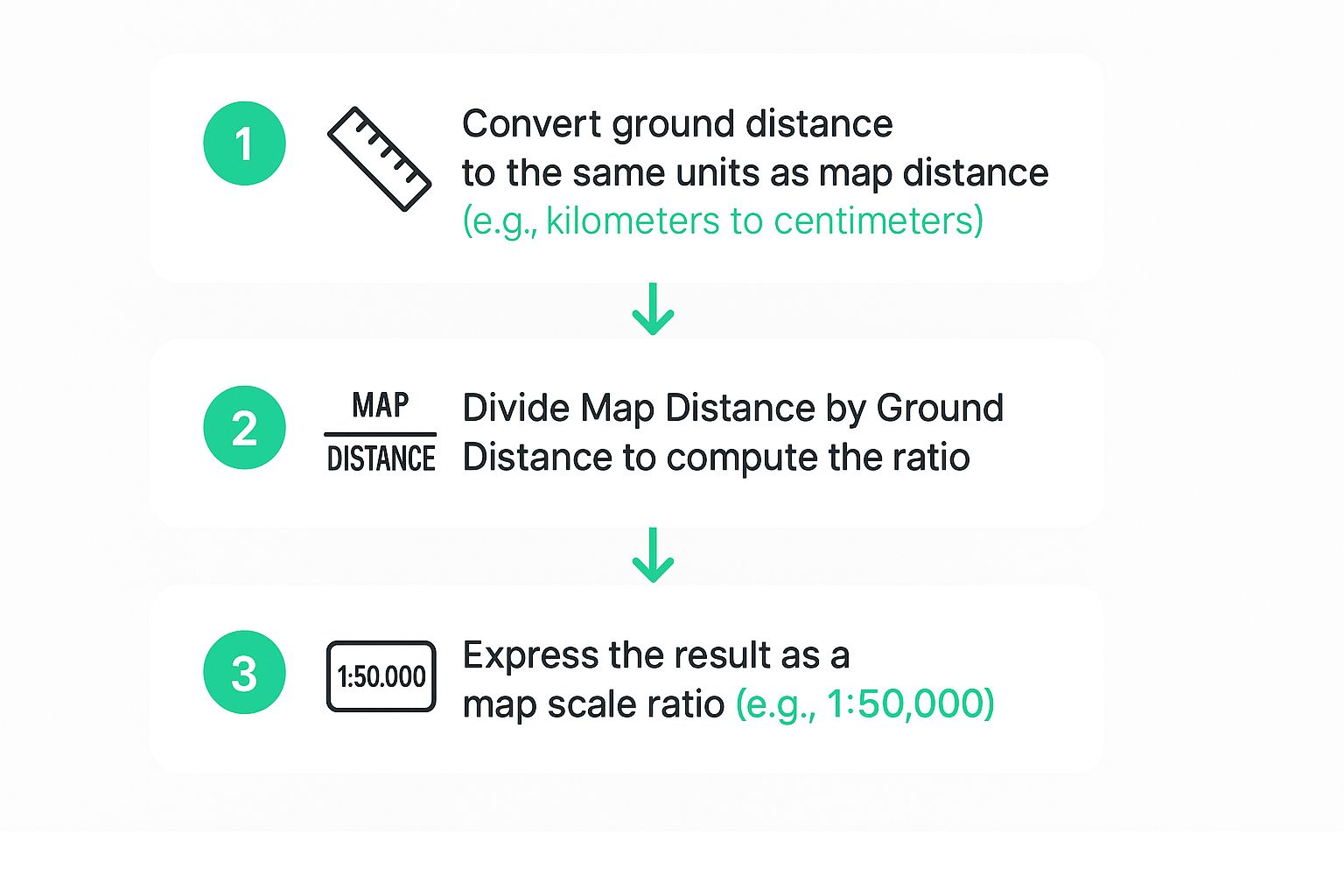
The main takeaway? Always convert your units first. It makes the final division clean and simple. Mastering this one technique is absolutely essential if you want to learn how to create custom maps that are actually accurate and reliable.
Mastering Unit Conversions for Accurate Results
Let's be honest—unit conversion is the single biggest hurdle when you're figuring out map scale. It’s where most people get tripped up. Get it wrong, and your perfectly measured map becomes completely useless.
The core formula only works when your map distance and ground distance are speaking the same language. It doesn’t matter if it’s centimeters or inches, but they must match. Forgetting to convert is like trying to compare apples and oranges; you'll get a number, but it won't mean anything in the real world.
Key Metric and Imperial Conversions
You don't need a degree in mathematics to get this right. Whether you're working with a metric topo map or an old imperial county map, you just need a few key numbers in your back pocket.
These are the most common conversion factors you’ll ever need:
- 1 kilometer (km) = 1,000 meters (m)
- 1 meter (m) = 100 centimeters (cm)
- 1 mile (mi) = 5,280 feet (ft)
- 1 foot (ft) = 12 inches (in)
These four simple facts are the building blocks for any scale calculation. Memorizing them will save you a ton of time and prevent the most common errors before they even happen.
The real trick is combining these. To get from kilometers all the way down to centimeters, you just multiply by 100,000 (that's 1,000 x 100). For miles to inches, you multiply by 63,360 (5,280 x 12).
Essential Unit Conversion Cheat Sheet
I've put together a quick reference table with the most critical conversions for map work. Bookmark this page so you can pull it up whenever you're crunching the numbers.
| From Unit | To Unit | Conversion Factor |
|---|---|---|
| Kilometer | Centimeter | Multiply by 100,000 |
| Meter | Centimeter | Multiply by 100 |
| Mile | Inch | Multiply by 63,360 |
| Foot | Inch | Multiply by 12 |
This little cheat sheet demystifies the whole process. By always converting your ground distance first, you make the final step a simple, clean division. That’s how you get an accurate map scale every single time.
Putting It All Together with Real-World Scenarios
Theory is great, but it only gets you so far. The real test is applying these formulas out in the field. So, let’s walk through a couple of practical examples to lock in these concepts and bridge the gap between knowing the steps and actually doing them.
Think of this as a hands-on workshop. We'll see the formulas and unit conversions in action, building on everything we've just covered. This is how the process stops being a math problem and starts feeling like second nature.
Finding the Scale of a Mystery Map
Let's say you've stumbled upon an old local map, but the scale information is torn off or faded. You notice a landmark you know: a standard American football field. You know it’s 360 feet long, goalpost to goalpost.
You pull out a ruler and measure the field on the map. It's exactly 0.5 inches long. Perfect. We have what we need.
- Map Distance: 0.5 inches
- Ground Distance: 360 feet
First things first, we need our units to match. Since there are 12 inches in a foot, we'll convert the ground distance to inches: 360 feet x 12 inches/foot = 4,320 inches.
Now, we just plug those numbers into our formula:
Scale = 0.5 inches / 4,320 inches = 1 / 8,640
Just like that, you’ve discovered your mystery map’s representative fraction is 1:8,640.
Calculating Ground Distance for a Hike
Now let's flip it around. You're planning a hike with a proper topographic map that clearly states a scale of 1:24,000. You trace the winding trail from the parking lot to the summit, and your measurement comes out to 15 inches on the map. So, how far is the actual hike?
When you know the scale, the formula is a simple rearrangement: Ground Distance = Map Distance x Scale Denominator.
Let's do the math: 15 inches x 24,000 = 360,000 inches.
While that's the correct answer, no one talks about hikes in inches. To make this number useful, we need to convert it to miles. Knowing there are 63,360 inches in a mile, the calculation is straightforward:
360,000 inches / 63,360 inches/mile ≈ 5.68 miles.
Your hike is just a bit over five and a half miles long. Easy enough.
This kind of precision has been a game-changer throughout history. Think about military logistics—Napoleon’s campaigns, for example, depended on highly accurate maps with ratios like 1:86,400. This allowed his officers to plan troop movements with a level of precision that was previously unthinkable.
If you want a quick way to double-check your own trail calculations, our handy distance and bearing calculator tool is a great resource.
Common Mistakes to Avoid When Calculating Scale
A tiny slip-up when calculating map scale can cascade into a massive error on the ground. Think of this section as your safety net—we'll walk through the common pitfalls that trip up everyone from first-timers to seasoned pros.
Knowing what to watch for is half the battle. Once you recognize these common errors, you can build solid habits that ensure your calculations are always spot-on.
The Unit Conversion Trap
The single most frequent mistake I see is mixing units. You just can't divide map inches by ground kilometers and expect a useful ratio. It doesn't work.
This one fundamental error invalidates the entire calculation from the start. So, here's the golden rule: always convert your ground distance to match your map units before you do any division. Get everything into inches, or centimeters, or whatever you're using on the map itself. Then, and only then, can you calculate the scale.
Forgetting Measurement Precision
Your final scale is only as reliable as your initial measurements. A slightly angled ruler or an imprecise click with a digital tool can throw everything off. On large-scale maps, where small details matter, these tiny errors get magnified in a hurry.
Take an extra moment to get it right.
- Always use a quality ruler with clear, fine markings.
- Make sure your ruler is perfectly flat and straight along the line you're measuring.
- For digital maps, zoom way in. Get as close as you can to place your measurement points with surgical precision.
This little bit of extra care ensures the numbers you plug into the formula are trustworthy from the very beginning.
A common slip-up is misinterpreting the final ratio. A scale of 1:10,000 means one unit on the map equals ten thousand units on the ground—not that the map is 10,000 times bigger. It's a ratio of reduction.
Misinterpreting the Final Ratio
So you've done the math correctly and have your shiny new ratio. Great! But it's surprisingly easy to get backward what that number actually means.
A scale like 1:50,000 isn't a direct measurement. It's the relationship between the map and reality. It tells you that any feature you see on that piece of paper is 50,000 times smaller than its real-world counterpart.
Keeping this simple concept in mind is key. It's what allows you to correctly apply the scale to calculate distances, plan routes, and turn your hard work into accurate, actionable information.
Common Questions About Map Scale
Once you've got the hang of the map scale formula, a few tricky questions almost always come up. Let's tackle them head-on to clear up any lingering confusion and make you a much more confident map reader.
What's the Difference Between a Large Scale and a Small Scale Map?
This is easily one of the most counterintuitive ideas in cartography, but it makes sense once you see it.
A large-scale map, like 1:10,000, shows a small area with a lot of detail. Think of a zoomed-in map of your neighborhood where you can see individual buildings. On this map, features look large.
On the flip side, a small-scale map, like 1:1,000,000, covers a huge area with less detail. A world map is the classic example. Here, entire countries look small.
The trick is to think of the scale as a fraction. The number 1/10,000 is a much larger value than 1/1,000,000. That's why it's a "large-scale" map—the ratio itself is larger.
How Do I Find the Scale on a Digital Map like Google Maps?
This is a great question because digital maps don't play by the old rules. Their scale is dynamic, meaning it changes every single time you zoom in or out.
Because the scale is always in flux, you won't find a fixed Representative Fraction (RF) like 1:24,000. Instead, you have to rely on the graphic scale bar. You'll usually spot it in one of the corners of the screen.
This little bar is your only reliable guide. It will show a length and its real-world equivalent, like "200 feet" or "50 meters," updating itself instantly as you zoom.
Can I Calculate Map Scale Without Any Known Distances?
In short, no. It's just not possible.
The whole point of a scale is to create a ratio that connects the map to reality. To do that, you absolutely need at least one known connection—a measured map distance and its corresponding real-world distance.
If a map has no scale bar, no RF, and no features with a standard, known size (like a football field or an airport runway), you can't determine its scale. Any attempt would just be a wild guess.
Ready to explore the world in a whole new way? Join the adventure with EarthChasers and turn your geographical knowledge into an exciting game. Start your global journey today at https://earthchasers.com