
What Are Tectonic Plates & How Do They Shape Earth
Discover what are tectonic plates and how their constant movement at boundaries drives earthquakes, creates volcanoes, and builds mountains on Earth.
Ever look at a world map and wonder how the continents fit together almost like puzzle pieces? That’s not a coincidence. The ground beneath our feet isn't one solid, static ball of rock—it's a dynamic, ever-shifting surface made of massive interlocking slabs called tectonic plates.
Think of the Earth's rigid outer layer, the lithosphere, as being like the cracked shell of a hard-boiled egg. Each of those shell fragments is a tectonic plate, and they all float on top of a hotter, gooier layer below called the asthenosphere.
Understanding Earth's Giant Jigsaw Puzzle
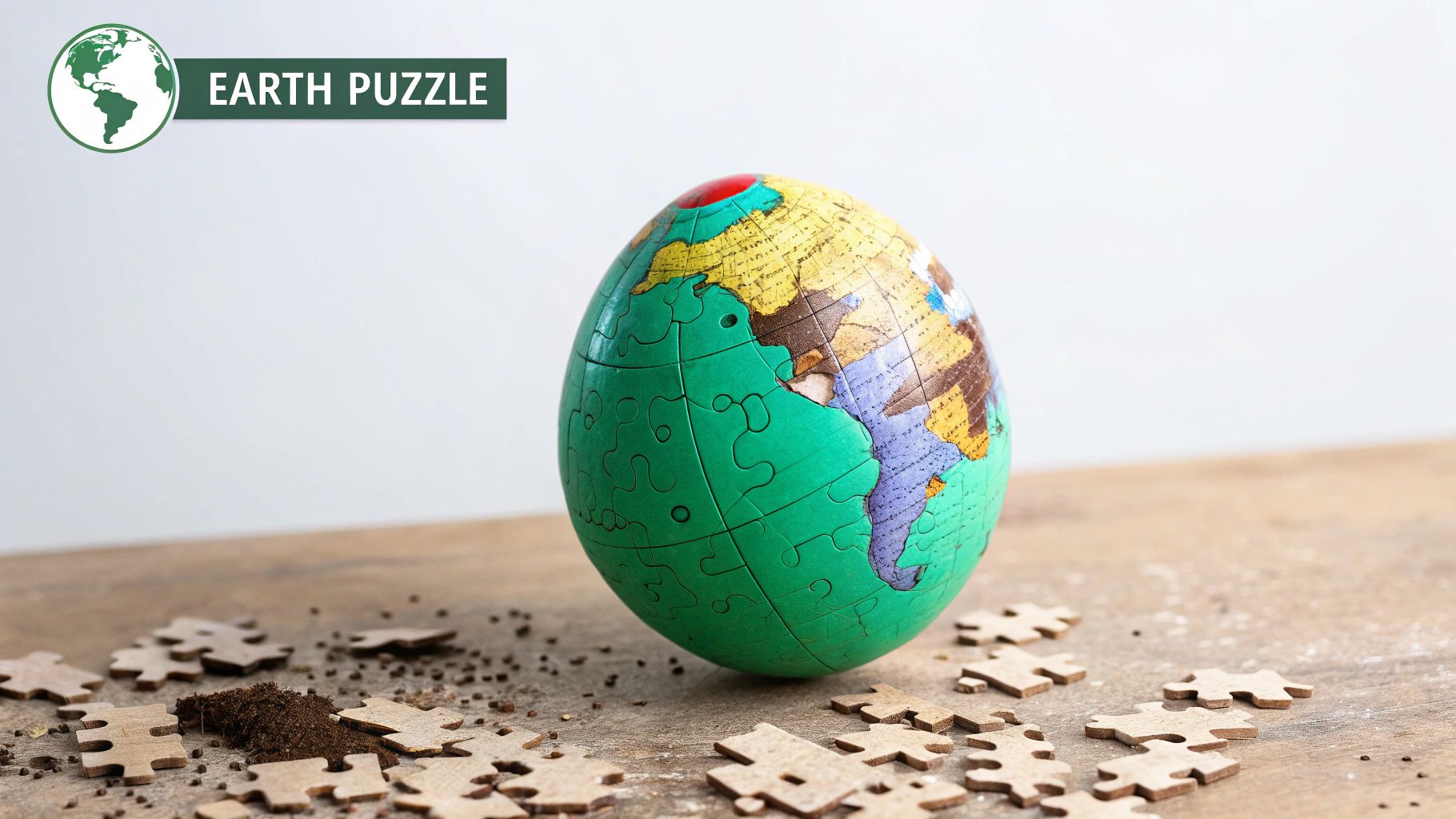
This jigsaw puzzle isn’t sitting still. Driven by the incredible heat rising from Earth’s core, these plates are in constant, slow-motion transit across the globe. Some are enormous, carrying entire continents and oceans on their backs, while others are smaller but just as crucial to the planet's geology.
This movement is the engine behind some of Earth's most spectacular and violent events. Where plates collide, separate, or grind past each other, we get everything from towering mountain ranges like the Himalayas to the deepest ocean trenches. The tell-tale signs of these epic forces are carved right into the landscape—something you can see for yourself when you learn how to read topographic maps.
Core Characteristics of Tectonic Plates
While the idea of continents drifting had been around for a while, the modern theory of plate tectonics really came together in the 1960s. It gave us a single, powerful way to explain earthquakes, volcanoes, and the very shape of our world.
These plates are about 100 km thick and cruise along at a blistering 5 to 10 cm per year—roughly the same speed your fingernails grow.
It's this slow, relentless dance over millions of years that has shaped the continents we know today, recycled the planet’s crust, and even influenced global climate patterns.
To get a quick handle on the basics, let's break down the essential properties of these plates.
Key Characteristics of Tectonic Plates
This table offers a quick summary of the fundamental properties of tectonic plates.
| Characteristic | Description |
|---|---|
| Composition | Made of the rigid lithosphere (crust and upper mantle). |
| Location | Float on the semi-molten, ductile asthenosphere. |
| Movement | Driven primarily by mantle convection currents below. |
| Boundaries | Interact at convergent, divergent, and transform boundaries. |
Ultimately, these massive slabs of rock are the planet's master architects, constantly building, destroying, and reshaping the very ground we live on.
The Engine Driving Plate Tectonics
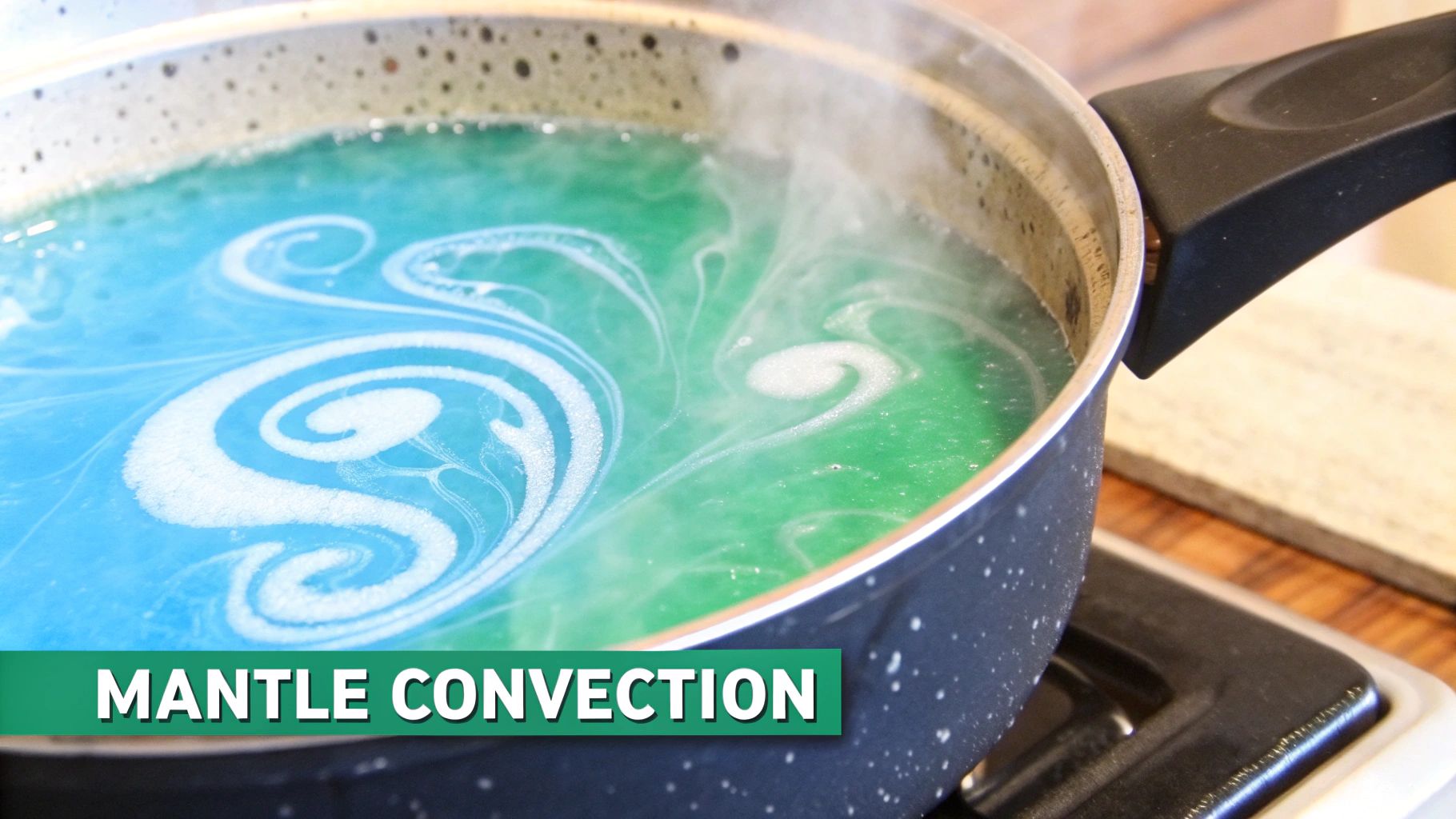
What kind of invisible force is strong enough to move entire continents? The answer lies deep beneath our feet, in a process that works a lot like a pot of boiling water on a stove. This powerful mechanism is called mantle convection, and it’s the primary engine pushing, pulling, and grinding tectonic plates across the globe.
Deep inside our planet, the core radiates an incredible amount of heat, warming the semi-molten rock of the mantle just above it. As this rock heats up, it expands, becomes less dense, and begins a slow, epic journey up toward the crust.
Once it gets near the surface, the material cools down, gets denser, and sinks back toward the core to be reheated. This creates a massive, slow-motion circulatory system—powerful currents flowing within the mantle. The tectonic plates are essentially just along for the ride, carried by these currents like rafts on a lazy, immensely powerful river.
Gravity's Helping Hand
While mantle convection is the main show, it doesn't work alone. Gravity pitches in with two crucial assists that help keep the plates moving: ridge push and slab pull. These secondary forces add another layer of complexity to the global dance of the continents.
- Ridge Push: At mid-ocean ridges, where new crust is being born, the fresh rock is hot, expanded, and sits higher than the surrounding seafloor. Gravity gives this elevated ridge a gentle but constant nudge, "pushing" the older, cooler plate material away from the ridge.
- Slab Pull: This is the heavy hitter. When a dense oceanic plate collides with a less dense plate, it dives back down into the mantle in a process called subduction. The sheer weight of this sinking slab acts like an anchor, pulling the rest of the plate along with it. Many geologists believe slab pull is the single most powerful force in plate tectonics.
Together, these three forces—mantle convection, ridge push, and slab pull—create a planetary-scale engine that has been running for billions of years, constantly reshaping the face of our world.
This constant motion isn't just a fun geological fact; it’s the reason we have the continents, oceans, and towering mountain ranges we see today. These are the very forces that sculpted the dramatic landscapes players can explore in games like EarthChasers, turning geological theory into a hands-on adventure.
Exploring Different Types of Plate Boundaries
The real action in plate tectonics happens at the seams—the boundaries where these enormous plates meet. You can think of them as slow-motion crash zones, massive construction sites, and geological fault lines all rolled into one. The way plates interact here is what shapes our continents and oceans and seas of the world, carving out some of the most dramatic landscapes on the planet.
There are three main ways these plates can interact, and each one leaves a completely unique geological signature. These aren't just minor shifts; they are the literal architects of our world, capable of building mountains or splitting continents apart.
Convergent Boundaries Where Plates Collide
When two tectonic plates are on a collision course, they form a convergent boundary. What happens next depends entirely on what kind of plates are crashing.
If a dense oceanic plate runs into a lighter continental plate, something has to give. The heavier oceanic plate is forced to bend and dive back down into the mantle—a process called subduction. This violent recycling process carves out deep ocean trenches and fuels the explosive volcanoes that often line coastlines.
But what if two continental plates collide? Neither one wants to give way. The immense pressure causes the crust to buckle, fold, and thrust violently upward, creating spectacular mountain ranges. The Himalayas are a perfect example, born from the ongoing collision between the Indian and Eurasian Plates, a crash that continues to push the peaks higher every single year.
Divergent Boundaries Where New Crust Is Born
A divergent boundary is the exact opposite: it’s a place where two plates are pulling away from each other. As they separate, hot magma from the mantle rises to fill the void. It then cools and hardens, forming brand-new crust. It’s like a geological factory floor, constantly churning out fresh rock.
The most famous example is the Mid-Atlantic Ridge, a massive underwater mountain range that runs right down the center of the Atlantic Ocean. This is where the North American and Eurasian plates are slowly drifting apart, a process that continues to widen the entire ocean basin over millions of years.
Transform Boundaries Where Plates Grind Past
Finally, at a transform boundary, two plates slide horizontally past one another. No new crust is made, and none is destroyed. Instead, the incredible friction between the grinding plates builds up a tremendous amount of stress in the rock.
That stored energy eventually gets released in the form of powerful earthquakes. The San Andreas Fault in California is the classic example, marking the boundary where the Pacific Plate grinds northwest past the North American Plate. This constant, grinding motion is behind much of the region's seismic activity.
To help visualize these distinct movements, let’s compare them side-by-side.
Types of Tectonic Plate Boundaries Compared
The table below breaks down the three primary boundary types, showing how their different movements result in very different geological features.
| Boundary Type | Movement | Geological Features |
|---|---|---|
| Convergent | Plates collide (move toward each other) | Mountain ranges (Himalayas), ocean trenches, volcanoes |
| Divergent | Plates separate (move away from each other) | Mid-ocean ridges (Mid-Atlantic Ridge), rift valleys |
| Transform | Plates slide past each other horizontally | Fault lines (San Andreas Fault), earthquakes |
Each boundary type tells a different story about the forces at work beneath our feet.
The infographic below offers another great visual, clearly showing the inward, outward, and sideways motions that lead to such different outcomes on the Earth's surface.
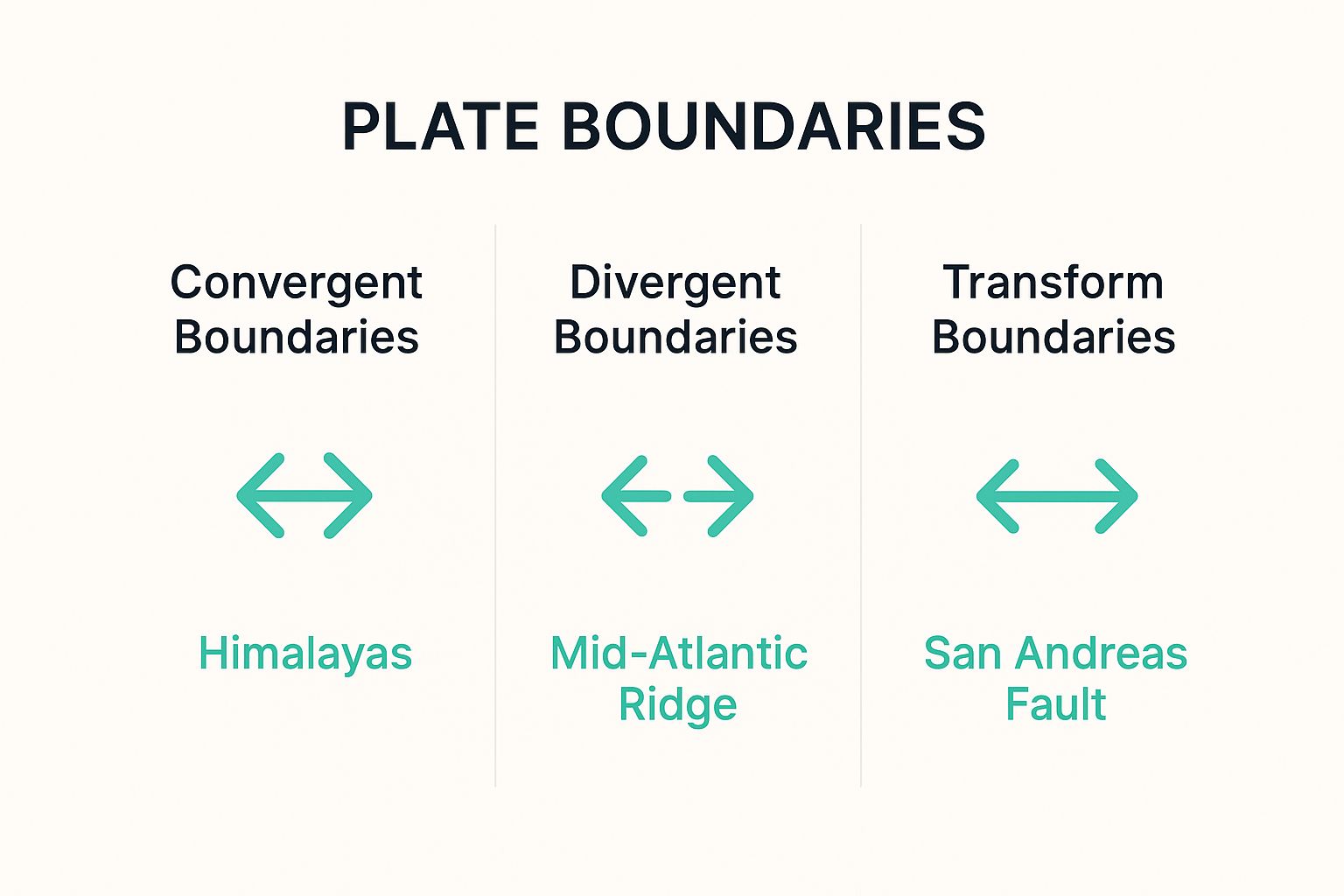
Understanding these fundamental boundary types is the key to grasping the big picture of plate tectonics and how it actively shapes the world we live in.
How Plate Tectonics Shape Our World
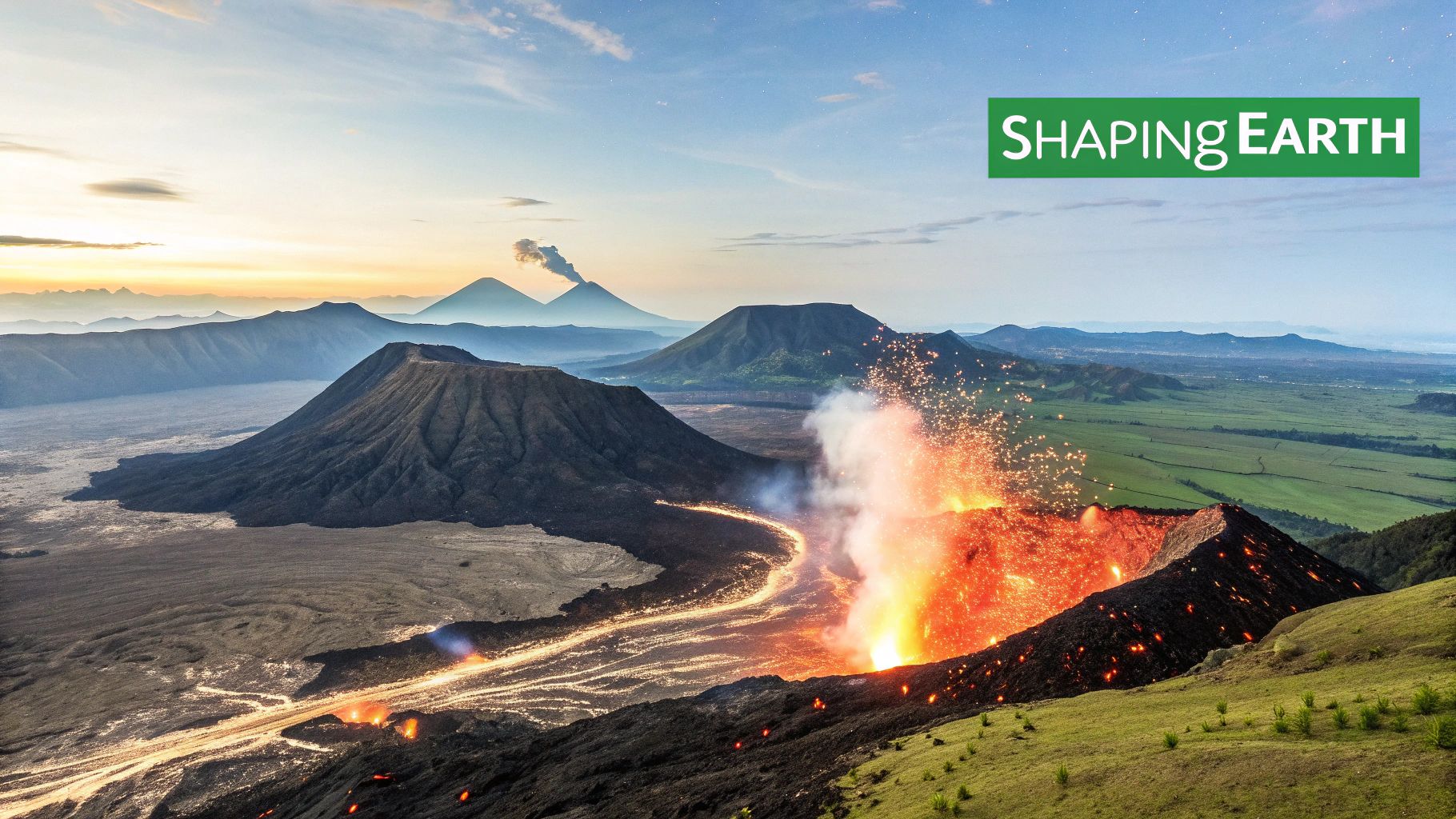
The incredible forces pushing and pulling tectonic plates don't stay hidden deep inside the Earth. They unleash profound, dramatic, and sometimes violent consequences right here on the surface. From the ground shaking beneath our feet to the slow-motion creation of entire mountain ranges, plate tectonics are the master architects of our world.
This constant geological drama is a direct result of cause and effect. When plates grind, collide, or pull apart, all that pent-up energy has to go somewhere. The results are some of nature’s most powerful and awe-inspiring events.
The Science of Earthquakes
Take a place like California's San Andreas Fault, a classic transform boundary where plates scrape past each other horizontally. They don't just glide smoothly. Massive friction locks them in place, causing stress to build up over years, decades, or even centuries.
When the built-up stress finally overcomes the friction, the rock snaps. This sudden, violent slip releases a colossal amount of energy that ripples through the crust as seismic waves. What we feel on the surface is an earthquake. The same basic process happens at convergent boundaries, where one plate dives under another, triggering some of the biggest quakes on record.
These aren't just isolated events. Major earthquake zones trace plate boundaries almost perfectly. The circum-Pacific Ring of Fire, for example, is ground zero for over 75% of the world's active volcanoes and gets hit with 90% of the world's largest earthquakes. The human impact can be devastating, as we've seen in events that have reshaped entire communities. The USGS offers incredible insights into these tectonically active zones.
Volcanoes Forged by Fire
Volcanic activity is another direct consequence of what’s happening at plate boundaries, especially where plates are either crashing together or pulling apart.
- At Convergent Boundaries: As a dense oceanic plate subducts, it drags water-logged minerals down into the scorching mantle. This water acts like a flux, lowering the melting point of the surrounding rock and creating buoyant magma. This magma then rises to the surface, often fueling explosive volcanoes.
- At Divergent Boundaries: Where plates separate, magma from the mantle easily wells up to fill the void. These eruptions are often much gentler, creating new crust on the seafloor and long chains of underwater volcanoes.
This intricate dance between subduction, magma, and eruption explains why so many volcanoes are clustered along specific belts, like the famous Ring of Fire that encircles the Pacific Ocean.
Building Mountains Over Millennia
The world’s most majestic mountain ranges are monuments to the slow, unstoppable power of colliding plates. When two continental plates slam into each other at a convergent boundary, neither is dense enough to be forced down into the mantle.
Instead, they have nowhere to go but up. The crust buckles, folds, and thrusts upward under unimaginable pressure.
This is exactly how the Himalayas were born—and are still growing—from the ongoing collision between the Indian and Eurasian plates. This epic geological clash continues today, pushing Mount Everest a few millimeters higher every single year. These forces aren't ancient history; they are actively sculpting our planet as we speak.
How Scientists Track Plate Movement
Embedded content
How do you prove that entire continents are creeping across the planet at the speed your fingernails grow? It sounds impossible, but for decades, geologists have been doing just that, using clever clues hidden in the Earth itself.
Long before we had satellites, scientists noticed a startling pattern. The world’s earthquakes and volcanoes weren't random; they formed distinct, connected lines that snaked around the globe. This network of seismic hotspots was a natural roadmap, perfectly outlining the edges of the tectonic plates.
It wasn't a coincidence. These zones of intense geological activity are exactly where plates meet, grind past each other, or collide. By simply mapping where the ground shook and magma erupted, early geologists could sketch out the colossal puzzle pieces that make up our planet's crust. It was the first, and most intuitive, way of seeing the invisible boundaries of our world.
Precision Tracking with Modern Tools
Today, we've moved from broad outlines to millimeter-perfect measurements. The secret? The Global Positioning System (GPS).
By placing ultra-sensitive, fixed GPS receivers on different tectonic plates, scientists can track their exact positions over time. This global network provides a constant stream of data, revealing not just the speed but the precise direction of each plate's slow-motion journey.
These GPS measurements confirm that plates drift at rates between 1 and 10 centimeters per year. The data has turned a powerful theory into a precisely measured reality, helping us better predict hazards in geologically active regions.
All this location data is then fed into powerful mapping software to be visualized and analyzed. To get a feel for how these programs work, check out our guide on what are geographic information systems, which are essential tools for modern geology. As the Geological Society of America explains, this data reveals incredibly complex interactions between plates.
Unlocking Earth's Magnetic History
Some of the most powerful proof for plate tectonics was found hiding on the ocean floor, recorded in a magnetic code locked into ancient rock. This amazing field of study is called paleomagnetism.
Here’s how it works: As new crust forms at mid-ocean ridges, molten rock rises and cools. Tiny magnetic minerals within the lava act like microscopic compass needles, aligning themselves with the Earth's magnetic field at that moment.
Since our planet's magnetic field has flipped its north and south poles many times over millions of years, this process created a stunningly perfect, symmetrical pattern of magnetic "stripes" on both sides of the ridge. This striped barcode was the smoking gun for seafloor spreading, providing the undeniable evidence that finally cemented the theory of plate tectonics.
Common Questions About Tectonic Plates
Even after getting the basics down, the mind-boggling scale of plate tectonics can bring up some really interesting questions. Let's dig into a few of the most common ones to clear up any lingering mysteries about how our planet works.
How Fast Do Tectonic Plates Move?
Tectonic plates drift at a famously slow pace—about the same speed your fingernails grow. On average, that’s between 2 to 5 centimeters (roughly 1-2 inches) per year.
But their speeds aren't the same everywhere. Some plates, like the Pacific Plate, are geological speed demons, zipping along at more than 10 centimeters per year. Others, like the North American Plate, are taking their sweet time. This constant, creeping motion is what drives massive geologic change over millions of years.
That might not sound like much, but over a human lifetime, a plate can travel several meters. Stretch that out over millions of years, and you're talking thousands of kilometers—more than enough to rearrange entire continents.
Could A New Supercontinent Like Pangea Form?
Absolutely. The whole process of supercontinents forming and breaking apart is thought to be cyclical. Geologists have even cooked up theories about what the next one might look like, with a popular model called Pangea Ultima.
This idea suggests that in about 250 million years, the Atlantic Ocean could close up, smashing North and South America back together with Europe and Africa. Of course, that's a long-range forecast, but it's grounded in the real-world trajectories of today's major tectonic plates.
Do All Planets Have Tectonic Plates?
All the evidence points to Earth being unique in our solar system for having active, long-term plate tectonics. Sure, other planets and moons show signs of geological action—think of Mars's colossal volcanoes or the cracked ice shells on Jupiter's moon Europa—but none of them have the global system of moving plates that we see here.
This one-of-a-kind feature is a huge reason Earth is so dynamic. It's constantly recycling its crust and reshaping its surface in ways other planets just can't.
Ready to see these geological forces in action? With EarthChasers, you can explore virtual landscapes carved by the very tectonic processes we've discussed. Start your adventure today and turn geological knowledge into a thrilling global quest at https://earthchasers.com.